Featured

A Monarch Above Politics: The Deeper Significance of King Charles’s Visit to the United States


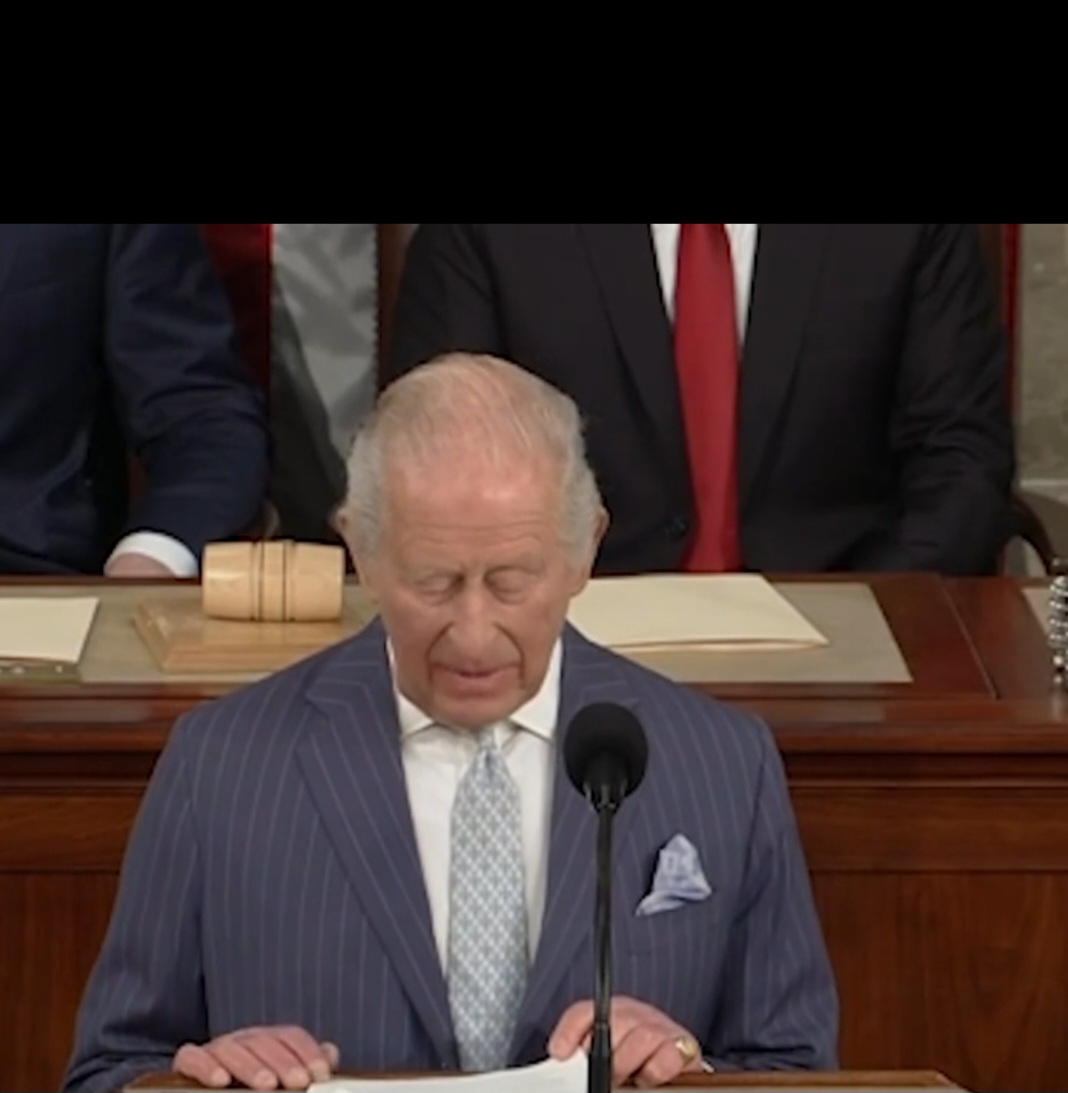
King Charles III’s visit to the United States, and particularly his address to Congress, was far more than a ceremonial occasion. It was a moment of quiet but consequential diplomacy—one that demonstrated the unique role a constitutional monarch can play in turbulent times. At a moment when democratic norms are under strain and the international order appears increasingly fractured, the King’s presence carried both symbolic weight and moral resonance.

One of the factors that made the visit so significant was his ability to remain above day‑to‑day politics while still engaging meaningfully with the most pressing issues of our time. As a constitutional monarch, King Charles does not speak as a partisan figure, nor does he represent the agenda of a particular government. Instead, he embodies continuity, institutional memory, and a tradition that transcends electoral cycles. That distance from partisan contest gives his words a different register. He speaks not to win arguments, but to remind audiences of enduring principles.

His congressional speech struck a careful balance between affirmation and gentle admonition. On the surface, it was rich in positive language—celebrating shared history, democratic traditions, and the longstanding partnership between the United Kingdom and the United States. Yet woven into that affirmation was a subtle but perceptible reminder of the principles that sustain that partnership. Without naming individuals or descending into overt criticism, the King delivered what might be described as a soft pushback against political tendencies that have unsettled alliances and strained international norms.

His historical allusions were especially powerful. By invoking Magna Carta as a pivotal document in the evolution of the rule of law, he did more than offer a ceremonial nod to British heritage. Magna Carta symbolizes limits on arbitrary power, the supremacy of law over personal rule, and the accountability of authority—principles foundational to both British and American constitutional traditions. In recalling this legacy before Congress, the King reaffirmed the sanctity of constitutional restraint and institutional balance. At a time when executive authority, democratic conduct, and respect for legal norms are subjects of intense debate, the reference carried unmistakable contemporary relevance. It was a reminder that democracy depends not on personalities, but on institutions.

Equally significant was his emphasis on the indispensability of the transatlantic alliance. By framing the relationship between Europe and the United States as one grounded in shared values rather than mere strategic convenience, the King underscored its civilizational importance. His reference to Russia’s invasion of Ukraine reinforced that point. The conflict is not merely a regional crisis; it represents a broader challenge to sovereignty, democratic integrity, and the rules‑based international system. In highlighting these realities, the King suggested that the stakes for democratic cooperation have rarely been higher.

Throughout the speech, he stressed that democratic values and international order are being tested in the present moment. The alliance between Europe and the United States, he implied, has never been more crucial. If there was a message aimed at recent strains in transatlantic relations, it was delivered with tact and good humour rather than confrontation. The tone was measured, even warm—but the underlying appeal was serious: a call to renewed commitment to alliances, to institutional norms, and to the cooperative spirit that has long underpinned the postwar order.

In this sense, the King’s message functioned as a subtle nudge—a reminder of the “old order” not as nostalgia, but as a framework that has preserved peace and prosperity for decades. He did not lecture; he invoked history. He did not accuse; he appealed to shared heritage. That is the quiet power of constitutional monarchy: the ability to caution without condemning, to defend principles without descending into political rancour.

Ultimately, King Charles’s visit was important not because it produced immediate policy shifts, but because it reaffirmed moral and institutional foundations at a time when both feel fragile. In remaining above politics, he was able to speak to politics’ deeper meaning—the values, restraints, and alliances that make democratic governance possible.

In an era of polarization and geopolitical uncertainty, such reminders matter. They may be delivered softly, but their resonance can be profound.

Featured

Grief, Rituals and the Deepening of Time

Grief arrives quietly at first, like a shift in the air, and then all at once it changes the texture of our days. In the immediate aftermath of loss, the world feels strangely suspended: familiar routines lose their meaning, and time seems to move with a weight we cannot quite name. We search for something to hold onto, some structure that can steady us when our inner world has been overturned. It is often in these moments that ritual steps forward—not as an answer, but as a way of moving through the unanswerable.

When my mother died, her funeral was conducted with Chinese Taoist rites. The ritual performers wore long ceremonial gowns and chanted to the blare of trumpets and the shimmer of small percussion instruments. Their purpose was to guide the deceased beyond the suffering of death and into a higher realm of being in her next life. During those several hours in the quiet of the night, the rawness of my sorrow settled into a stillness of mind, a sense that I was, for the final time, saying goodbye to her. Rituals like these give form to emotions that would otherwise feel chaotic. They create a solemn space in which private sorrow becomes part of a shared act of remembrance, allowing grief to settle into something we can begin to carry.

Yet the power of ritual does not depend on believing in its cosmology. Even for those who no longer hold such metaphysical views, ritual still performs an essential task. It prepares the living for the next stage of their own life. It soothes the conscience: it reassures us that we have honoured the person properly, that nothing essential has been left undone. The ritual is not a conclusion to the relationship, but it offers a kind of conclusion to our sorrow, allowing us to continue living. Across cultures and faiths, mourning rites are never only about wishing the dead well in a metaphysical sense. They also exist to guide the living back into the flow of life without feeling that they are abandoning the person they loved.

This is why people often say that ritual “slows down time.” They do not mean that the hours literally stretch. My mother’s funeral lasted several hours, and I felt those hours exactly as they were. The slowing is not in the clock but in the mind. Ritual suspends the forward rush of daily life and holds us in a moment where nothing else is supposed to happen. Our attention narrows to the chanting, the incense, the solemnity of the space. The future falls away. Time becomes denser, more deliberate. It is not longer, but deeper.

Within this deepened time, another dimension of grief becomes perceptible: its cadence. There is a rhythm to grief that reveals itself only when we allow time to slow. At first the beat is heavy, irregular, almost unbearable. But as days pass, the cadence changes; sorrow loses its sharpness and becomes something more contemplative. Ritual helps us hear this rhythm. In the solemn choreography of the funeral, the chanting and gestures create a tempo that steadies the mind and gives shape to emotions that would otherwise overwhelm us. Through this cadence, grief becomes not only an expression of loss but a quiet inquiry into what it means to continue living.

As this rhythm unfolds, we begin to recognise that grief is not a single emotion but a shifting landscape. It moves through many shades: sorrow, guilt, fear, anger, longing. Its complexity resists simple narration. When we are in the midst of grief, we inevitably find ourselves reflecting on larger questions about our own life. In this sense, grief resembles a tragedy: for all its heaviness, it contains a process of catharsis, a slow purification of the self. As time passes, our sorrow becomes less raw, and our thoughts begin to transcend the immediate pain of personal loss. Grief then leads us toward broader reflections on the human condition.

In time, what remains is not the sharpness of loss but the quiet presence of memory. Grief does not disappear; it changes its shape. It becomes a companion that walks beside us rather than a weight that presses upon us. The rituals that once held our sorrow begin to fade into the background, but their work continues in subtler ways. They have given us a way to carry the dead forward without being held back by the pain of their absence.

We learn, slowly, that remembering is not the same as clinging, and continuing to live is not the same as leaving someone behind. The people we have lost remain with us in gestures, in habits, in the small instincts of daily life. They surface in moments of stillness, in unexpected recollections, in dreams, in the quiet knowledge that our lives have been shaped by theirs. This is the companionship that follows grief—not loud, not dramatic, but steady and enduring.

And so the cadence of mourning softens into something more spacious. We begin to move through the world again, not because the sorrow has vanished, but because it has settled into a place where it can live alongside everything else. In this way, grief becomes a form of love that has learned to breathe. It reminds us that to continue living is not a betrayal, but a way of honouring the life that touched ours so deeply.

Featured

Would the End of US Matter?


So here is a more unsettling question: if life is, at its core, absurd, would the extinction of humankind really deserve our grief? One might be tempted to say no. After all, we rarely mourn what we believe has no lasting purpose; we let it fade without ceremony. But the thought refuses to settle so easily. It lingers, pressing back against our instincts. And if such an end were to arrive—an Armageddon of our own making—it would be difficult to deny our role in it. After all, this anthropogenic age has not merely shaped the world; it has, in many ways, unravelled it.


Yet this reasoning falters the moment we seriously imagine the end.What would we actually mourn if humanity knew it was about to end?

It wouldn’t be just death. We already live with that certainty, quietly unfolding into our days. What unsettles us more deeply is something harder to name: the sudden collapse of continuity. We move through life with an unspoken assumption that the human story will go on—that there will always be a “later,” someone to remember, to reinterpret, to carry things forward. An imminent end shatters that expectation. It doesn’t just take away our future; it erases the very idea of a future.

When an individual dies, their story ends, but ours continues. We absorb the loss. We remember, retell, reshape. Humanity itself acts as the larger narrative that gives individual lives context. But if humanity ends, that narrative has nowhere to go. There is no one left to remember us, no audience for our meanings, no continuation in which our lives can echo. It is not only that we vanish, but that everything we’ve ever been loses its place.

Perhaps this is why it feels like a story cut off mid-sentence. We are creatures of arcs and resolutions, always in the middle of becoming, discovering, understanding. Extinction interrupts that motion completely. Every unanswered question remains unanswered forever. Every beginning is stripped of its potential to become something more. There is no conclusion—only an abrupt silence.

And then there is the scale of the loss. It is not personal grief, anchored in a face or a voice, but something far more diffuse and overwhelming: grief for everything at once. For the countless lives never lived, the ordinary moments that will never occur, the ideas that will never be thought. It is a loss without edges, too vast to hold.

In the end, what we mourn is not only ourselves, but the fragile thread  that connects past, present, and future. If that thread snaps, the past is no more relevant, the future disappears, and the present becomes a final, unshared moment. The sorrow lies in realizing that the human story—so long imagined as ongoing—can, in fact, simply stop.
It is true that such an end feels too remote, almost abstract—too vast and too unlikely to press upon our daily concerns. We wake, we work, we plan as if the human story stretches safely beyond us. And yet, there is a reason we return to this question. To imagine the end of humanity is, in a way, to measure what we think matters about its continuation. It forces us to ask what, if anything, we believe is worth preserving—not just in our own lives, but in the fragile, ongoing thread of human existence. Even as a distant thought, it sharpens our sense of value, stripping away the trivial and leaving behind what we would not want to lose. Perhaps that is why it feels worth writing about: not because the end is near, but because the reflection reveals, with unusual clarity, what it means for us to be here at all.

Featured

Against the Tide: Why We Still  Create

People have long sought a kind of immortality by leaving behind legacies—works of art, writing, institutions, traces of themselves meant to endure. This impulse stretches back across human history. Shakespeare, for instance, imagined that his poetry could grant a form of permanence, declaring, “So long as men can breathe or eyes can see, / So long lives this, and this gives life to thee.” Here, the poem itself becomes a vessel of immortality, preserving not only the beloved but, implicitly, the poet as well.

But why should this matter to us? It may benefit future generations, certainly, yet what good does it do for the one who creates it? We will not be around to witness its impact or take comfort in its survival. In that case, in what sense does the pursuit of immortality through legacy truly make sense for us at all?

Few philosophical questions are as old—or as persistent—as this one: why do we strive for a kind of immortality through our achievements? Art, writing, and other legacies seem to promise a life that stretches beyond our own, yet we will never be there to witness it. So what, exactly, are we gaining?

The answer may be less about the future and more about the present. We do not create for the sake of some distant recognition after death, but to make our lives feel coherent and worthwhile now. Human life is, in many ways, a quiet struggle against existential unease—a sense that everything is fleeting, unstable, and ultimately beyond our control. In response, we reach for meaning. We commit ourselves to projects, relationships, and creations that allow us to feel anchored.

In doing so, we construct what might be called a form of symbolic immortality. It is not that we literally continue on, but that our actions seem to resist the erasure that time threatens. The alternative—surrendering entirely to the chaos and impermanence of the world—is difficult to accept. Meaning, then, becomes less a luxury and more a necessity. It is what renders life not just bearable, but, in some fragile and deeply human way, lovable.

There is also the question of the self. We tend to think of ourselves as discrete individuals: bounded, self-contained, and ultimately extinguished at death. From that perspective, the idea of legacy can seem irrelevant. If consciousness ends, then nothing that follows can matter to us—at least not in any direct, experiential sense. This is a coherent and, in many ways, compelling view.

Yet it may rest on too narrow a notion of who we are. Our sense of self is rarely confined to the limits of our own bodies or lifespans. We are entangled with others—extended through our children, embedded in our communities, and shaped by the cultures that give us language, values, and form. In this broader frame, the self is not a fixed point but a continuum, something that exceeds the individual life.

Seen this way, the idea of living on in one’s work is not mere sentimentality. When a writer says, “I live in my work,” it is not meant literally. Rather, it gestures toward a different understanding of life—one in which a person’s thoughts, sensibilities, and ways of seeing continue to move through the world, carried by others. What persists is not the body or the private stream of consciousness, but something less tangible and yet still real: a pattern of life that outlasts the individual who first gave it shape.

Perhaps, then, the Epicurean view has the final word. The world matters to us only insofar as we are alive to experience it; beyond that boundary, meaning dissolves. As Epicurus famously put it, “Where death is, I am not; where I am, death is not.” On this account, the idea of legacy cannot truly concern us once we are gone. Whatever follows our death unfolds without us, and to invest it with personal significance may seem like a subtle form of self-deception.

There is a hard clarity to this position. The dead do not witness, feel, or take pride in what they leave behind. No work, however enduring, can be experienced by the one who created it once their consciousness has ceased. In that sense, legacy belongs entirely to the living—to those who remember, interpret, and carry it forward—not to the one who is no longer there to claim it.

Perhaps, then, the point is not to solve the problem of death at all. Creating art, writing novels, founding institutions—these are not strategies for outwitting mortality, but ways of learning how to live with it. They do not grant us literal permanence; rather, they reshape our experience of finitude.

Legacy, in this sense, is not for the person we will no longer be, but for the one we are now. It offers a way to gather the scattered moments of a life into something that feels coherent, directed, and meaningful. In a world marked by constant change and uncertainty, the act of creating or building something enduring allows us to take hold of our existence, however briefly, and give it form.

What we seek, then, is not immortality in any strict sense, but a kind of steadiness within impermanence—a way of anchoring ourselves in the midst of flux. Legacy is less about surviving death than about making life, while it is ours, feel inhabitable and whole.

You know the waves will eventually wash ashore and carry everything away, and yet you still choose to build a sandcastle. Why devote yourself to something so obviously temporary? The example brings the question of legacy and immortality into sharp focus.

What matters is not the endurance of the sandcastle, but the act of building it. Its value lies entirely in the doing—in the shaping, the attention, the small satisfaction of creation. There is no real expectation that it will last, nor does its meaning depend on that. As a piece of art, it is complete in the moment of its existence, not in whatever remains of it afterward.

In this way, the sandcastle quietly challenges the very premise of immortality. It suggests that something need not endure to be worthwhile. Its brief presence is already enough to justify the effort, reminding us that meaning can reside fully in the act itself, rather than in any hope of permanence.

Featured

Travelling Light


I recently made the decision to move out of my home and into a long-stay hotel — and honestly, it wasn’t that big a deal. As a pensioner, I travel light these days, so I spent no more than half an hour stuffing everything I needed into a rucksack. Done. For most people, moving home is nothing short of an epic undertaking — the sorting, the packing, the endless decluttering. But not for me.

The idea didn’t come out of the blue. It had been quietly taking shape for years, rooted in a bigger question I’d been asking myself: how did I want to live out my retirement?

I can still pinpoint the exact moment it first stirred. It was eight years ago, on a Friday evening in July, when I said goodbye to my colleagues at a university in Macau where I’d been working for  many years. I switched off my computer for the very last time, and pressed  through the campus — past the glinting waterways and the green stretches of meadow shimmering in the summer sunset. It was a beautiful place, and I took my time leaving it.

Then I boarded the jetfoil back to Hong Kong — for the last time  (I would still make trips back to Macau in the following years, but that’s  a different story).  As the ferry sailed out into a glowing but fast fading sunset, I sat with those fresh images of the campus still vivid in my mind, and something quietly shifted inside me. A chapter was closing, and a new one was waiting to be written.

When I arrived home in Hong Kong, I  looked around the flat. Everything was familiar — perhaps too familiar. The sofa bed that my late mother had slept on  until she moved out to a care home in her last years; the windows that framed the flux of the world for the past five decades.  It all felt perfectly fine, and yet something nagged at me. I’d always assumed that retirement would simply mean returning home to resettle, to ease naturally into a quieter domestic life. But standing there, I wasn’t so sure anymore. I found myself wondering: ‘is this really how I want the next chapter to look?’

At first, I thought it might be about freedom. The romance of it — cutting loose, breaking free from routine. But that idea quickly fell apart under scrutiny. Freedom isn’t something you find by changing your location. If your heart is already free, it doesn’t much matter where you lay your head. I was just as free in my Hong Kong flat as I would ever be in any hotel room. So freedom wasn’t it.

What it was really about, I slowly came to realise, was the desire to travel light — not just in terms of luggage, but in life itself. And that began with taking a long, honest look at the things around me.

The flat was cluttered with years of accumulated living. Among the most meaningful objects were my mother’s personal effects — her clothes, her belongings, all the things she’d kept close when she was there. Letting go of them in the conventional sense felt unthinkable. But technology offered a quiet solution: I photographed everything and preserved it all in the digital world. It struck a balance between honouring the emotional weight of those memories and freeing myself from their physical presence. That was an important realisation — that keeping something in your heart doesn’t require keeping it in your home.

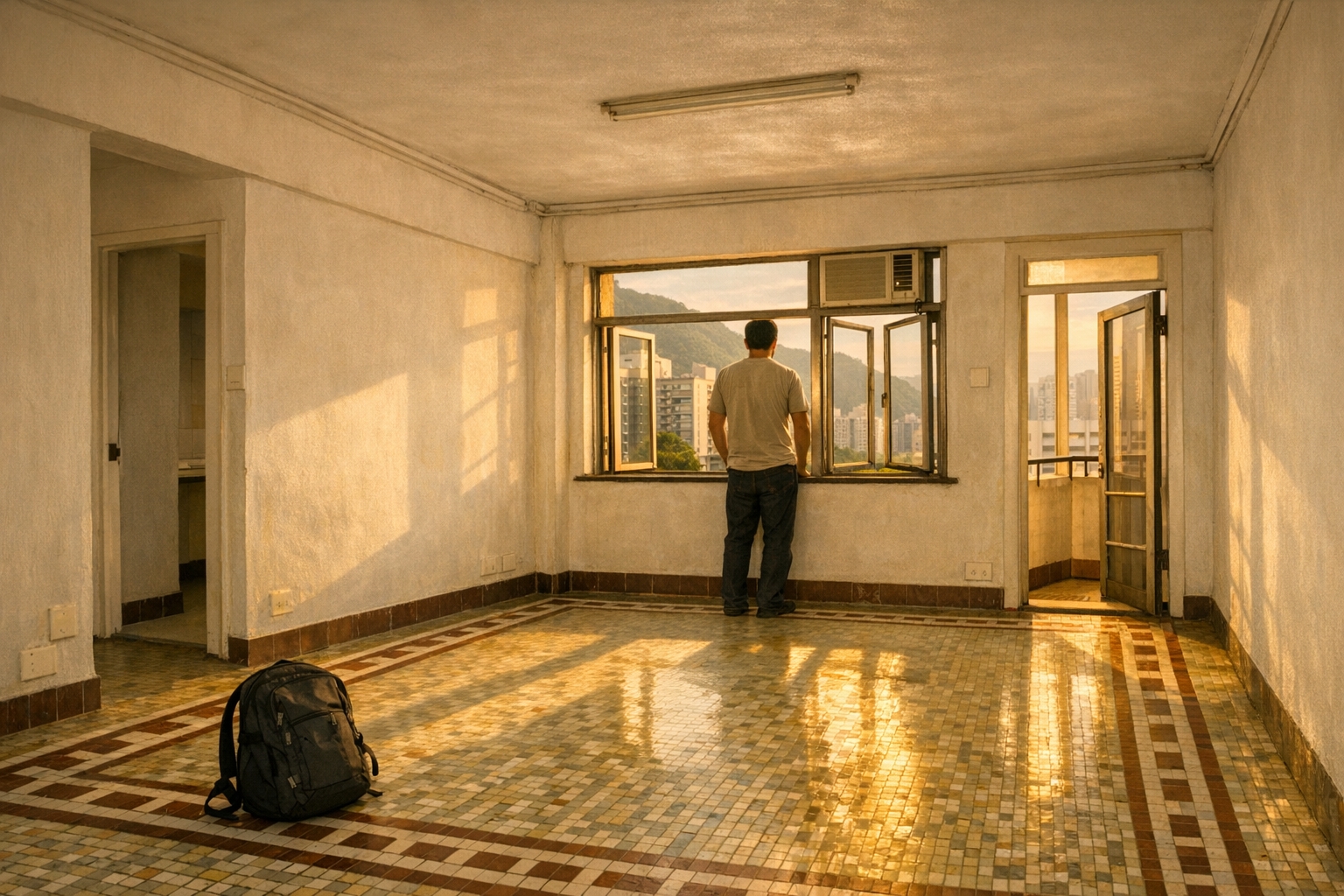
When the flat underwent a major renovation some years later,  a great deal of old furniture was cleared out as a result and I took up lodging in a hotel in the meantime.  When I moved back in, the place had been restored  to its bare interiors, exuding the same sense of spaciousness as it did more than 50 years ago.  With sunlight streaming  in, sparkling off the freshly  painted white walls and the shiny mosaic floor, it transported me back to being that child of ten in 1968 when I, upon opening its door, would enter  a whole new world of light and roominess.    The space now breathed in a way it hadn’t for decades. There was a kind of quiet clarity to it that I hadn’t expected to find so moving.

That experience of minimalism turned out to be more than just an aesthetic preference — it became a philosophy. A way of thinking about how to live. And it raised one final, liberating question: if I could feel this light, this unanchored, in my own renovated flat — why not take it one step further? Why not beat a path that would untie myself entirely from the idea of a fixed home, and simply see what that felt like?

And so a serviced apartment became the logical next step. Not a chase for something missing, not an escape from anything. Just a quiet, deliberate choice to live differently — to carry only what I needed, and leave the rest behind.

Featured

Beyond Consciousness — the Case for AI as a Creative Force


The definition of what it means for something to be “creative” often depends on perspective. Artificial intelligence has demonstrated its ability to compose music, write stories, and create visual art with such innovation and quality that its work can often be mistaken for that of a human. However, the process through which AI generates these creations is fundamentally different from human creativity. AI relies on identifying patterns within vast datasets and predicting what comes next, rather than drawing from personal experience or intention. It does not possess a mind of its own. For this reason, many argue that AI’s outputs, no matter how impressive, cannot truly be considered creative.

Those who assert that consciousness is a prerequisite for creativity often emphasize the role of subjective experience in the creative process. Why does a poet create the way they do? The focus on a particular theme, along with their selection of words and imagery, is part of a poet’s conscious effort to achieve specific effects or evoke a desired emotional response. These choices are guided by their individual experiences, intentions, and desires. From this perspective, AI falls short of qualifying as a true creator. It lacks consciousness, personal experience, and any innate desire to create. Consequently, critics argue that AI’s outputs, no matter how sophisticated or seemingly innovative, are merely the results of computational processes—imitative rather than original.


We judge creativity in a piece of work by evaluating whether it embodies the elements that define creativity. For something to be considered creative, it must be innovative and depart from conventional modes of representation. Creativity often surprises or even inspires awe, emerging in various forms—whether through combining familiar concepts in novel ways, pushing the boundaries of a particular field, or breaking completely from tradition to create something entirely new. Importantly, these judgments don’t require us to understand the inner life or consciousness of the creator. What matters is the experience the work offers us—the sense of originality and transformation it brings.

In this regard, AI is fully capable of producing creative work. Advanced language models, for example, can generate writing that rivals, and sometimes even surpasses, the creativity of the human mind. They can weave together ideas, experiment with language, and produce compositions that feel fresh and original, demonstrating that creative output doesn’t necessarily depend on consciousness.


Consciousness drives much of what humans do. It is the lens through which we understand our actions and the reasons behind them. Historically, creativity has been seen as a product of conscious effort—a uniquely human trait rooted in thought, intention, and personal experience. But with the advent of artificial intelligence, we are being challenged to rethink whether creativity must remain tied to the human mind. While human creativity is undeniably driven by consciousness, this alone does not automatically disqualify AI from being capable of creative expression.

When we admire a painting or listen to a piece of music, our primary interaction is with the work itself—its colours, composition, melody, or emotional resonance. Rarely do we stop to question the consciousness or inner life of its creator. What captivates us is the transformative and thought-provoking nature of the work, its originality, and its ability to elicit an emotional or intellectual response. In fact, our appreciation of creative works often begins and ends with the experience they provide. While understanding the creator’s intent or mental process may deepen our appreciation, it is not a necessary condition for judging a work as creative. In this sense, creativity can exist independently of conscious effort, as long as the output meets the criteria of being innovative, meaningful, and aesthetically or intellectually significant.

This shift in perspective invites us to see creativity not as something exclusively rooted in human consciousness, but as something that can emerge from other processes as well. AI, for instance, does not create out of personal intention or desire, but it is capable of producing outputs that demonstrate novelty and originality. If an AI-generated piece of art or writing can move us, surprise us, or provoke new ways of thinking, then it has fulfilled the same purpose as a human creation. Creativity, therefore, does not need to originate solely from human thought. It can be judged by the quality and impact of the work itself, regardless of how or by whom it was created.

We often associate creativity with human thought processes, assuming that only humans can truly create because only humans can think. This association has led us to reserve the concept of creativity exclusively for human efforts. However, AI challenges this assumption. While AI may not feel the urge to create or possess a conscious mind, its output can nonetheless be as creative as that of humans. An AI does not need to replicate the human experience of creativity in order to produce work that is innovative or transformative. By broadening our definition of creativity to focus on what rather than how, we can recognize that AI is not merely a tool, but a potential contributor to the evolving landscape of creative work.


In conclusion, creativity should not be limited to the confines of human consciousness or intent. While traditional notions of creativity have long been tied to subjective experience and conscious effort, the advent of artificial intelligence challenges us to rethink these assumptions. AI, though lacking personal desire or awareness, is capable of producing works that are innovative, transformative, and thought-provoking—qualities that define creativity itself. By shifting our focus from the creator to the output, we can recognize AI’s contributions as both valid and creative. As we move further into an era where technology and human ingenuity intersect, it is essential to embrace a broader and more inclusive understanding of creativity—one that acknowledges the potential of AI to expand the boundaries of what is possible in art, literature, and beyond.

Featured

Telling Stories to the Night

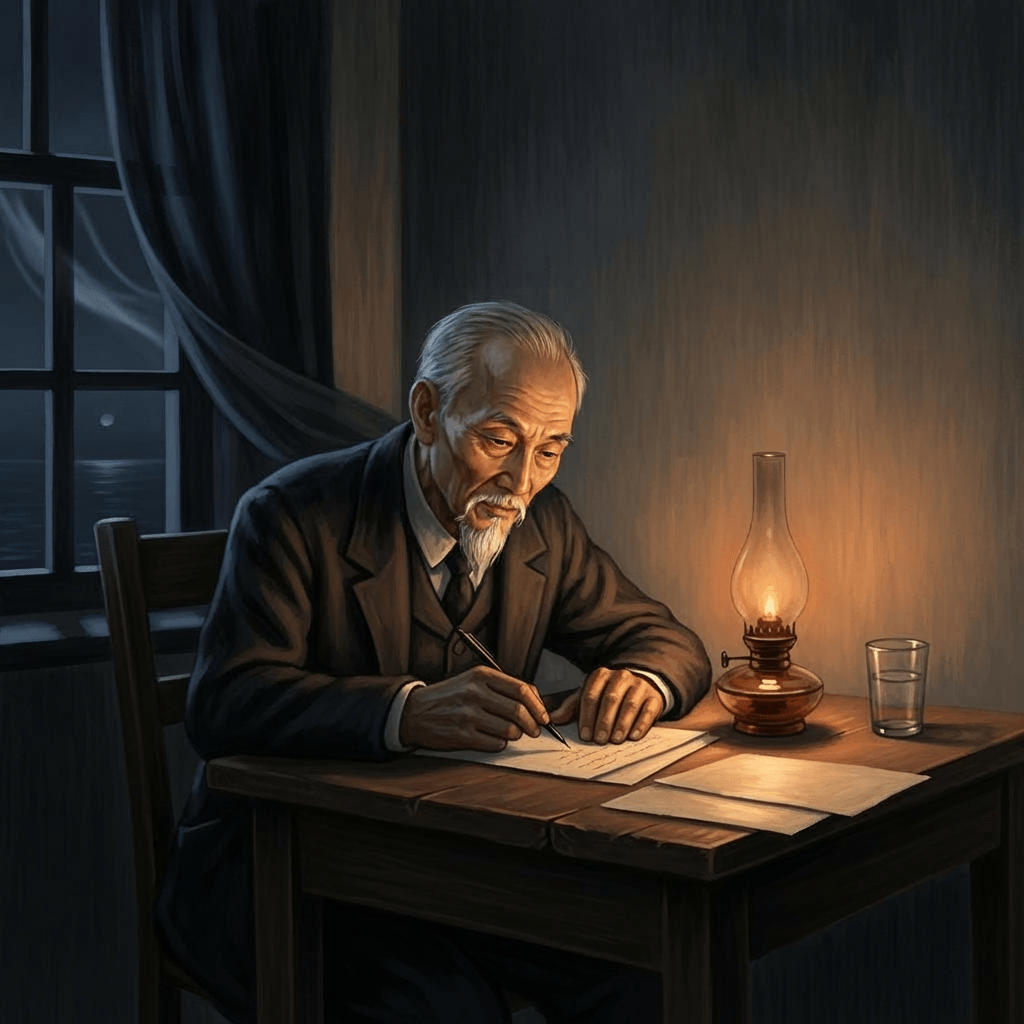
Amber light seeps into the dark, softening the edges of the things in the care home —chair, curtain, glass of water—until  everything becomes mere smudges of shadows.


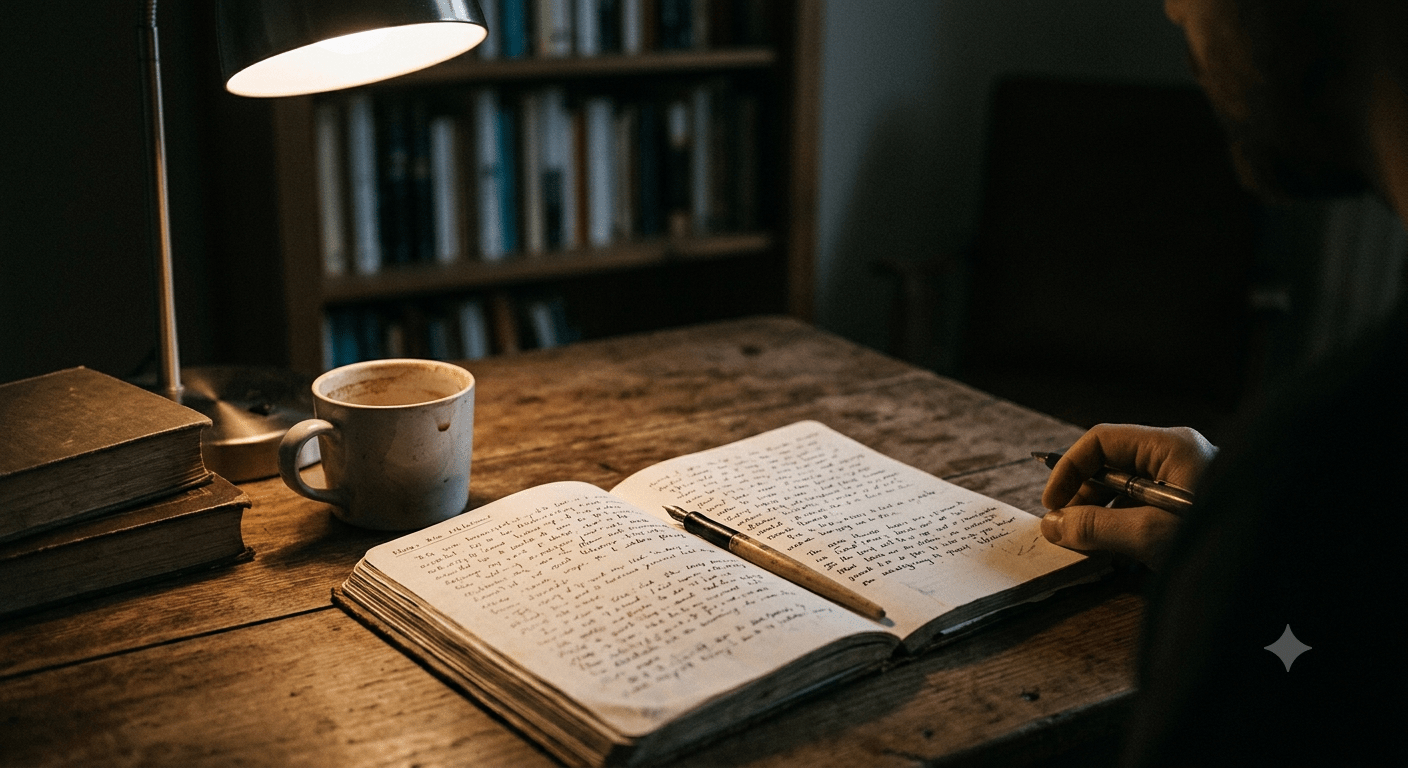
I take up my pen, as I often do at this hour, to write. Habit, almost: to trawl the day for small truths, to catch brief scraps of living in a net of words before they slip away. But tonight it’s different. Tonight I’m not trying to gather anything. I’m trying to reduce.

I’m writing a line—yes, only a line—here at the end of my dying days.

An epitaph.  It’s a strange task, isn’t it?  To leave behind a single line, and beyond that, cross into silence.


I’ve seen the world in constant motion. Monday follows Sunday, Tuesday follows Monday. It’s now September. Soon October. And things happen in between. I sought verbs to catch these moments the way I, once as a child, thought I could catch falling stars—by setting out a bucket of water and waiting for their reflections to settle there, trapped. So I believed verbs were the key to truth. The noun sits still, but the verb breathes.


What are you thinking, Bart? You’re so quiet?  Margaret’s voice. I’ve been thinking about verbs, honey. Verbs? Then how would you think of me as a verb? She was laughing.  You’re not serious. I am. Go on then—how would you animate me? If verbs capture the essence of life, as you say, how would you frame me in one?  You bloom. Ah. And what about thirty years from now?  Well?  She looked at me. Such a tender look. Well, You’d still be bloomingBlooming still?

Where is she now? She may have faded long ago. Mother went twenty years past.

The trees outside green and brown—green and brown, green and brown—the way seasons verb themselves through wood. I thought verbs could best catch the fleeting, the fluorescent, the thing that flares and goes. And I came to believe that life, like everything else, was bracketed by verbs: to bud, to bloom, to fade, and all the others in between in infinite permutation. One summer night I trapped a moth in a box which I filled with plastic leaves and branches to emulate the woods through which it had flown. And I suppose I have done the same with life—trapped it in a box of verbs, hoping it might go on beating its wings there, believing the plastic leaves were real.


But now I see it as vanity. And yet I find glory in it too.

What is a story, after all? A net cast into the sea of chaos, hauling something back. I imposed order where there was none. Looking back at those protagonists I created—women, men, the dead, the living—they raged, they loved, they suffered. Hope existed alongside despair because I willed it so. I gave them motives. I gave them voices. Most important, I gave them a purpose for living. Never mind that they were fictional. The ghost said, “I said this because I was suffering.” Or he said, “I did that because it hurt so much I had no choice.” I soothed them by setting them at the beach where waves caressed them with whispers. I carved pattern from formlessness. From the raw, buzzing, inchoate mess of being, I extracted order. All this I did with words in those moments of quiet. All this I completed by giving them voices that could speak their emotions—their trepidations, their pangs of pain, their small bewildered joys. I turned the random falling of leaves into omen. I turned the conversation of two lovers into layers: silence and speech, the muted and the sounded, what was said and what could never be said.


Now death brings me an impossible task: to compress sixty years of stories into a single line. It asks me to reverse everything I ever did as a writer.Then, I expanded. I found words elastic, capable of stretching to hold whole lives.  Now, I must pare it all down to a point of singularity—one sentence, maybe two. How can I compress sixty years into that? All those experiences that occurred between the greening and the yellowing of the trees outside. All those moments that seared themselves into memory. There is so much I want to say. How can any of it fit onto a cold stone?

Language is a sieve. We pour hot soup through it, and the froth filters away, the warmth escapes, the body of it slips through the mesh. What remains are only the solid bits—verbs, nouns. The bones of meaning. But the taste, the heat, the nourishment—the ineffable passes through and is lost

Once, Margaret and I stood on an island bluff, watching the sea foam against the rocks below. It was September. The wind came hard off the water, ruffling her hair across her face; she lifted her right hand to smooth it back and slipped off her glasses, as if to meet the moment unmediated. A grain of sand blew into my eye. We laughed, or perhaps we said something trivial about the cold. I no longer remember.

Years later, trying to set that afternoon down in a story, I found that what endured was not the warmth of the wind or the salt in the air, not the softness of her unguarded face, but only the scaffolding of action. Verbs threading through nouns: she smoothed her hair; she removed her glasses; the sea broke; the wind blew. The mesh had done its work. The immediacy had thinned to grammar. What remained were gestures without weather, movement without heat.

The rest—the living warmth of it—had already drained away.


Will anyone who reads  it understand? I would be glad — truly glad — if even one person knew what it meant. I wanted to walk up to King’s Road and hold up my notebook of sprawling stories and say:

here, here is the key to truth.

But there is no answer. The passers-by stream across the road. The light turns and they cross in currents, scattering toward their separate destinations. Red again. They accumulate once more. The process repeats. Next turn.

Now I know. Story is a contrivance. Things and people in real life do not live in such a neat, formulaic fashion. They do not arrive at a satisfying dénouement. Their stories come to a sudden halt — no development, no arc. They merely stop. The thread snaps and the tension is gone. Their lives fan out along paths pre-determined for them. But in my story I must design a resolution: mostly happy, some tragic, though I feel obliged to ring a note of hope — for me, for my protagonists, for readers.

Disillusioned? And yet… and yet…

Oh, disillusioned? There was that mirror in the dining room, wasn’t there? Can language ever be as reflective as that glass was? I could have got Margaret to fetch it for me. Just imagine how one day I can still be around to do your chores. She said this, standing me in front of it. Bullshit! I laughed.  I saw her last cleaning the mirror with a small towel. When was it? She hasn’t been around for — how long? Five years? No, no, it can’t be that short. I attended a concert at the Barbican five years ago. Mahler’s Ninth. It paused. It ended. Like all the others in the audience I left in silence — no ceremonial applause. I was alone. I held out my hand, instinctively wanting to hold hers. There was no hand. I was by myself. No, no, must be longer than five years. Ten? Ah. That should be it. She hasn’t been around for ten years. I have been greying. She had been getting weaker. She wore jeans. She was holding my hands. She stood on my left — or left on reflection, and actually she was to my right? Which one is really you, she asked, the reflection or the self outside the mirror?   I really wish we could be in the glass world — a pause — forever. The last word delayed. No way, I said. We cannot arrest the flux except in language. She was dabbing her face, pressing close to the pane. Her pale face glowed as the autumn morning sun streamed in.

I’m struggling from my bed and shuffling  across the room to reach the mirror, propped at an angle on my desk in this small room. My wrinkled paws. My trembling. No more reflections of the past — my vision is fading as the last ray of sun fades in this part of the day. Who am I if I have not been writing? A chance existence at this particular spot, this particular time. What if I had never existed? What if I had never written a single story? Would I be anything more than a bone on a beach, left to bleach under the sun? Perhaps deception is necessary — it is what underwrites my creativity. Without creativity, what is left? And perhaps our imagination is the only truth we have.


I am not a single one. I am the mélange of many. I am the boy who once dreamt of dissolving a star in a basin of water. I am the man who baulked at the faith Margaret tried to make me believe in. I am the old man who is afraid of the dark and thought language was a tool against death. I am all of them. They spoke through my writing — first one by one, then their voices folding into one another’s until they formed a chorus.

So I start to write. I will no longer be able to write in profusion. I will have to write only one line. Not a summation. Not a story — no more time for stories. Those I wanted to write about have all gone, and to write about them now would be to chase the phantoms of memory. I will write one line, only to acknowledge the inadequacy of the cold stone.


I will write this much: that I was here. That I tried to make sense of people and the mess of things by pinning them down with words. That I braided them into tales, knowing—always knowing—that each narrative would fall short of the crowded, stubborn complexity of the real.

I am tired. I am exhausted. I’m too tired even to hold my pen the way I used to, as if it could steady me. And now I’m tired of language itself: of its shine, its tricks, its habit of pretending it can contain what it only circles. I want to dissolve. Not to be understood, not even to be remembered—just to be gone from the burden of words.

Is there any way to dissolve into the worlds I made for my characters? To step through the paper and become only another figure in the distance—unwritten, unnamed, and therefore free? The strange thing is: I built those places, and still I don’t belong there. They were never meant to hold me. They were meant to hold everyone else. Yet I want them now the way a drowning man wants the imagined shore. But now they are but just mirages.  And – listen. What’s that distant thud outside the window, an incessant and rhythmic hum?

But edging near as privately for me rustling at my feet,
Creeping thence steadily up to my ears and laving me softly all over,

Professor Gray  was reading out those lines in that classroom.  I was twenty then. I was in awe of his deep-throated voice, almost a  croon.   I understand now that he wasn’t so much performing as confessing.  Years later, I learnt that he’d drunk himself to death.  Perhaps in that distant afternoon when he intoned those lines, he had already heard what the sea was saying  and  simply had decided to let himself surrender to the ‘grey old mother’. I chose words instead. I’ve often wondered which of us was the braver.


I wish to stop being the “I” who writes and become the “we” who are silent and I would melt into their choruses. 

But I still have one sentence left to write.  I must make it count before I exit.


“The waves break,” I whisper. “They hiss into foam. And we are gone.”

No—not for the stone. That is for the dark.


“Here lies a man who told stories to the night.”


It isn’t enough. I know it the moment the ink settles. One line cannot be the seed of all truth. It cannot hold the whole weight of a life, or the hunger that drove it. And yet I have to treat it as everything now. I have to let it stand—one small shape pitched against the vast, formless outside.

All my life I cast language like a net, knowing it would come back torn, knowing the ineffable would slip through every knot. But the casting was the point—the throw, the reach, the brief arc of effort. If that is sublimation, then so be it. And what follows, when the arm finally gives out, is resignation.

The waves recede. They leave a thin line on the beach—temporary, precise, already fading.

That is enough.

That must be enough.

Featured

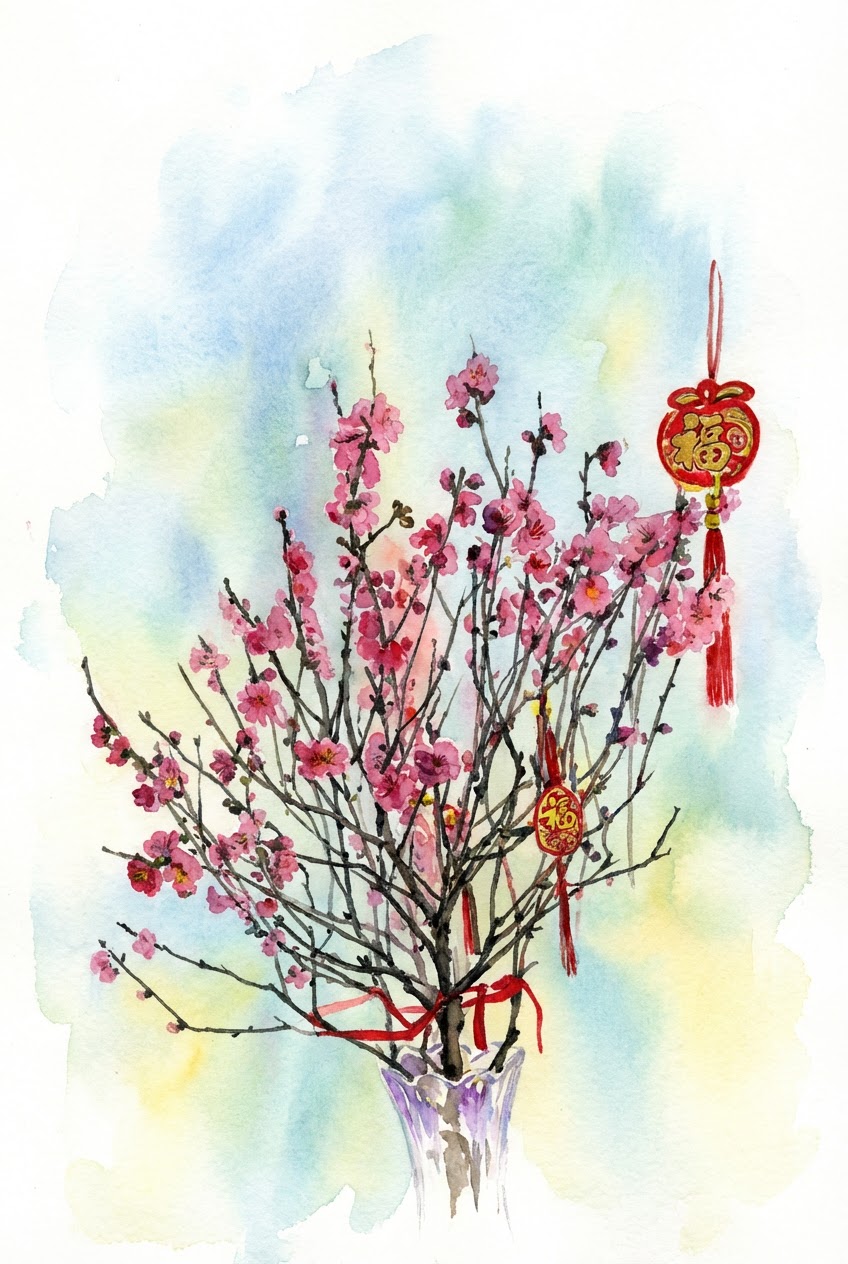
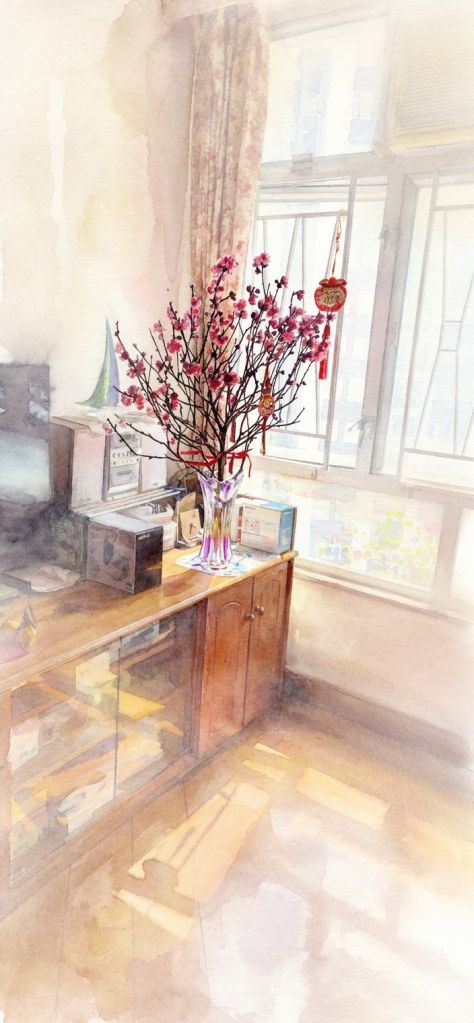
You Simply Are: Two Plum Blossoms and the Art of Immortality

Your peers blossom in a sunlit room,
By curtain, cabinet and New Year’s knot;
They wear the season’s warm and hopeful bloom,
Yet all that lives in time must live and rot.
No sooner do they flower than they fade—
For all that dwells in place must know an end,
And every gift that light and context made
Is but a loan that dying days must lend.

But you are shorn of window, clock and floor,
Against a formless neither-here-nor-there;
Your dark hands hold their pink blooms evermore,
Buds ever-opening, blossoms always fair.


     No metaphor, no symbol * left to say—
     You simply are, and cannot pass away.

*The plum blossom is celebrated for its resilience against the last onslaught of winter and for presaging the arrival of spring. Hence it is an auspicious plant for Lunar New Year, a symbol of endurance and renewal.

Featured

The Quiet Moment of Waiting

I’m standing in a clinic queue right now—one of the many lines I find myself in every day. You queue for banking, for the bus, at the grocery counter. For such an ordinary experience, I should just take it for granted, the way we take breathing or blinking for granted. But curiously, there’s a sense of something amiss. It feels, in its small way, like suffering. Not the dramatic kind—no one writes tragedies about waiting for your number to be called. But it’s a feeling that clings to the mind like a dull ache, a quiet wrongness you can’t quite name.


It’s a curious cycle. When I’m trapped in waiting, my mind drifts toward the question: what do all these waits actually mean? Perhaps you’ve wondered the same. We’re all waiting for something, always. Waiting for exam results. Waiting for the Chinese new year, when the lucky money comes again. Waiting to hear back after an interview. Waiting for the light to change while running late. Waiting for the bus that never seems to arrive on time.


These tiny waits accumulate into something larger. If we were to add them all up, we’d find that a surprising portion of life is spent in this strange suspension. Present in body, but not quite here. You are leaning forward into a future that hasn’t arrived yet, unable to settle into the moment you’re actually standing in.


What does waiting reveal about us? At its core, it is a confrontation between our desire to be agents of our own lives and the stubborn reality that we cannot bend time to our will. We cannot make the bus arrive faster. We cannot know the outcome of a job interview the moment we walk out the door.


There’s a small ritual of disappointment built into these situations. When you ask, half-hopefully, “When will I hear back?”—and they reply, “Possibly in a month”—something sinks. It’s too long. Too vague. We want certainty, and we want it now. Modern life, in particular, has trained us for immediacy. We refresh the page, check our phones, glance at the clock, as though our attention could somehow hurry things along. Beneath the surface, there’s always a low hum of irritation.


Why does waiting feel so unbearable? Perhaps because we’ve come to see it as wasted time—empty, unproductive, a gap between the moments that actually count. In an age that prizes busyness over stillness, doing over simply being, waiting becomes a kind of failure. It resists usefulness. It refuses to justify itself. And so we treat it as mere transition, something to endure on the way to somewhere else, rather than an experience worth inhabiting on its own terms.


Waiting is often dismissed as empty time, but the quiet suspense between one moment and the next carries its own quiet power. In those pauses—standing in line, anticipating a reply, watching the clock before a new beginning—we are suspended between what was and what will be. This in‑between space invites reflection, heightens awareness, and deepens our appreciation of what finally arrives. While impatience urges us to rush past these intervals, waiting subtly shapes our resilience, teaches us trust in unfolding processes, and reminds us that growth often happens in unseen transitions. The suspense of waiting is not wasted time; it is the threshold where anticipation matures into meaning.


I used to find waiting unsettling, an uncomfortable limbo I wanted to escape. But I’ve since learned to bend toward these pauses, even to welcome them. Waiting resists being “useful” in the conventional sense—if usefulness means actively doing, producing, advancing. Instead, the suspense of waiting invites us into a different kind of attention: a heightened awareness of the present moment itself. These pauses position us in a liminal space between what was and what is yet to come, offering us space to slow down and reflect. Often, the wait isn’t an obstacle delaying our progress but a preparation, priming us for what lies ahead rather than holding us back.


Consider how our lives unfold like stories, shaped by the drift and turn of happenstance. In any good story, the transitions between scenes are rarely empty—they’re filled with authorial asides, atmospheric shifts, internal reflections that enrich the narrative’s texture. These interludes aren’t filler; they’re intrinsic to the story’s meaning. Our waits function much the same way. They give us a window for our own reflections and awareness, a chance to observe rather than simply react. In those moments, you might feel something approaching authorship over your own experience—not because you control what happens next, but because you can step aside from the current, hold yourself at a remove, and simply witness. Here, in the pause, we’re granted permission to be rather than to do, to inhabit our existence rather than relentlessly propel it forward.


Perhaps waiting is, at heart, the experience of standing before a crossing. We wait in order to move into another stage. The traffic light changes, and we cross to the other side of the road. Our number appears on the screen, and it is our turn to see the doctor. Each wait, however brief or mundane, carries the quiet possibility of transition. What follows may become a consequential moment. In this way, waiting stitches together the twists and turns of our lives. If life itself is ritualistic in rhythm, then waiting is not incidental but intrinsic to its design. To cross a threshold is to risk change; once crossed, life may never be quite the same.


Though waiting often feels ordinary—almost woven invisibly into the fabric of daily routine—it matters precisely because it marks the space between “before” and “after.”  If we extend this idea further, if we imagine the span of an entire lifetime as a kind of waiting, then the significance deepens. What then of the  final crossing  — the one we all must cross ?  Alfred, Lord Tennyson’s poem ‘Crossing the Bar’ captures this ultimate moment: the crossing from life into what lies beyond.  This beautiful poem goes like this:

“Sunset and evening star,

 And  one clear call for me!

And may there be no moaning   of the bar,

When I put out to sea,

But such a tide as moving  seems asleep,

Too full for sound and foam,

When that which drew from    out the boundless deep

Turns again home.

Twilight and evening bell,

 And after that the dark!

And may there be no sadness of farewell,

When I embark;

For tho’ from out our bourne of Time and Place

 The flood may bear me far,


I hope to see my Pilot face to face

When I have crost the bar.”


The poem frames death not as an abrupt end, but as a passage—like putting out to sea, borne by a quiet tide toward a hoped‑for meeting “face to face” with the Pilot. In this light, waiting becomes more than delay; it is preparation for crossing. Just as the poet envisions death as a serene transition into another stage of being, so every wait in our lives, small or great, stands as a passage. To wait is to stand at the edge of change—and to trust that on the other side, another chapter awaits.

So, even waiting here at this moment for my number to be called, I’m already crossing.


Featured

Unhousing Myself


I’ve been living in a hotel for a few months now, and I’m beginning to see it not as a temporary arrangement but as a possible long‑term way of life. At my age, why should I feel bound to the convention of maintaining a “home” in the traditional sense? If one can afford an extended hotel stay, perhaps it’s worth experimenting with a different mode of living altogether.

When you think about it, a home—despite all its sentimental associations—is also a kind of baggage. I don’t even mean this in a metaphysical way. Quite practically, a home demands upkeep. It requires time, money, and a constant low‑level vigilance: repairs, cleaning, utilities, clutter, the slow accumulation of things you don’t need but somehow keep. A hotel, by contrast, strips life back to essentials. Someone else handles the maintenance. You occupy space without owning it. You move lightly.

There’s also the emotional dimension. As we grow older, perhaps part of aging gracefully is learning to loosen our attachments rather than deepen them. A fixed home can anchor you, yes, but it can also tether you to past versions of yourself—memories, habits, identities that no longer fit. Letting go of that can be a quiet liberation. A hotel room, with its neutrality and impermanence, invites a different relationship to the world: one that is freer, less burdened by history, more open to change.

In that sense, choosing to live in a hotel isn’t an escape from life but a reconfiguration of it. It’s a way of saying: I don’t need walls filled with possessions to feel grounded. I can carry my sense of home within myself.

Featured

Where Grief Becomes Language

Give sorrow words; the grief that does not speak knits up the o’er-wrought heart and bids it break. 

Macbeth, Act 4, Scene 3


Grief often reshapes the way we see art, and sometimes it reveals the hidden stories behind the works we think we know. Reading Hamnet made me reconsider Hamlet not as a monument of genius alone, but as a vessel of private sorrow.

Shakespeare writes Hamlet while still moving through the dense, unspoken fog of losing his son, Hamnet. Agnes, his wife—so attuned to the rhythms of the earth, to the pulse of living things—cannot decipher the way her husband grieves. To her, his composure feels like distance. His return to London, his relentless work on the stage, his immersion in characters and plots all seem like evasions, as though he has shunned their shared sorrow. While she mourns with her hands, her breath, her body, he mourns in silence, in absence, in the strange inwardness of a man who turns pain into language.


For a long time, Agnes believes he has abandoned the grief that has hollowed her out. She imagines him thriving among actors and patrons, untouched by the loss that has reshaped her world. But when she travels to London and sits in the dimness of the theatre to watch Hamlet, something shifts. Onstage, she sees a ghostly father summoned from death, a son who cannot release the past, a family fractured by absence. In those figures—so distant from her life yet uncannily familiar—she recognizes the contours of her own mourning.

Only then does she understand: her husband has not escaped their grief. He has carried it with him, threading it into the fabric of the play. The ghost onstage is not merely a dramatic device; it is the echo of their lost child, the shape of a sorrow he could not speak aloud. Through Hamlet, he has given form to the ache that bound them both. Agnes realizes that the play is not a departure from their loss but an offering—a way of holding Hamnet close, of keeping him alive in the only language Shakespeare knows how to wield.
Art holds a central, almost sacred place in Shakespeare’s life. We often imagine the Bard spinning his plays out of sheer, unbounded imagination, as though genius alone were the source of his creativity. But that view does not quite do justice to the depth of his artistry. In the case of Hamlet, it is grief—raw, bewildering, and transformative—that becomes the true engine of creation. The death of Hamnet does not silence Shakespeare; instead, it is transmuted, refined, and sublimated into one of the greatest tragedies ever written.

The beauty of art, in this sense, proves more enduring than any epitaph or ritual gesture. A gravestone marks a life; a play reanimates it. Through Hamlet, Shakespeare not only memorializes his son but also inscribes himself into the fabric of cultural memory. The tragedy becomes a double act of preservation: the child who died young and the father who mourned him both find a kind of immortality in its lines.

Language becomes the vessel through which grief is transformed. Instead of loud cries or outward displays of sorrow, the pain distills into quiet, resonant meditations on death, memory, and the fragile condition of being human. The play’s reflections—its ghosts, its hesitations, its questions—carry the weight of a father’s loss without ever naming it directly.

In this way, art becomes a means of transcending death. What is lost in life is carried forward in language. What cannot be restored in the world is reimagined on the stage. Through the alchemy of creativity, Shakespeare turns grief into something enduring, something that continues to speak across centuries. And in that transformation, both he and Hamnet step beyond the limits of mortality.

Featured

The Mythic Life of Ordinary  Days


When you wake up—still half‑lost in sleep—you shuffle to the kitchen and make a cup of coffee. You pull back the curtain. Sunlight spills in. It’s a tiny ritual you perform every morning without a second thought.

But here’s a question: have you ever noticed that you’re actually starting to  re-enacting a host of ancient myths that follow later in the day.


I’m serious.


To begin with, you pull yourself out of sleep, that strange in‑between place where dreams wander off on their own and nothing quite makes sense. As you open your eyes, the room slowly comes back. The contours of things reappear. The world, which  completely disappeared for the whole night, quietly takes shape again.


Then you put on your “day self”.  The part of you that knows who you are, what day it is, and what needs doing. The dreamy nocturnal part fades into the background, and your thinking mind puts back in gear.


And without really noticing it, you’ve just done something very old.


In ancient Egyptian myth, the sun god Ra rises each morning to bring light and order back into the world. Your version starts when you turn off the alarm. Chaos gives way to form. Darkness gives way to direction. A new day begins — not with a fanfare, but with a sleepy decision to get up.


So you might be thinking, ‘okay, this is a cool parallel… but so what?’


The “so what” is that what happens inside you—the small, intimate world of your feelings—isn’t separate from the big patterns of life at all. Every culture has stories of loss, transformation, and renewal because those movements happen everywhere: in seasons, in ecosystems, in the rise and fall of worlds. And they also happen in us. The microcosm mirrors the macrocosm. 


When you feel completely undone—when you grieve the loss of someone you love—it can feel like a descent into an underworld. That inner journey, as personal as it feels, echoes a much larger rhythm. Our ancestors recognized this long ago. They noticed the same patterns playing out in nature and in the soul, and they wove that understanding into myths and rituals. 


Those stories are like maps of the inner landscape. They remind us that what’s happening inside us isn’t random or meaningless—it’s part of a cycle that has been lived, named, and remembered many times before. And when you realize that, you’re no longer just stuck inside your own pain. You’re standing at the meeting point of the small world and the great one, able to draw on a deep, ancient wisdom as you find your way through.


You begin to realize that your journey is more epic than you ever gave it credit for. Something shifts when you see this: you’re not just someone enduring a hard moment, you’re a hero in your own right—no less real than any figure from a Greek tragedy. 


When you descend into your own underworld, you’re not failing or falling behind. You’re in the middle of the story. You’re shaping it as you go, even if it doesn’t feel graceful or heroic right now. And this moment—this dark, uncertain stretch—isn’t the end. It’s a chapter in motion, a passage between what was and what’s still becoming.


You don’t need to watch Greek drama or read classical epics to appreciate the epic scale of human experience or grasp the depths of the tragic human condition. These grand narratives exist within each of us, playing out in our daily lives. While Greek dramas and epic poems certainly create magnificent spectacles that amplify our sense of awe and pity through their larger-than-life heroes and cosmic stakes, we ordinary people possess all the same essential elements of human dignity and struggle. Our lives contain the same fundamental conflicts, desires, and moments of profound significance, even if they unfold on a smaller, more intimate stage.


This recognition has become especially pronounced in modern times, where we have developed a profound appreciation for the individual as sacred and sovereign. The democratic spirit of modernity insists that every person’s inner life matters, that every consciousness is worthy of deep attention and respect. We no longer believe that only kings and warriors merit epic treatment; the checkout clerk, the teacher, the office worker—all carry within them the weight of human experience.


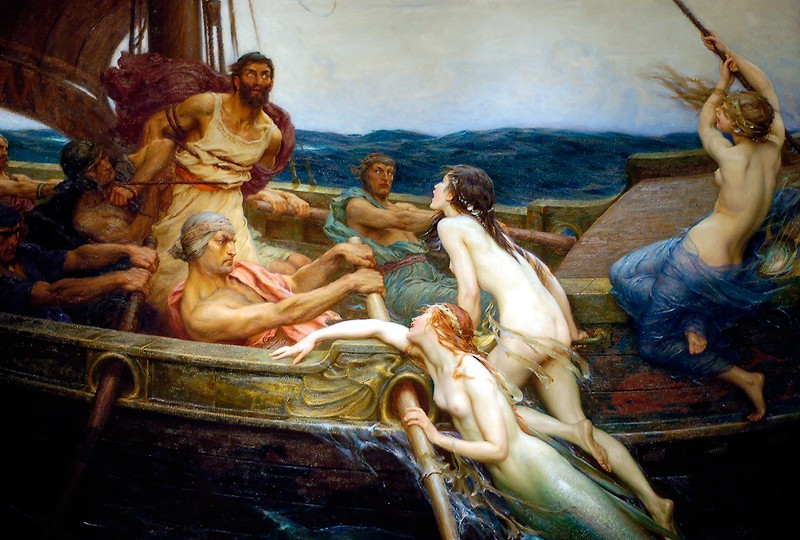
If you examine modern schools of the novel, you’ll discover how authors understand that ordinary people repeat and re-enact the ancient myths, embarking on grand journeys even when they never leave their hometown. James Joyce’s Ulysses provides perhaps the most famous example. The novel’s protagonist, Leopold Bloom, simply potters around Dublin on an ordinary Thursday in June 1904. His journey deliberately mirrors that of Odysseus returning home to Ithaca after the Trojan War, but instead of battling Cyclops and resisting Sirens, Bloom attends a funeral, buys soap, eats lunch, and navigates the complexities of his troubled marriage.


For all the mundane activities that fill Bloom’s Thursday—getting breakfast, visiting the newspaper office, going to the public baths—he encounters events and moments of surprising depth and resonance. He confronts his personal history, including his grief over his infant son’s death and his anguish over his wife’s infidelity, all within the larger context of Irish history and the struggle for national identity. Joyce demonstrates that Bloom’s journey through Dublin is no less grand, no less heroic, and no less worthy of epic treatment than Homer’s Odysseus sailing across the wine-dark sea. The interior landscape of a single human mind on a single day contains multitudes.


The remarkable thing is that you don’t need to be consciously aware that these myths are shaping your life—they’re already embedded in your psychology, operating beneath the surface of your awareness. Over the course of human culture spanning millennia, these archetypal patterns and stories have been passed down through generations, depositing themselves in the depths of our minds where we cannot directly perceive them. They function like invisible scaffolding, providing an unconscious framework that helps us organize our experiences and derive meaning from the chaos of daily existence. We live out these patterns without realizing it, our choices and responses echoing the ancient stories our ancestors told around fires thousands of years ago.


But something transformative happens when we become aware of these mythic undertones running through our lives. This awareness creates what we might call psychological gravitas—a weight, a depth, a sense of significance that elevates our understanding of ourselves. When we recognize the mythic dimensions of our experience, we suddenly possess a vocabulary and a structure for understanding what happens to us and what we do. The random-seeming events of our lives begin to cohere into patterns; we can see ourselves as protagonists in an ongoing story rather than merely drifting through disconnected moments.


This consciousness fundamentally changes our relationship to meaning-making. Instead of passively receiving whatever significance our culture assigns to our actions, we can actively participate in creating our own meaning. As we carve out purposes for our life journey and make deliberate choices about the direction we want to move, cognition of these innate mythical elements provides us with a pathway—a method for consciously constructing meaning rather than stumbling upon it accidentally. We become both the author and the hero of our own story, aware of the ancient patterns we’re working with and capable of adapting them to our unique circumstances and aspirations.

Featured

The Ordinary as a Test of Freedom

I meet my brother for lunch every week. I tap a heart to my beloved. I scroll through my photo album and notice faces I haven’t seen in years. And then it hits me—how quickly time has passed, how quietly distances form, how easily a life can drift without anyone meaning to drift. In that moment, “catching up” stops being a casual intention and becomes a kind of urgency: not panic, but recognition.


None of this proves anything metaphysical. It doesn’t need to. These are ordinary gestures—small, repeatable, almost effortless on the surface—and yet they carry real consequence. They’re shaping my life. When you’re struggling to name a grand purpose, meaning doesn’t arrive as an answer from the outside; it shows up as something you ‘do’: a pattern of chosen commitments that you keep returning to.


A weekly lunch is not just a meal; it’s a decision to remain in someone’s life. A heart icon is not just a symbol; it’s a renewal of attention—brief, but intentional. Reaching out to an old friend is a refusal to let time turn everything valuable into “back then.” These acts matter because they push back against the inert pull of days that would otherwise run on autopilot. In a world that won’t guarantee significance, they are the way you carved out so that you can say to yourself:  something ‘counts’.


And once something matters, your actions are no longer merely personal preferences. They become a form of alignment: you begin to live in accordance with what you believe in —relationship, loyalty, care, memory, presence. That alignment brings a quiet sense of duty, not as moral theatre, but as a lived seriousness: ‘this is worth showing up for; this is worth maintaining’.  Not because the universe demands it, but because you do—and because a life without such chosen obligations can start to feel like it’s dissolving into sound and fury.


These aren’t grand gestures arguing for cosmic significance. They’re ordinary rhythms, almost forgettable. Yet they carry weight precisely because they’re chosen without guarantee. You choose them because you know that’s what gives you meaning.


In a world that won’t explain itself, these repeated acts become anchors. Not because they solve the question. They’re the practical ground of meaning itself: small initiations that keep you from surrendering to indifference, and that give your finite time a direction you can stand behind.

Featured

Where Imagination  First Met Truth

When I was a kid, my brother used to buy me English and Chinese storybooks and simplified versions of classic novels. From the very beginning, I found myself opening out into new worlds through those pages. They captivated my young mind in a way I couldn’t fully explain then. These weren’t just books I read and set aside—they were places I entered, spaces where my imagination stretched and my sense of reality quietly expanded.
Only later did I realize how much they were shaping me.

I still remember some of those stories. Robinson Crusoe was one of the first. A man alone on an island, figuring things out day by day. Back then, it felt like pure adventure. Now, I see it as a lesson in resilience and imagination. It showed me that even in isolation, the mind keeps working, keeps building meaning, keeps going.

The Mill on the Floss stayed with me in a quieter way. Maggie’s inner conflicts made me aware, very early on, that life isn’t simple and that people often carry invisible struggles. That story taught me how to sit with complexity, how to feel for someone without needing clear answers. I think that’s where empathy first began for me.


Greek mythology opened an entirely different door. Gods and mortals, fate and choice, beauty and tragedy—all of it expanded my sense of wonder. Those stories in the later stages of my life stretched my vision of reality. They didn’t pull me away from the real world; they widened it. The imagined situations pushed the frontiers of what I thought reality could be, showing me that truth can live inside symbols, myths, and stories passed down across time.


These works weren’t just creating worlds of imagination. They were quietly showing me how writing itself can be a way of seeking truth. Even when the stories were fictional, the emotions felt real. Through characters’ doubts, mistakes, longings and their struggles, I learned that truth isn’t always found in facts—it’s found in experience, shaped by story.


Somewhere along the way, I began to want to write. Not with a clear goal or ambition, but with a feeling. Writing felt like a way to understand things I couldn’t explain yet, a way to ask questions I didn’t have answers for. Imagination and truth no longer felt separate to me. One led naturally to the other.


What I understand now is that my brother gave me more than books. He gave me a way of seeing. Those early stories expanded my reality, shaped my inner world, and gently pointed me toward writing as a form of truth-seeking and thus immortality.


I may not remember every plot or every line now, but I remember what those books gave me. And that, in a quiet way, has stayed with me ever since.

Featured

A Second Existence – Epilogue  to ‘The Day That Wouldn’t Turn’

All stories are rooted in reality.

This story emerges from one of those early memories that lodge themselves in the mind like a splinter—small, nearly forgotten, yet somehow never fully dissolving. I was about seven years old, in Primary Two in Hong Kong, 1967. Our English teacher was Miss Lee, a young woman whose exact age I couldn’t gauge through a child’s eyes, where all adults existed in that vague territory of “grown-up.” Looking back now, she was likely in her twenties—barely begun.

One day, she simply wasn’t there anymore. The classroom door opened to a substitute, and Miss Lee’s absence stretched from days into permanence. Then came the whisper that travelled through our school in that mysterious way news reaches children: she had taken her own life. I cannot recall now who told us or how we came to know. The official story was sparse: young teacher, tragic decision, life cut short. Details, if any, have worn away like text on old paper.  But  sparse stories haunt  precisely where they omit. 

It was my first  encounter with mortality though to a seven- year old, death was abstract and incomprehensible —something that happened elsewhere, to others. Miss Lee hadn’t been close enough to trigger immediate grief in a child’s heart. She was simply our teacher, a figure at the blackboard, a voice reading stories. Yet her absence left something behind, a kind of shadow that has never quite lifted.

For many years, I carried the convenient explanation: a young woman who took her own life at her prime must have died for love. It was the story that made immediate sense, the narrative that required no further questions. When tragedy strikes someone so impossibly young, we tend to reach for the familiar plot—the failed romance, the broken heart, the love that destroyed rather than saved. I viewed her story from this assumption, because the idea that dying for a love that failed, however banal, offered a framework that made the incomprehensible seem comprehensible.

But as years accumulated and I grew more nuanced in my understanding of the complexity of human condition, this neat explanation began to feel like another form of silencing. Life resists singular explanations. A person is never just one story, one disappointment, one unbearable weight. She was a twenty something lady — old enough to have accumulated layers of frustration, aspiration, suffocation and longing that had nothing to do with just romantic love. Perhaps she was crushed  by the weight of others’ expectations, by a future that seemed to be a corridor with no doors. Perhaps it was the specific exhaustion of being brilliant with nowhere to apply that brilliance, or being seen only as what she could never fully be.

The truth is, I’ll never know the precise calculus of her decision. But in growing older myself, I’ve learned that reducing her to a love story was my child-mind’s way of organizing chaos—and then my adult mind’s lazy acceptance of that childhood framework. The real gift fiction offers isn’t the ability to solve her mystery with a convenient plot, but to acknowledge the mystery’s true dimensions: that a life can be unbearable in ways that have nothing to do with romance, that despair can accumulate from a thousand small refusals rather than one dramatic rejection, that sometimes the story we tell about someone’s death says more about our need for comprehension than about their actual experience.

Over the decades, this memory –  if memory is even the right word for something that time has dissolved into imagination –  has settled into the sediment of my consciousness, mixing with other losses, other moments when life revealed its fragility. The specifics of Miss Lee herself—her face, her voice, the particular way she held chalk or turned pages—have faded beyond recovery. What remains is not her portrait but something more elemental: an early understanding that lives can simply stop, that young women with their whole futures ahead can choose to step out of time entirely.

I find myself calculating sometimes: she would be in her eighties now had she lived. All those unlived decades accumulate into a kind of shadow existence, a parallel life that never was. In Hong Kong’s relentless forward motion, her story was quickly paved over, but something in me refused to let her disappear completely.

I’ve borrowed the shape of my seven-year-old bewilderment and wrapped it in fiction, creating a ghost who waits in that flat, suspended between departure and arrival. Because that’s what haunts me still—not just her death, but all those interrupted possibilities, the thesis never defended, the pupils never taught, the life never fully lived.

Fiction cannot resurrect the dead, but it can offer them what history denied: complexity, interiority, voice. In imagining Sylvia’s ghost, I’ve given Miss Lee a space to exist beyond the verdict of her final action—not to excuse or explain, but to insist on her fullness as a person who was more than her ending.

She can therefore be given  a second life in the reconstructed reality of a story. And perhaps that’s the power of fiction: to create parallel realities where different laws govern what’s possible. You might argue that,  as with Bryony’ s alternate ending  in Atonement,  these reconstructed lives and possibilities are self-delusion—comfortable lies we tell ourselves about permanence and loss. But here’s what unsettles me: I’m not sure our own sense of existence is any more “real” than the reality we create for the dead in stories. We live inside narratives too—the stories we tell  ourselves about who we are, why we matter, what our lives mean. Our consciousness is already a kind of fiction-making machine, constantly constructing coherent narratives from the chaos of experience. We’re all , in a sense, fictional characters under our own self-authored stories.

This story, then, is my attempt at what the living owe: to tell a story for someone who can no longer speak, to imagine her not as tragedy but as a complete consciousness, still waiting to be understood. In giving her fictional form, I haven’t changed what happened, but I’ve changed how she’s allowed to exist in memory—not as a cautionary tale or a tragic statistic, but as a woman who lived, who struggled, who mattered, and who deserves more than silence.

Featured

The Day That Wouldn’t Turn: A Short Story


The living owe it to those who no longer can speak to tell their story for them.
—Czesław Miłosz


I got off the bus into the early dark. That particular November dusk already filled with a cool sensation. A woman stood still  beneath the amber streetlight.  Leaves from the trees that lined the street dropped and brushed past her hair and  shoulders. They had clung  to their branches until with a quiet resolve, they finally let go –  drifting past her before resting on the ground softly, waiting for the wind to carry them somewhere. She looked at me as if we had agreed to meet and  I hadn’t remembered.


“Would you come with me?” she  beckoned  in a tone so soft that I could hardly hear it. 

As if under a spell, I heard myself say yes and followed her.  At the time, I didn’t know why there was  none of the usual calculations and hesitations that rise when a stranger asks too much too quickly.  I could hear  only my footsteps as  the leaves crackled under them. Perhaps I was too conscious of my own.


She led me farther from the bus stop, away from the constellation of  neon lights on Shaukiwan  Road.  We continued  until the city’s bluster  and din faded behind us.   Before I knew it, we were  walking past a row of dimly lit Hong Kong cafés, their neon signs flickering in the humid air. Through fogged windows, I glimpsed marble tables, red vinyl stools, and ceiling fans turning lazily above the haze of cigarette smoke. From an old radio came the ghostly strains of Cantonese opera—music from another time. The aura was eerily familiar.    It felt as though we had stepped into the Hong Kong of my childhood.

As we turned into a narrow alley,  an old worn building surfaced from the dark,   its concrete  the colour of weak tea;  balconies rusted, laundry lines hanging slack. I recognized the type immediately—a post-war tenement like the one I’d grown up in, the kind still sheltering families in some run-down areas today. But this one stood strangely isolated, a solitary block with no neighbours, as if the city had receded around it like a tide. She looked up at a single window that framed a faint yellow light.


“So… it’s your home?” I asked, needing something – anything – to fill the silence between us.

“I keep a place,” she said. “It keeps me.”

That’s where I … she paused before she uttered  ‘live’, looking up at that lit window.  In the immensity of the dark, there was no mistaking it; every other unit was a blind eye.

The entrance to the mansion smelled musty with a hint of rust. No bulb burned.  I felt my way up a wooden spiral.  The banister was worn  smooth with the polish of hands that, as I would later find out,  had long stopped coming home. I was about to turn my phone light on as I was ascending. But she stopped me.   Please don’t , her voice  slightly trembled . The staircase was too narrow  to  permit us to walk abreast. I followed her, with each  stair groaning under my weight.  I was curious though why hers were accepted with its stoical silence .


At the top, her hand hovered near the latch of an rusty iron gate.  It’s a bit nippy inside, she warned.


The door creaked open. A small dining room awaited inside, lit by a weak bulb  that struggled against the darkness. I could see her more clearly now. She looked in her early twenties—her complexion pale, her eyes touched with sorrow. She was so pale  she might have been formed from the weak light itself.   She was wearing  a pink coat over a floral, knee-length skirt, the kind of style my mother and her contemporaries would wear in her young days.  Most of the time, she gazed towards the window, as if searching for something far beyond it.
I wonder how the world outside is now, she mused. 
You may well step out and feel it yourself,  I was going to say.  But I held back, surmising that she looked so sickly  that she must have been too frail to go outside.  Yes, it’s a bit chilly outside. I said. I knew  I’d said something  irrelevant.  She  pressed herself against the window for sometime. She then left her face off the window. The window  did not leave any steam as if  she was holding her breath while she was looking. 


Your dress, I said, looking at the careful pleats and  the modest hem. It looks belonging to  another era.


Really? She glanced at the mirror as if noticing it for the first time in years.


No one dresses like that anymore, I said gently.
I suppose fashions change. How long has it been?  She smoothed the fabric with pale fingers.

She turned  her eyes to the wall above the table.
A photograph in a rosewood frame hangs on the wall. It captures a young woman in her early twenties. She stands in a park, framed by a profusion of flowers, her hands loosely folded as she smiles toward something beyond the camera’s view. Her image, in her pink dress and light windbreaker,  create a relief against  the surrounding azaleas, lending balance to the composition. The sunlight falls across her right cheek, forming a small, luminous highlight that draws attention to her calm, youthful face. Her unblemished complexion  and bright clear eyes exude a freshness that unmistakably only belongs to the very young.  Perhaps because there is a breeze stirring her hair, sending soft waves across her shoulders, she gently restrains with her hand  a few strands from drifting free. Her body leans lightly against the trunk of a nearby tree, giving the pose an easy, unforced grace. Her smile captures a quiet, fleeting moment of natural warmth.


I took this in the Botanical Garden in the autumn of 1966, she touched the photograph.  I sensed an uncanny moment as I looked between the image and the woman beside me. They were the same. Not similar,  not  resembling, but the same.  The same pink coat, the same angle of the shoulders, the same tilt to her chin—only much paler now, perhaps the years had slowly drained the colour from her while leaving everything else untouched. It was as though she’d stepped out of that silver halide a moment ago and spent decades trying to find her way back into the frame.

The room suddenly felt unmoored from reality. Where was I? More importantly—who was it that was sitting across from me? The girl from the photograph who never  ages past that distant  autumn of 1966, or something that had simply borrowed her shape and refused to let it change?


Are you afraid of me? Perhaps she had noticed that I was shivering. Yet the  profound sorrow in her face stirred something gentler in me, softening my fear before it could take hold.

No, not really. I composed myself.


As she moved towards the window, I took the moment to survey the place. It had the stillness of a held breath. Navy blue paint peeled from the walls in long strips, exposing patches of gray plaster underneath. On the dresser, an old wind-up clock sat silent, its key still protruding from the back, hands frozen at some forgotten hour. A lamp with a yellowed shade cast dim light over a small table which held its arrangement like a museum display —a teacup with dried residue forming rings inside, a pair of glasses folded over a newspaper, a bowl with three wrapped coconut sweets, all coated with a thin film of dust.


You want to…. tell me a story? I asked, trying to establish why she wanted me to come with her.


If I doubted anything about reality, it’s never that reality had deserted us. This WAS reality now: The flat. The woman. The clock. The table and its things.   Actually, everything within these walls. This was what was real—so why should I trouble myself with my own idea of it? I’d completely lost track of what that “reality” was supposed to be anyway. Whatever order of reality this was, it had become the only one that mattered. And I, through my deepening entanglement with this place, felt myself becoming part of the reality the flat contained—as if this was where I’d always been meant to be.


I was no longer afraid.


On the wall, a calendar showed  the 13th  of July 1967.
The calendar has held that date for as long as anyone remembers, she said. it hasn’t  been turned ever since .

I didn’t die here, she added.


Where then? I asked, confused.


Her eyes moved to the window. The sash was painted shut, sealed by decades of humidity and neglect. That window hasn’t opened since the 13th July . I walked to Sai Wan Ho Jetty on that day. There’s a small stretch of water there, away from the main harbour traffic. That’s where I went in. Her voice was matter-of-fact, as if describing a routine errand. But afterwards, I found myself back here. This was my home.  Her gaze drew mine  back to the calender.  Everything about me ended and began all in the same day.


A silence fell between us. My gaze drifted around the unchanged room and caught on something I hadn’t noticed before—a clothesline stretched from wall to wall. A single floral shirt hung there, arms spread slightly as if mid-gesture, the fabric holding the ghost of a shape. The print had faded but I could still make out small blue flowers against what was once white.

She followed my gaze. I wore that on my last day.

By this time, I already felt at ease with her and felt at home to ask more. She sat down at the table, running her fingers along its worn edge.

People say I died for love, she said. It makes the story simple. It fits neatly into their desire of hearing a tragic romance.  She looked at me. But it wasn’t just him. It was everything the waiting turned me into.


She told me about how she fell in love with a young man. He promised he would come back from his study overseas, —perhaps in one year, he said. At first the letters came thick and eager. Then they thinned, like a season fading. Then nothing. Hers went out into the void.

His name doesn’t matter anymore, she said. What happened to me was bigger than a name.

I had a life of my own to live. Her tone grew more certain as she continued.  I taught primary school to save money to go to a university abroad. I  had to tend to my aging mother and look after my little brother. I waited for my opportunity.  I waited for his return.  Over the years, that life turned out to be one of waiting, hoping and eventually disenchantment.    The waiting was just one thread woven through all the rest.


The things on the table chimed in with their testimony. A rejection letter from the University of London, —the paper yellowed at the edges but the words still sharp. Two tickets for West Side Story, the show date two months past, never used. A stack of pupils’ exercises she’d been marking, red pen still uncapped beside them. An unfinished lesson plan for teaching the alphabet, the letters A through M carefully illustrated; the rest left  forever waiting. Amidst all this lay a scrap of notepad paper on which was written in a steady and careful hand: prepare pills for mother.

Every day was full. She continued: But full of things that led nowhere. I was always preparing for a life that kept being postponed.

I spent my life waiting. At first, I knew what I was waiting for: His return, the day when I could have saved enough money for university, the results of applications. And then year after year, I lost focus. It all blurred into a dull sensation,  waiting with no specific goal.  It just became a dreary game of waiting,   yet I felt compelled  to wait. As for waiting for what, I was no longer sure. She looked away, her voice fading.
Instead of letters coming from him,  rumours found her.   Some said he had fallen ill. Some said he had stayed overseas, married there. Someone swore they saw him back in the city, thinner, changed, a quick shadow near the tram stop.

I waited for years, she murmured. When footsteps came down the corridor, my heart quickened. Could it be him? But the doorbell never rang with that particular visitor she had been expecting —a slim young man with hair parted to the right, who would say her name and pull her into his embrace.


She paused, then again: Waiting became the role everyone gave me. At first, I told myself stories— He’ll come back soon, I’d whisper to my reflection.  Just save a bit more money, then apply to university again. But my mother had other plans. You must wait until your brother grows up, she would say. A daughter’s duty is to family, not books. So I waited for my brother to finish school. Waited for enough savings. Waited for life to somehow rearrange itself into what I wanted it to be. Each year, another reason to postpone. Another obligation. And he—the one who never wrote, never returned— became just one more thing in a long list of things that would never come.


By the time I finally understood he wasn’t coming back, it didn’t matter anymore. The role had already been written for me. One word: Wait.  Then there was another voice inside me gathering momentum:  Sylvia, you can break it. Now,  I know what I should do. She said calmly, and I could hear in her voice that fatal moment of clarity—when the path forward had suddenly revealed itself.


I didn’t die for a man, she said firmly. I refused the life that made waiting my whole identity.


She told me about her childhood—growing up in a modest family  where her younger brother always came first, no matter what she achieved. Her father didn’t  particularly like working; responsibilities slid off him and onto everyone else. But she cherished small joys too: a stray cat that chose their doorstep, the triumph when her first loaf of bread rose properly in the oven. And that first Christmas ball at school when she was 16—she wore a blue floral dress and when a boy asked her to dance, she felt something shift inside her, some door opening onto a different possible life.
Those were the little stories, she said, the threads in the fabric. But they felt like sparks—bright for a breath, then gone into the dark.

She had been keeping diaries —years of them—and a bundle of the man’s letters. I threw them away. They all contained an agonising voice of a life that clamour for fulfillment yet being dragged by indefinite waiting.   When I decided to define my life on my own terms, I let them go. Each entry pinned me to a day I didn’t want to live in anymore. When I burned them , I felt a tremendous sense of letting go, symbolic if not actual.

I asked if that brief liberation might have prepared her for what was to come. 


Sort of,   she said softly. I still felt crushed by the gravity of the present. The diaries were the first refusal. Death was the only thing left that I could choose .

On  the 13th of  July, the feeling that had been humming for years gathered itself. Everything she had postponed stood around her at once, and all the doors she’d been promised were still shut. It was as if a black circle opened in the middle of the room, made from every “not yet” she had ever obeyed.

It wasn’t a rushed decision, she said. I stepped into it – she stressed the word –  refusing to keep orbiting a life that never let me begin.

I missed my chances, she whispered, and a tear rolled down her cheek. I was cut off in my prime. I lost the chance to find out what living feels like over a long stretch. Maybe even to learn what a love that lasts actually is.

Maybe, I said.  You might have suffered more by living. Or less.  But who knows?  We only guess what other lives  could have been for us.

She smiled. You’re saying there might have been lives I saved myself from without knowing?

I’m saying none of us gets the full accounting. Most lives are patchwork anyway, and whatever warmth we find comes from the stitching itself, from creating meaning for your present.


She was  silent again. But I had tried, she said.

She glanced at the calendar. And this? What do you call this?

A life with one day kept, I said. Not wasted— just a different way of becoming.  You spent everything you had to preserve that single moment, that exact point you ended your life.

She was quiet for a moment. I missed the chance to grow old. To watch those pupils become adults with their own pupils to mark. And to see if the city would change or if I would.


Perhaps by freezing yourself that day, it’s not so much the dramatic moments you would have missed as… that gentle erosion and shaping that comes from everyday life. Like an artist’s kneading, you know? Small things—hair going gray, hands that know their work, that favourite teacup that gets worn smooth where your thumb rests. The window where you’d watch the same trees turn green, then brown, year after year. Everything in between.


Yes. And more, she said. I missed the chance to forgive, she continued with the words coming harder now. To forgive him for not returning. To forgive myself for waiting. Maybe forgiveness only comes with time, and I didn’t give myself enough.

Do you regret it? I asked.

The question seemed to fill the room. She didn’t answer. The silence stretched until it became its own reply: some choices are beyond regret. They simply are what happened, the path the story took.

Why tell me all this? I asked.
I need someone to know I existed—that our love was real, even if it ended in shadow. That I once lived  with a throbbing heart.  Please write that I did not succumb to frustration. Write that I refused to live by the script life handed me. I didn’t accept the part.
She looked at me directly. Write that my story isn’t that of  Ophelia floating downstream with her flowers. I chose to leave—I just never got all the way gone.


Never got all the way gone? I echoed, not quite understanding.


I’m caught, she said, her voice steady but distant. Too far from life to return, not far enough gone to reach whatever comes after. Suspended in the space between my  memory and the next world’s threshold—like a door that won’t quite close. Her words made me think of the Haunted Mansion’s ballroom scene in Disneyland—spirits locked in an endless waltz, circling through dusty air and faded music. Like her, they were caught in a single moment stretched into forever, performing the same steps in the half-light between worlds.


People like to box me into a neat romance that failed—a pretty tragedy with a moral attached.  But I’m not a cautionary tale. I was a person.

So you’ll write my story? She looked at me, almost beggingly.

Her expectations weighed on me like a coat I hadn’t asked to wear but couldn’t refuse. This was no longer just about a young woman long forgotten by history. Her story had become something else to me now—a debt between the living and the dead, a responsibility I hadn’t sought but recognized. Perhaps it was the way she’d walked me through those collapsed decades, showing me how thin the membrane was between her 1967 and my present 2025. Or perhaps it was simpler: she had no one else to ask, and I was the only one who’d followed her up those stairs, the only one who’d sat in her unchanged apartment and conversed with her – though anyone reading this may think it mere  imagination.

And perhaps most importantly —though I can’t quite  explain it—I felt sure I’d met her when I was small. The memory wouldn’t come clear, only the conviction that somewhere in my childhood’s blurred landscape, she’d been there.  The obligation felt both ancient and immediate—the old contract between witness and testimony. She’d chosen me, or time had chosen me for her, to carry what remained of the 13th July , 1967, back into the world of the living.
How  then could I refuse the dead their only request?


Yes, I will. I promised.


Thank you. And those were her last words.


Whereupon she got paler almost to the point I started to be struggling to distinguish her from the weakening   amber light. Her form grew fainter, as if the telling itself were a key turning. The house listened once more, then let go.

Silence settled. In the mirror, only my own face looked back. Outside, the autumn wind stirred the leaves with nothing but its own voice.  When I looked back the flat, the lamp that had burned for fifty-eight years went dark.

I stepped out carrying her story. Only then did I understand why she had chosen me: I, too, had my waiting hours—for a love that had left, for a life that would not arrive. Her warning was simple: waiting is not a life.
By morning, the old building was gone. The site stood empty—truly empty—for the first time since 1967. Perhaps that was her peace: not in death, not in the long vigil, but in being seen at last—remembered without the myth, carried forward without the neat bow of a moral.

I thought of the small things she’d wanted: the harbour at dusk, the steady tide, the children growing, the gray that comes honestly. I promised, out loud to no one, to choose one unglamorous act of living each day and to call it by its name.


She was weightless in every physical sense—a woman made of memory and air. Yet she’d been pinned to this place since that calender date by something heavier than any living body: the need to be known, to be remembered, to have someone say : yes, you were here and listened to.
Somewhere – if there is a somewhere – she should now feel lighter for having been told.

And somewhere closer, the part of me that kept a chair for what never arrived got up, switched on a new light, and began to write. Through the writing, the gray man at the present, the woman who never ages past 1967, and that child in a classroom sixty years ago became part of the same story—though which one of us was telling it, I could no longer say.

Written on 25 December  2025

(Epilogue to follow in the next post)

Featured

Escaping the Illusion of Infinite Choices

Have you ever opened Netflix, spent 20 minutes scrolling, and then… just closed the app? Yeah. Same. At this point, I think I’ve spent more time choosing what to watch than actually watching anything.

It’s funny—we live in a world overflowing with choices.  The gamut of cereal.  Different kinds of milk (oat, almond, soy, cashew… I can’t keep up). An endless  list of job adverts. In my case, a hundred book titles   my friends swear you ‘must’  read, or a Google search would recommend you. You’d think all these options would make life better, right?

Well… maybe. But it ain’t always a yes.


There’s this idea in philosophy and psychology called “the paradox of choice”, which basically says: the more options we have, the more overwhelmed we feel. And honestly? That checks out. Just yesterday, I spent an embarrassing amount of time trying to choose a book from google search. Yes, just a book. Sounds like not that big deal. But I ended up spending the amount of search time that I would have used to do other more interesting things. But that’s what it was. 

Here’s what’s wild: having more options feels like freedom, but it can also feel like pressure. If you have only two choices and you pick the wrong one, you shrug it off. But with 200 choices? Suddenly you start thinking, “What if I missed the perfect one? What if I chose wrong? What if my soulmate book is sitting on page two of search results?”

And that’s where things get interesting. It’s not just about book choices. Choice shapes how we see ourselves. What we pick becomes part of our life, our identity —and that makes choosing feel bigger than it really is.

But let’s be honest: oftentimes, we don’t need the perfect option. We just need one that works. Still, something in us loves to agonize over tiny decisions as if we’re philosophers contemplating the meaning of life.

So I’m curious—what’s the last thing you overthought way too much? 
A pair of shoes? A restaurant? A phone avatar? (No judgment. I’ve changed my avatar three times this week.)

Here’s what helps me when I’m stuck in Decision Overload Land: 
• limit the number of options I’ll even look at 
• give myself a time limit (surprisingly effective!) 
• accept that “good enough” is… well, good enough  and jump right into it with a leap of faith.

Because maybe the goal isn’t to find the perfect choice. 
Maybe it’s just to enjoy the choice we make.
What do you think?

Are you a “decide in 5 seconds” person or a “compare every grain of rice” person? I’d genuinely love to know.


P.S. And honestly, in our age of endless information, this whole “paradox of choice” hits even harder. We’re constantly nudged into this myth of option meaning freedom —when half the time, it just means more stress. The good news? We do have agency. Sometimes the most powerful choice is simply refusing to get sucked into the endless scroll of possibilities.

Featured

Why Soft, Simple Writing Stays with Us

You don’t always need big ideas or sophisticated literary techniques to make an impact. Sometimes a softer approach—a simple story told without complexity or pretension—can reach people more deeply. Tuesdays with Morrie is a perfect example of that. It’s quiet, straightforward style doesn’t try to dazzle the reader. Instead, it invites you in gently, and before you realize it, the book has settled into your heart.

You know, one  reason the book pulls people in is it’s written almost like a real conversation you’re overhearing. When you read it, you don’t feel like you’re studying themes or analysing arguments—you feel like you’ve just pulled up a chair next to Mitch and Morrie. The dialogue is so warm and natural that it’s easy to slip into the rhythm of their talks. And because most of us have had moments like this with someone older or wiser, it instantly feels familiar. It makes you think about your own conversations, your own memories, your own questions about life. The book doesn’t push you away with big ideas; it invites you in, gently, as if saying, “Sit with us for a bit.” That’s a big part of why readers feel so involved, even though the story is simple ( there’s hardly any plot to speak of ) and  the language plain. The ideas don’t feel particularly profound or original. But that’s part of  what makes it  so accessible to readers.

Featured

Telescopic Lives: A 400‑Year‑Old Man Remembers

PROLOGUE

Recently, I read How to Stop Time by Matt Haig, a novel about a man who ages far more slowly than everyone around him. The story follows him across centuries, watching people he loves grow old and disappear while he continues on. Something about that premise stayed with me—the way memory stretches, blurs, and reshapes itself when a life lasts far longer than it should. It got me thinking: what would memory feel like if only one person lived to be 400 years old while everyone else lived normal lives? Since no one has ever lived long enough to tell us how their centuries-old memories feel –  just like no one has ever come back  from death to recount what it lies beyond –  the question became the seed for the thought experiment that follows.

In this piece, I explore, more decisively than Hamlet does  in his contemplation of the state after death, this thought experiment through the imagined monologue of such a man—one who remembers, forgets, and reflects on the long-distant past in ways the rest of us can only guess at.

MONOLOGUE

[Quietly, near a window overlooking a timeless landscape]

Four hundred years… and sometimes I still wake expecting to hear the voices of people who have been gone for centuries. Longevity, when it belongs only to you, is not a gift you hold—it’s a room you inhabit alone.

Everyone I once loved lived their natural span, just as people always have. They aged, they weakened, they died… and I kept going. At first I tried to hold every memory close, terrified that forgetting them would be another kind of death. But the centuries have their own logic. Memory thins, the edges blur, and what remains are mere impressions—warm, but drifting further away in the  universe of my mind.

How do I feel now? Strange, mostly. Not sorrowing the way I once did, but not untouched either. There is a quiet ache that never quite leaves. I walk through a world  of young faces, new families, new stories, while mine stretch back so far that even I struggle to recognize the person I used to be.

The people I lost… I remember them not as portraits but as atmospheres. My parents feel like the sensation of  being hugged, rather than two specific faces. Friends from early centuries linger in me only as a jingle of laughter, or just the faint  afterglow of being together – warm, cosy –  but not as clear images. My siblings, my niece … but wait.  Were they there in the first place? Were there truly people tied to me by blood?  Oh, yes, thanks to those persistent,  involuntary flashes of memory,  I recall their names, James and Lydia. But little else. After  so many lifetimes have passed since those early days, my remembrances  of them have dissolved into  abstractions. It’s only by simple logic that I’m sure I watched them grow old, and that I must  have been with them in their dying days and that I must have grieved. But that certainty only comes from reasoning. Simple logic gives me facts. It doesn’t  retain  the lingering rawness of emotions, the sharpness of images I might  have had if I’d lived a normal span, an old man in his eighties,  reminiscing about the past.  The love of my life—her memory has become a feeling more than a person… a warmth in the chest, a softness in the voice when I speak of certain years.

Sometimes, though, something jolts my numbness: a particular melody, a scent, a phrase someone speaks with the same rhythm as a friend long gone. In those déjà vu moments, memory briefly sharpens, and for a heartbeat I see them with startling clarity. It is beautiful—and it hurts. Because the moment I notice that clarity, it slips away again.

Do I feel lonely? Yes, in a way no one around me would understand. Not for company—I have that though  I know  I will again lose it —but for shared history. No one alive remembers the world I began in. No one remembers the people who made me who I am.  Their stories exist only in me, and even I carry them imperfectly now.

I’ve made peace  with all this.  And I also feel grateful. Grateful that they lived, grateful that I knew them, grateful that even centuries later, the essence of them still stirs within me. They are not gone—not entirely. They’ve faded into the foundation of the person I’ve become. And though details fail me; the influence does not.


But tonight? Tonight I miss the texture of them. The sound, the touch, the weight of a hand in mine. That… that never stops aching. Not sharply. Just… persistently. Like the tide, always there, always pulling something back out to sea. 

Four hundred years. You carry what you can. You let the rest become starlight. 

Featured

The Paradox of Creating From Dreams

While I might want to sketch a rough contour of my dreams upon waking up, and fill in the details later, there lies a paradox in that process of creation.

Dreams can be a powerful source of ideas, but they come with a strange limitation: we usually remember only pieces of them. The moment we wake up, parts start fading, no matter how hard we try to hold on. And yet, those fragments often spark something new—a thought, an image, a feeling that pushes us to create.

That’s the paradox. Any dream‑inspired creation depends as much on forgetting as it does on remembering. We can’t bring a full dream into waking life. We can only carry whatever survives the transition. By the time we write it down or turn it into a drawing or story, we’ve already lost parts of it. The act of creating from a dream is also the act of accepting that much of it is gone.

But this isn’t necessarily a problem. Forgetting can actually help us. When the exact details slip away, we’re free to interpret the fragments in our own way. We fill in the gaps with imagination, experience, or intuition. The result isn’t a perfect record of the dream; it’s something new that grew out of it.

So whenever we create something based on a dream, we’re really working with both memory and absence. What we remember gives us the starting point. What we forget opens space for creativity. In the end, the finished work becomes its own thing—shaped by the dream, but not bound to it.

No great artists or writers  work  from a pure memory of  dreams. The rest is a conscious process of creativity.

Featured

A Star that Shines with Words

The other day,  my brother asked if I’d managed to build a following for my blog.

Well, I’m not particularly trying to build a crowd; I’m trying to become a star –  one that shines with words.

Even if I exist as a solitary star in a quiet corner of the universe, that doesn’t matter. A star doesn’t ask who is watching. It burns with its own inner fire. 

My writing is that light. Like starlight, it may travel a long time before anyone sees it. By the time a reader looks up and notices, I may be gone, but  still exist in my works as an afterglow in the mind of another. And that’s enough.

What they’ll meet on the page is therefore not who I am in that moment, but who I was when those words were born: a distant glowing past; a scatter of stardust still making its way through the dark, its light still streaming.

Featured

Mining Dreams: How to Capture Your Subconscious Creativity

Salvador Dalí slept with a key in his hand, positioned over a metal plate. As he drifted off, the key would slip from his fingers and clang against the plate, jolting him awake just as dream images began to flood his mind. Mary Shelley dreamed the central scene of Frankenstein. Paul McCartney heard “Yesterday” in his sleep. These artists understood something fundamental: our dreams are portals to a vast creative reservoir that our waking mind barely touches.

The conscious mind, for all its cleverness, is just the tip of the iceberg. Below the surface lies the subconscious—a sprawling warehouse of memories, associations, and creative possibilities that consciousness can only access in fragments. During our waking hours, our rational mind acts as a gatekeeper, filtering and organizing, often blocking what it thinks are the strange and wonderful connections that fuel truly original ideas. But when we sleep, that gatekeeper steps aside.
Dreams are the subconscious finding its voice. With our conscious mind offline, the deeper layers of our psyche begin assembling thoughts in ways that defy logic but often hold surprising insight. Characters merge impossibly; time loops back on itself; everyday objects transform into symbols—all the bizarre imagery that makes dreams feel so surreal is actually our creative engine running without its usual constraints.
The tragedy is how quickly these visions dissolve. Dreams are phosphorescent, glowing brilliantly for mere moments before fading into nothing. You wake with a sense of having witnessed something profound, only to watch it evaporate like morning mist. Five minutes later, you can barely recall a single image. Ten minutes later, it’s gone completely.
This creates an impossible choice: sacrifice sleep to capture the dream, or sacrifice the dream to preserve sleep. Getting up to write a detailed account means disrupting rest, potentially making it harder to fall back asleep. But letting the dream slip away means losing whatever creative sparks it contained.
Well, the solution lies in compromise. Keep a notebook or phone beside your bed. When you wake from a vivid dream—whether in the middle of the night or first thing in the morning—don’t try to capture everything. Instead, jot down quick fragments: key images, emotions, the strangest details, essential plot points. Just a few words or phrases, whatever you can scrawl in the dark without fully waking yourself up.
These fragments act as anchors. Later, when you’re properly awake, those brief notes will help reconstruct the fuller dream. A single phrase like “me levitating ” or “falling but laughing” can unlock entire sequences that would have otherwise vanished. You’re essentially creating a signpost  that your waking mind can follow back into the territory of dreams.
Not every dream will yield creative gold, of course. But by making this practice habitual, you give yourself regular access to  your swirling subconscious. Over time, you’ll notice patterns, recurring symbols, and unexpected ideas that your conscious mind would never generate on its own. The reservoir is always there, waiting. You just need a way to dip into it without drowning in the process.

Note: I asked Chatbot to give me a few famous examples of who were inspired by their dreams for their works, hence the first paragraph.

Featured

On Stillness, Memory, and the Subconscious

As you may agree with me,  my blog entries so far have carried a sense of stillness, dream, and liminal awareness. While Discovering Stillness in Small Moments The Rest Between the Notes and Moonlit Threads, Human Ties are the clearest explorations of it, other posts also hover in that quiet, introspective register — even when their subjects differ.

When I write my reminiscences, it’s never just an act of remembering. It’s more like a quiet descent — a letting go — where I allow myself to drift as deeply as possible into the depths of my own subconscious. For a while, I suspend judgment. I loosen my grip on logic. I let the mind wander where it takes me, letting these remembrances run wild, unrestrained. 

Some of these thoughts surface in moments of stillness — those small, luminous pauses that I wrote about in Discovering Stillness in Small Moments. Others emerge from a more elusive source: the twilight realm between waking and dreaming. That half-lit territory has always fascinated me. In pieces like The Rest Between the Notes and Moonlit Threads, Human Ties, I began to sense how dreams and the subconscious can weave themselves into conscious reflection. The imagery, tone, and rhythm of those writings seem to come from somewhere deeper — as though they had been resting quietly inside me, waiting for the right moment to rise. 


Looking back, I realize that this process — this surrender to stillness and dream — is often where my writing begins. The subconscious seems to store fragments of experience: sensations, voices, faces, and fleeting impressions that never quite left me. When I stop trying to control them, they find their own way to the surface, sometimes as words, sometimes as images, sometimes as silence. 
Perhaps what I’m really exploring in all these pieces is how memory, stillness, and dream converge — how each moment of inner quiet allows the unseen parts of the mind to speak. In that sense, writing becomes less an act of mindful creation and more an act of listening. 


This is what I hope to explore next — the importance of dreams as a source of inspiration. For it’s often there, in the dim spaces of the subconscious, that the truest emotions and the most vivid images reside, waiting to be found.

Featured

Discovering Stillness in Small Moments — A Reflection on Life’s Impermanence

Recently, I’ve been spending  slow coffee mornings at Pret, sitting by the floor‑to‑ceiling glass window with a flat white or latte  in hand. Most of my time there slips away in writing and reading, punctuated now and then by moments of idle gazing—watching the world drift past the window.

Then there was another ordinary morning—so ordinary it almost escaped notice—the sunlight came streaming through the glass in slender, golden shafts. They fell across my table, catching the rising steam from my cup. Such a simple, fleeting thing—and yet something about it felt extraordinary, almost poetic.

That was it. No grand epiphany. No orchestral swell. Just a ribbon of light, and a sudden awareness that I had ‘seen’ it—truly seen it—not merely with my eyes but with some  part of the subconsciousness that rarely awakens. That tiny flicker of life was and vanished all in one breath. Just as all things do.

Maybe that’s the whole secret. We’re always searching for something real, something that endures. But perhaps it doesn’t take a story worthy of an ancient Greek tragedy  to remind us how fragile beauty really is. We wait for life to come in fanfare, when meaning often arrives softly: sunlight caressing a coffee cup; the conversations   of strangers at nearby tables  weaving their own stories; the stirring of our mind for some inspiration. Each moment appears, glints,  vanishes – the triptych of our being.


We don’t have to stand, like the man in the green overcoat in Casper David Friedric’s famous painting The Wanderer Above the Sea of Fog, gazing heroically at the horizon to have a brush with the sublime. Sometimes, it’s hidden inside the most mundane jiffies of our lives—tucked so gently into our days that we overlook them.

When I paused long enough to notice that light, something inside me paused too—or perhaps, stepped briefly into a state unbound by time. For that instant, I glimpsed what the Buddha called śūnyatā —emptiness not as absence, but as the infinite space from which all things arise and to which they return. It’s the Truth he awakened to beneath the Bodhi tree two and a half millennia ago.

Outside the window, the world then became a moving poem: blurred reflections, people passing through the sunlight, each heading into their own horizons.  None stayed long enough to be part of mine, and that, I realized, was a quiet comfort. Everything, like the light, moves on.

Maybe life is just that—a sequence of shimmering moments, each one vanishing even as we notice it. And yet, when we do notice, the ordinary becomes luminous. The mundane glows. Existence itself turns into poetry—fragile, radiant, ephemeral.

So now, each morning, I still sit by that window. The coffee tastes the same. The world still hurries past. The only difference is that sometimes, I look up from my screen and see how the light touches the steam, how time folds itself into an ordinary hour. And in that instant, I remember: 
The purpose of life is not to chase the permanent, but to experience the efflorescence —while it happens, in ribbons of gold, before it slips quietly into memory.

And then even memory thins to air.

What Remains When Nothing Stays

There are moments — usually the quiet ones, never during the daily grind — when a strange kind of clarity slips in. It’s like the world loosens its grip for a second, and you suddenly see your life from a slight distance. Not dramatically. Just… clearly.

For me, it often starts with a memory.

Sometimes she appears — young, exactly as she was, untouched by the decades that have passed. In reality she’s in her sixties now, but the mind doesn’t care about reality. It keeps its own museum, where certain moments stay frozen in their original light.

And when that memory surfaces, it doesn’t hit with the old rawness anymore.
It’s more of a soft melancholy, the kind that sits lightly on the chest. A reminder that the passions I once lived through have completed their cycle. Maybe I’ve outgrown them. Maybe they’ve simply dissolved because the conditions that held them together are gone. Either way, they don’t burn the way they used to.

Reading Buddhism in recent years helped me understand why.

Śūnyatā — emptiness — isn’t some abstract idea. It’s just the recognition that nothing has a fixed, permanent core. Everything comes into being because certain conditions line up. And everything fades when those conditions fall apart. Relationships, ambitions, identities — all of them.

And honestly, as a pensioner, this way of seeing feels more relevant than ever.
Awareness of mortality becomes real, not theoretical. Old ambitions lose their urgency. The world gets quieter. And in that quiet, you start to realise you don’t need to defend your past or cling to it. You can just let it be.

I look at my younger self now with a kind of softness.
He did what he did because that’s who he was at the time. No need to rewrite him. No need to judge him. He was part of the conditions that led to me now. That’s enough.

This acceptance brings both softness and closure. Softness because I no longer fight the past. Closure because the story doesn’t demand anything from me anymore.

Maybe that’s why I’ve been drawn to minimalism — clearing out the flat, keeping only the essentials. It’s not about aesthetics. It’s about matching the outside world to the inside one. When you understand that nothing stays, clutter starts to feel like a misunderstanding.

And in those rare windows of calm — when the noise of daily life falls away — I feel a kind of loneliness that’s not sad. More like Hamlet after everyone leaves the stage. Alone, yes, but with a clarity that only solitude can give. And in that clarity, the reflections on letting go arise naturally.

Not as a practice.
Not as a philosophy.
Just as the way things are.

Between Fate and Freedom — on Living with Regret

Regret has a way of arriving uninvited, often disguised as a simple question: could things have been otherwise? Of course, I have regrets. I find myself, at times, drifting into thoughts of the life—or even the lives—that might have been. And yet, there is something strangely futile about that exercise. Our lives unfold within the conditions we are given, shaped by what we knew, what we felt, and who we were at the time. In that sense, every decision seems inevitable. It could not have been otherwise.

And still, we regret.

We regret because we cannot help but believe that something better was possible—that we might have chosen differently, acted more wisely, loved more fully. Regret begins with memory: we return to a moment and wish it had unfolded in another way. Then imagination takes over, offering us a version of events more aligned with what we now value. We live, in this way, under the quiet shadow of “what could have been.” Part of us wants to dismiss this as irrelevant. But regret persists, because it speaks to something deeper.

In fact, regret reveals what we care about. It is not merely a fixation on the past; it is an expression of our values. To regret not pursuing a certain path is to admit that it mattered. To regret not spending more time with those we love is to recognize love as something we hold dear. Even our most ordinary regrets carry within them a map of our priorities. What appears, at first, as meaningless longing turns out to be a kind of moral clarity.

And yet, this clarity leads us into a paradox.

Regret seems to depend on the idea that we could have chosen otherwise —that there were genuine alternatives before us. Without that assumption, regret would make no sense. And yet, when we look closely, each decision we made was shaped entirely by the circumstances of the moment: our knowledge, our limitations, our character. In that light, it becomes difficult to say that we truly couldn’t have done the way we did.

So regret occupies a strange space. It rests on the idea of freedom, even as it coexists with a life that often feels determined. Like a lamp, it casts shadows of choices that never fully existed. In the moment of action, there may have been no real alternative. But in memory, those alternatives multiply.

Perhaps this is why regret is never personified in Greek mythology. Hope, famously preserved in Pandora’s jar, is given a place among divine forces—it looks forward, toward what may still come. But regret, which turns us back toward what cannot be changed, is absent from the pantheon. That absence is telling.

The Greeks did not ignore regret; they gave it a different form. It lives not as a god, but as an experience within their tragedies. There, regret unfolds through action and consequence. A single decision reshapes an entire life. Midas, in his desire, is granted the golden touch, only to find his daughter turned to lifeless metal in his arms. Orpheus, unable to resist a backward glance, loses Eurydice forever. These are not stories about regret as an entity, but about the weight of choices that cannot be undone.

Regret, then, belongs to us. It is not sent by the gods; it arises from within. It emerges from the peculiar condition of being human—caught between a sense of freedom and the suspicion that everything we have done was, in some way, inevitable. We imagine alternatives, and in doing so, we become aware of the fragility of our own agency. We see that our choices matter, precisely because they cannot be reversed.

In this sense, regret is not merely a lament for past mistakes. It is a form of self-knowledge. It reveals the distance between who we were and who we are now. It reminds us that even a single decision can alter the course of a life in ways we only understand much later. And in that recognition, there is both burden and responsibility.

Ian McEwan’s Atonement offers a modern echo of this ancient structure. Bryony, burdened by guilt, attempts to repair the harm she has caused by rewriting it. In her fictional world, she grants Robbie and Cecilia the ending they were denied in reality. What the past refuses, imagination permits.

But this act is as fragile as it is sincere. Bryony knows that no story can undo what has been done. Her imagined resolution does not erase her guilt; it only gives it shape. Her “atonement” remains incomplete—less a redemption than an acknowledgment of its impossibility. Like the figures of Greek tragedy, she must live with the consequences of a single irreversible act. Her story reminds us that while we may live under forces beyond our control, we do not escape responsibility for what we have done.

And yet, regret does not leave us only with guilt.

If it teaches us anything, it is that we must learn to live with the past self who made those choices. The past is not a place we can return to, but a landscape we revisit in memory—not to rewrite it, but to understand it. Regret allows us, at its best, to look back not with anger, but with a certain tenderness. We begin to see that our past selves acted within the limits of what they knew and who they were.

To recognize this is not to excuse everything, but to accept both our fallibility and our responsibility. The person who regrets is no longer the same as the person who chose. In that gap, something important is revealed: we are always in the process of becoming.

Regret, then, is not simply a wound. It can become a companion—a quiet reminder that we are capable of reflection, of change, of growth. It does not ask us to rewrite the past, but to face it honestly and carry it forward. Even the ability to regret suggests that our choices matter, that our lives are not empty of meaning.

So regret, for all its discomfort, is not meaningless. It binds us to what has been, but also points us toward what we might yet become.