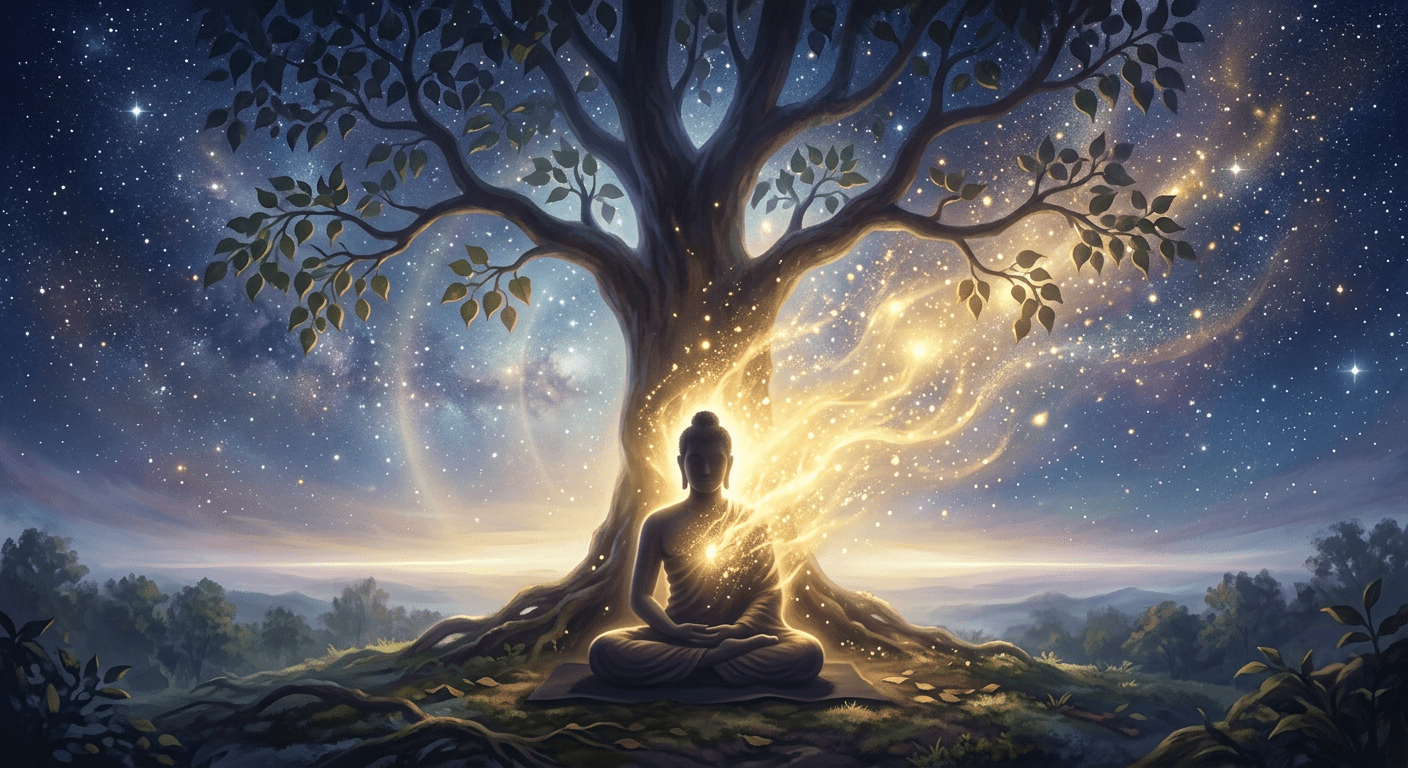
Nirvana, or Buddhahood, cannot be fully comprehended through concepts, language, or ordinary thought. Words function within the realm of distinctions—self and other, existence and non-existence, birth and death. Buddhahood, however, transcends such dualities. Therefore, any attempt to define it as we define ordinary experiences will inevitably fall short.
It is especially misleading to think of Buddhahood as a “life” in the conventional sense. When we speak of life, we usually mean a living organism, a stream of consciousness, or an individual existence that begins, changes, and eventually ends. But anything that fits within this framework is subject to impermanence, decay, and dissolution. If Buddhahood were merely another form of life as we know it, it too would be conditioned, limited, and impermanent. This would contradict its very nature.
Thus, Buddhahood cannot be understood as a physical form, nor simply as a continuing consciousness. It is not an extended version of individual existence. It is not a refined or eternalized self. To imagine it this way is to project our ordinary categories onto what lies beyond them.
Rather than a “life,” Buddhahood may be described as a state—but even the word “state” is only a pointer. It refers to the original reality that is beyond time and space. It is not something that comes into being, and therefore it does not pass away. In this sense, it is sometimes spoken of as a primordial or pre-conditioned reality—not because it exists in time before other things, but because it is not bound by temporal sequence at all.
Is it existence? Is it non-existence? These categories do not apply. The moment we label it as “existence” in the ordinary sense, we subject it to impermanence, since everything that exists in conditioned reality must eventually cease. Yet it cannot be described as non-existence either, because it is not mere nothingness. Nirvana transcends both being and non-being.
This reality is the supreme truth—ultimate reality itself. To attain Buddhahood is not to acquire something new, nor to travel somewhere else. It is to directly realize and experience this final reality. It is an awakening to what has always been true, but obscured by ignorance and attachment.
After the realization of nirvana, it is no longer meaningful to speak of life and death in the ordinary way. These distinctions belong to the conditioned world of appearances. From the standpoint of ultimate reality, they are provisional designations.
Furthermore, this ultimate reality is not separate from the world of phenomena. It is the fundamental law or principle that governs all phenomena. In Buddhist thought, this may be understood as the Dharma—the timeless truth underlying the arising and passing of all things. Though forms change and worlds appear and disappear, this law itself is unconditioned and timeless.
Thus, Buddhahood is not a personal immortality, nor an eternal individual consciousness. It is the direct realization of the unconditioned reality that transcends all conceptual limitations. It is freedom from birth and death, from becoming and ceasing, from all forms of conditioned existence.
Because it lies beyond language, we can only gesture toward it. Yet through practice, insight, and awakening, it can be directly realized.

