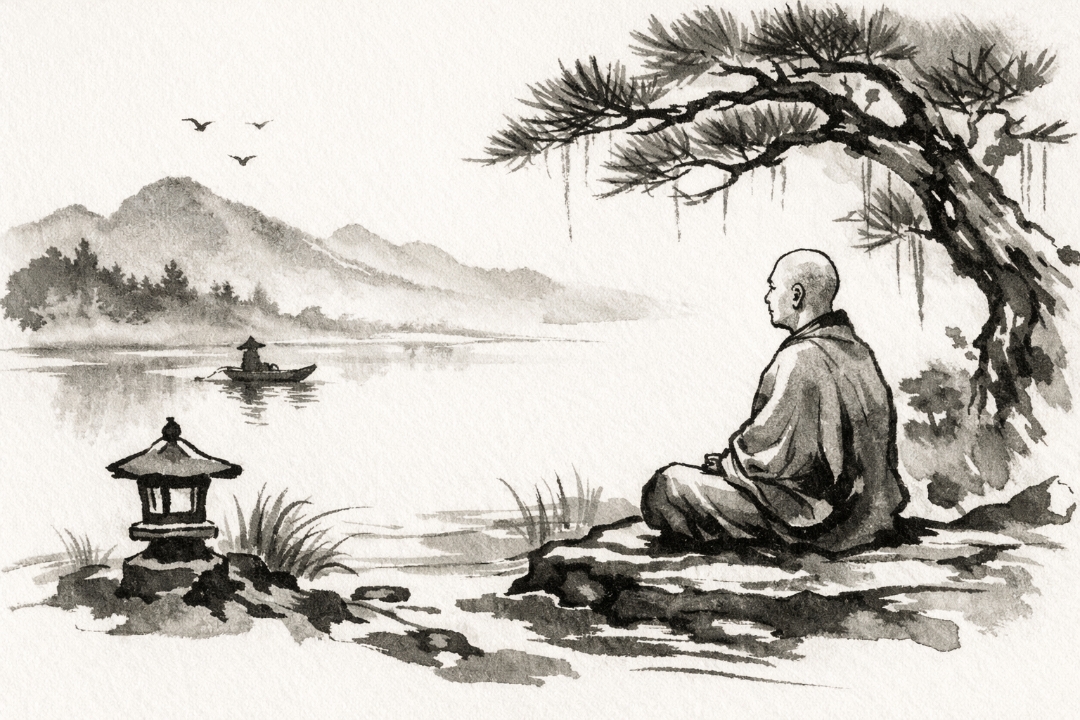
There are moments — usually the quiet ones, never during the daily grind — when a strange kind of clarity slips in. It’s like the world loosens its grip for a second, and you suddenly see your life from a slight distance. Not dramatically. Just… clearly.
For me, it often starts with a memory.
Sometimes she appears — young, exactly as she was, untouched by the decades that have passed. In reality she’s in her sixties now, but the mind doesn’t care about reality. It keeps its own museum, where certain moments stay frozen in their original light.
And when that memory surfaces, it doesn’t hit with the old rawness anymore.
It’s more of a soft melancholy, the kind that sits lightly on the chest. A reminder that the passions I once lived through have completed their cycle. Maybe I’ve outgrown them. Maybe they’ve simply dissolved because the conditions that held them together are gone. Either way, they don’t burn the way they used to.
Reading Buddhism in recent years helped me understand why.
Śūnyatā — emptiness — isn’t some abstract idea. It’s just the recognition that nothing has a fixed, permanent core. Everything comes into being because certain conditions line up. And everything fades when those conditions fall apart. Relationships, ambitions, identities — all of them.
And honestly, as a pensioner, this way of seeing feels more relevant than ever.
Awareness of mortality becomes real, not theoretical. Old ambitions lose their urgency. The world gets quieter. And in that quiet, you start to realise you don’t need to defend your past or cling to it. You can just let it be.
I look at my younger self now with a kind of softness.
He did what he did because that’s who he was at the time. No need to rewrite him. No need to judge him. He was part of the conditions that led to me now. That’s enough.
This acceptance brings both softness and closure. Softness because I no longer fight the past. Closure because the story doesn’t demand anything from me anymore.
Maybe that’s why I’ve been drawn to minimalism — clearing out the flat, keeping only the essentials. It’s not about aesthetics. It’s about matching the outside world to the inside one. When you understand that nothing stays, clutter starts to feel like a misunderstanding.
And in those rare windows of calm — when the noise of daily life falls away — I feel a kind of loneliness that’s not sad. More like Hamlet after everyone leaves the stage. Alone, yes, but with a clarity that only solitude can give. And in that clarity, the reflections on letting go arise naturally.
Not as a practice.
Not as a philosophy.
Just as the way things are.

