When I retired eight years ago, I did not expect nostalgia to arrive so quietly.
Retirement felt like the turning of an era. For decades, work structured my days and quietly defined who I was. Then suddenly, that chapter closed. I would not say I felt old exactly — but I became aware that I had stepped into what people call the “golden years.” That phrase sounds celebratory, but it also carries a certain finality.
And it was then, in that spaciousness without deadlines and meetings, that an unexpected longing surfaced: I wanted to see my old classmates again.
It surprised me how strong the feeling was. I found myself wondering: What became of us? Who did we turn out to be? Who fulfilled their youthful dreams, and who wandered into something entirely different? And perhaps more quietly — what would they see when they looked at me now?
Class reunions are often described as bittersweet occasions. But I have come to think they are more complicated than that. Of course there is curiosity and even excitement. Yet there is also hesitation. Some people may have thrived and accumulated impressive stories. Others may feel their paths have been more modest or more troubled. After so many decades, a reunion can easily become an unspoken comparison — who has done well, who has not.
At our age, however, I wonder if that competitive edge softens. When one reaches 68, life has usually humbled us in one way or another. We have known success and disappointment, health and perhaps illness, gain and loss. Some classmates may no longer even be with us. Their absence would be felt as strongly as any presence.
Perhaps what I truly long for is not a display of achievements, but a sense of continuity. The people from our youth carry a version of us that no one else remembers. They knew us before careers, before family responsibilities, before life layered us with complexity. To meet them again would be to encounter a forgotten self.
This feeling reminds me of Virginia Woolf’s The Waves. In that novel, a group of friends grow up together and then drift into separate lives. Some succeed outwardly; others remain inwardly restless. Two of them die, one of whom ending her life as she finds reality too crushing. When they meet again, time hangs between them like a silent presence. They are together, yet each remains alone within his or her own consciousness.
The novel ends with Bernard’s long monologue in his dotage in small hours at a pub — a solitary attempt to gather the fragments of his life as well as others’ into some kind of unity. That, to me, feels very close to what retirement brings. Without the daily occupation of work, one begins to look back and ask: Who have I been? What holds all these versions of myself together?
Perhaps my yearning for a reunion is part of that gathering process.
Yet organizing such a meeting after so many years is not easy. People have moved away. Contact is lost. No one has taken the initiative. Sometimes I wonder whether everyone else feels the same hesitation — waiting for someone else to begin.
Still, I find comfort in the thought that if the longing exists in me, it may well exist in others too.
If a reunion were to happen, I hope it would not be a contest of accomplishments. I hope it would be gentler than that. A sharing of stories — not just of triumphs, but of detours and resilience. At this stage of life, perhaps honesty matters more than prestige.
Perhaps a reunion is not about measuring the distance we have travelled, nor about displaying the trophies gathered along the way. Perhaps it is simply about standing, for a brief moment, in the same room where our lives once began to diverge — and feeling the quiet astonishment that we are still here.
We would not be meeting the young faces we remember. Those have dissolved into time. Instead, we would meet the weathered versions of ourselves, carrying invisible histories of love, disappointment, resilience, and survival. Some chairs might be empty. Some names spoken softly.
And yet, beneath the lined faces and silvered hair, there might flicker the same light that once animated our youth — the same laughter, the same awkward hopes, the same fragile dreams.
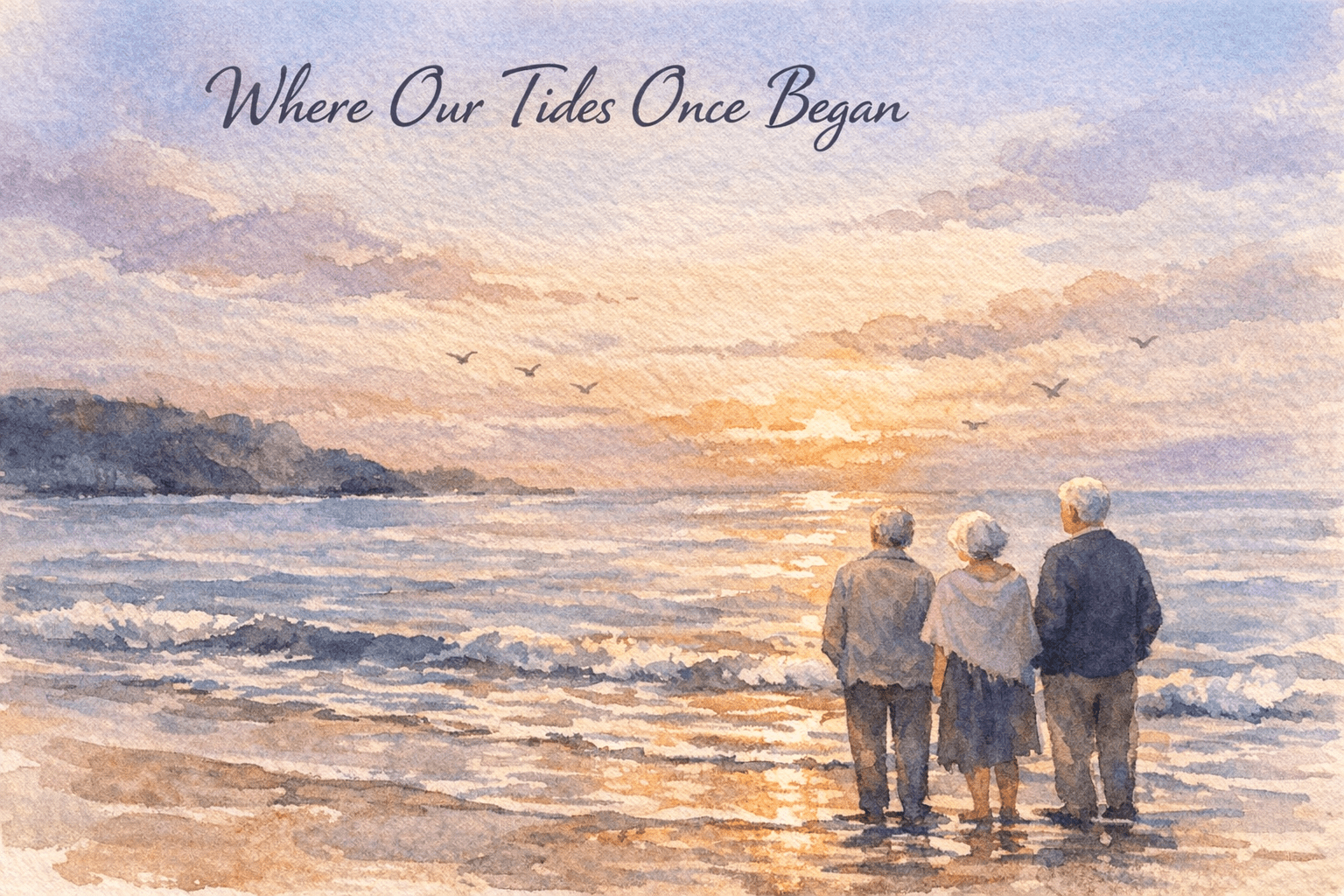
Like Woolf’s waves, we rose from the same shore, travelled in different rhythms, and broke upon different sands. For a fleeting instant, our tides might touch again — not to compete, not to compare, but simply to recognize.
And then we would return to our separate seas, perhaps a little quieter, perhaps a little more whole.
Where Our Tides Once Began