Grief arrives quietly at first, like a shift in the air, and then all at once it changes the texture of our days. In the immediate aftermath of loss, the world feels strangely suspended: familiar routines lose their meaning, and time seems to move with a weight we cannot quite name. We search for something to hold onto, some structure that can steady us when our inner world has been overturned. It is often in these moments that ritual steps forward—not as an answer, but as a way of moving through the unanswerable.
When my mother died, her funeral was conducted with Chinese Taoist rites. The ritual performers wore long ceremonial gowns and chanted to the blare of trumpets and the shimmer of small percussion instruments. Their purpose was to guide the deceased beyond the suffering of death and into a higher realm of being in her next life. During those several hours in the quiet of the night, the rawness of my sorrow settled into a stillness of mind, a sense that I was, for the final time, saying goodbye to her. Rituals like these give form to emotions that would otherwise feel chaotic. They create a solemn space in which private sorrow becomes part of a shared act of remembrance, allowing grief to settle into something we can begin to carry.
Yet the power of ritual does not depend on believing in its cosmology. Even for those who no longer hold such metaphysical views, ritual still performs an essential task. It prepares the living for the next stage of their own life. It soothes the conscience: it reassures us that we have honoured the person properly, that nothing essential has been left undone. The ritual is not a conclusion to the relationship, but it offers a kind of conclusion to our sorrow, allowing us to continue living. Across cultures and faiths, mourning rites are never only about wishing the dead well in a metaphysical sense. They also exist to guide the living back into the flow of life without feeling that they are abandoning the person they loved.
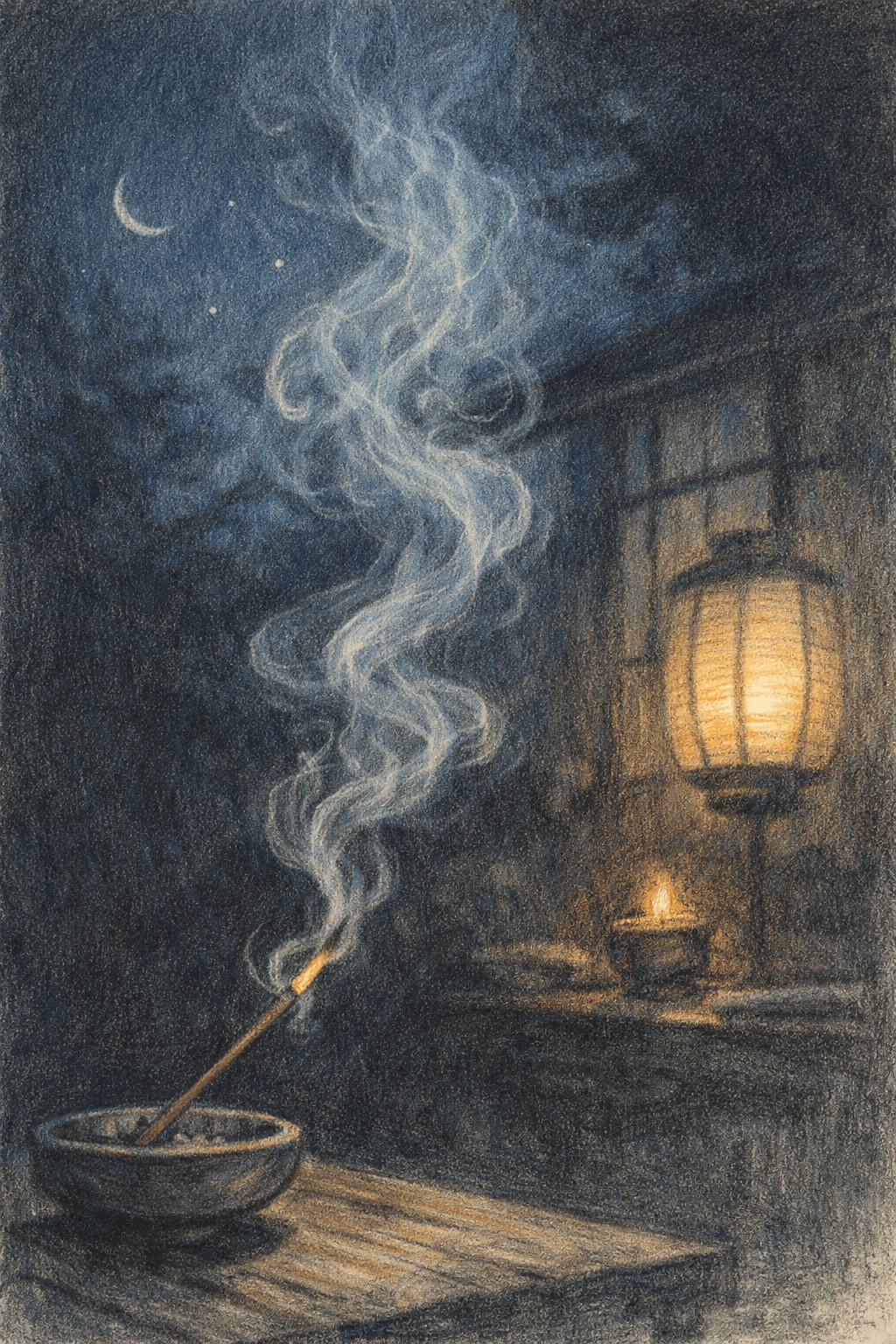
This is why people often say that ritual “slows down time.” They do not mean that the hours literally stretch. My mother’s funeral lasted several hours, and I felt those hours exactly as they were. The slowing is not in the clock but in the mind. Ritual suspends the forward rush of daily life and holds us in a moment where nothing else is supposed to happen. Our attention narrows to the chanting, the incense, the solemnity of the space. The future falls away. Time becomes denser, more deliberate. It is not longer, but deeper.
Within this deepened time, another dimension of grief becomes perceptible: its cadence. There is a rhythm to grief that reveals itself only when we allow time to slow. At first the beat is heavy, irregular, almost unbearable. But as days pass, the cadence changes; sorrow loses its sharpness and becomes something more contemplative. Ritual helps us hear this rhythm. In the solemn choreography of the funeral, the chanting and gestures create a tempo that steadies the mind and gives shape to emotions that would otherwise overwhelm us. Through this cadence, grief becomes not only an expression of loss but a quiet inquiry into what it means to continue living.
As this rhythm unfolds, we begin to recognise that grief is not a single emotion but a shifting landscape. It moves through many shades: sorrow, guilt, fear, anger, longing. Its complexity resists simple narration. When we are in the midst of grief, we inevitably find ourselves reflecting on larger questions about our own life. In this sense, grief resembles a tragedy: for all its heaviness, it contains a process of catharsis, a slow purification of the self. As time passes, our sorrow becomes less raw, and our thoughts begin to transcend the immediate pain of personal loss. Grief then leads us toward broader reflections on the human condition.
In time, what remains is not the sharpness of loss but the quiet presence of memory. Grief does not disappear; it changes its shape. It becomes a companion that walks beside us rather than a weight that presses upon us. The rituals that once held our sorrow begin to fade into the background, but their work continues in subtler ways. They have given us a way to carry the dead forward without being held back by the pain of their absence.
We learn, slowly, that remembering is not the same as clinging, and continuing to live is not the same as leaving someone behind. The people we have lost remain with us in gestures, in habits, in the small instincts of daily life. They surface in moments of stillness, in unexpected recollections, in dreams, in the quiet knowledge that our lives have been shaped by theirs. This is the companionship that follows grief—not loud, not dramatic, but steady and enduring.
And so the cadence of mourning softens into something more spacious. We begin to move through the world again, not because the sorrow has vanished, but because it has settled into a place where it can live alongside everything else. In this way, grief becomes a form of love that has learned to breathe. It reminds us that to continue living is not a betrayal, but a way of honouring the life that touched ours so deeply.

