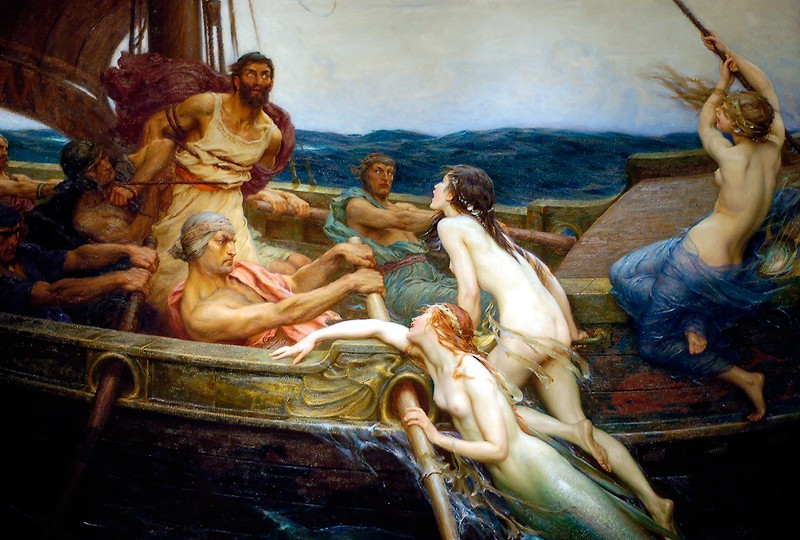
(This is a classic, evocative painting depicting Odysseus tied to the mast as he listens to the Sirens, capturing the exact tension between heroic vulnerability, temptation, and the power of the female figures who shaped his journey.)
“The epic 2,800-year-old poem – now adapted for the big screen – is so much more than a straightforward tale of heroism. The protagonist Odysseus is a heroic male – but the story is shaped by the stratagems, subterfuge and seductions of the women, nymphs, sorceresses and goddesses he meets along the way. It’s what makes him seem so human.”
This headline from a recent BBC article cuts straight to the heart of why Homer’s The Odyssey has survived for nearly three millennia. When we think of ancient Greek epics, the mind naturally drifts to classic Bronze Age masculinity: muscles, bronze armor, and swordplay. We picture a solitary king battling monsters to find his way home. But reducing this masterpiece to a straightforward tale of masculine heroism completely misses the point. Odysseus is certainly the protagonist, but he is rarely the sole director of his own fate. Instead, his entire ten-year journey is anchored, disrupted, and ultimately saved by an intricate network of women, goddesses, and sorceresses.
Without them, Odysseus would not be a legend; he would just be another forgotten casualty of the Mediterranean.
Divine Strategy and Mortal Subterfuge
From the very opening lines of the epic, Odysseus is a passive player. He is trapped on an island, weeping for home. The engine that jumpstarts the plot is not his own might, but the divine political maneuvering of Athena, the goddess of wisdom. Acting as the ultimate strategist, Athena lobbies Zeus, guides Odysseus’s son Telemachus, and repeatedly blankets Odysseus in cloaks of mist or transforms his appearance to ensure his survival.
Meanwhile, back in Ithaca, the kingdom is held together not by a standing army, but by the intellectual warfare of Penelope. Surrounded by hostile suitors vying for her throne, she orchestrates one of the most famous acts of subterfuge in literary history: promising to remarry only when she finishes weaving a burial shroud, while secretly unraveling her work every night under the cover of darkness. Her psychological stamina matches—and perhaps surpasses—her husband’s.
On the wine-dark sea, the women Odysseus encounters serve as structural gatekeepers. They are the ones who possess the knowledge he lacks, forcing him to adapt from a brash warrior into a calculating survivor. The formidable sorceress Circe turns his men into swine, forcing Odysseus to learn humility and diplomacy. Once outwitted, she becomes his indispensable guide, providing the precise navigation instructions required to survive the perils ahead.
Later, he must survive the Sirens, creatures whose deadly, seductive songs threaten to lure sailors to their deaths. Odysseus only survives their psychological trap by submitting to a strategy—having his crew tie him to the mast while they plug their ears with beeswax. Finally, Calypso detains him for seven years on her paradise island, highlighting his utter vulnerability. He cannot fight his way off her island with a sword; he is entirely at the mercy of divine intervention to secure his release.
Redefining Ancient Heroism
In the tradition of ancient epic poetry, heroism is typically cast in a rigid mold. In The Iliad, true heroes are defined by overwhelming physical might, unyielding pride (hubris), and a glorious, tragic death on the battlefield. Think of Achilles or Hector—warriors who would rather die young in a blaze of fury than compromise their honour.
Odysseus, however, breaks this mold entirely. He is not a towering titan of brute force; instead, he succeeds through a kind of calculated meekness, choosing patience over pride. He survives not by overpowering his enemies, but by outwitting them—relying on his metis (cunning intelligence) to navigate dangers that a sword cannot fix. Furthermore, unlike the fiercely independent warriors of Troy, Odysseus is humble enough to recognize his own limitations. He openly relies on the strategic counsel, magical interventions, and intellectual partnerships of the women and deities he meets. By trading rigid machismo for adaptability and collaboration, Odysseus redefines what it means to be a hero, offering a blueprint for survival that feels profoundly human.
In this regard, part of the true tour de force of Homer’s epic lies in the pivotal, dual role these women play. They do not fit into neat Hollywood boxes of “good guys” or “bad guys.” Instead, they are a double-edged sword: they are the very forces that put him in harm’s way, challenging his ego and tempting him to stray, yet they are also the only ones capable of paving his road home.
Why the Myth Endures Today
The reason this nearly three-thousand-year-old masterpiece continues to resonate so deeply today is that it refuses to merely delineate a tribal hero fighting with brute force to protect his clan. Homer sheds the rigid, mythical armor of the traditional warrior, choosing instead to delve into the raw psychological nuances of trauma, resilience, and the universal yearning for “home”—a destination that is always wrought with peril.
Odysseus’s voyage is far more than a physical, geographical crossing; it is the spiritual pilgrimage of a war-wearied soul desperate to reintegrate into civilized society. The trials he faces—profound personal loss, the erosion of identity, seductive temptations, and crushing isolation—are not ancient relics, but experiences deeply embedded in our own modern psyche.
In this way, The Odyssey proves that ancient myths are not dusty fables, but living embodiments of the human condition. Unlike the demigod Achilles, who exists in the untouchable realm of legend, Odysseus exists as a true human being, defined as much by his vulnerabilities and frailties as he is by his strengths.
The Challenge for Modern Cinema
It will be fascinating to see how the upcoming cinematic adaptation of this epic reflects this true spirit. If the film falls back on the formulaic Hollywood action template—focusing on a macho hero who demonstrates his worth solely by wielding a sword—it will disappointingly bypass a protagonist whose real triumph is intellectual.
By sidelining or minimizing the intricate network of female stratagems, a film would inevitably flatten Odysseus into a shallow, generic action figure, reborn as a hero of a completely different, and far less interesting, kind. To do justice to The Odyssey, modern filmmakers must understand that Odysseus’s greatest weapon was never his sword—it was his ability to listen, adapt, and learn from the extraordinary women who shaped his destiny.

