A short story
I
It was in one of those days when, in his dreams, Benny came home and Jimmy, his elder brother, was standing at the doorway and opened the gate for him. The amber light drew him in, its glow falling across an array of familiar things — objects all jumbled together blurred at the edges, refusing to be named one by one. Jimmy rested his hand lightly on Benny’s shoulder. And then, in that strange, fluid way dreams have, Jimmy began to shift — becoming their mother, then their father, then all of them at once, as if the years had folded and the four of them were gathered again in some lost corner of yesteryear. For a moment, it felt whole — impossibly whole — as though time had loosened its grip and allowed them one more meeting. But then he woke in another place, the dream fading like mist. Still, in its afterglow, Jimmy remained in his mind: quiet, unwavering, like the keeper of a lighthouse — the one who stays, who watches, who remembers.
Dreams continue into reality.
II
Benny had spent the better part of his life away from this old home for work, with only brief returns now and then. His absences were long enough that, each time he came back, he could feel what time had altered—how it had both accumulated and erased, layering new traces while the old ones quietly slipped away. The flat had grown old in this way, shaped as much by what was added as by what had been lost.
When he opened the door, the old smell rushed out to meet him.
It was thick and familiar — the stale air of a space long inhabited, of furniture that had absorbed more than half a century of use. The scent rose from the wooden cabinets, from the bookshelves, from the curtains that had hung there year after year. The musty scent evoked a past that he had special memories of. For a moment, the vibe of it almost overwhelmed him. Not the smell alone, but what came with it — habit, memory, the pull of family life accumulated over the years.
He would in those moments find himself revisiting all his memories as they flashed like a rapid montage. It was then that he began to understand how much the flat meant to Jimmy.
Jimmy had bought it with the modest salaries from his first job. As a fresh graduate having just started to work in 1967, he was proud to be earning his own living. It was not just his first piece of property; it was, more importantly, proof that he had made a beginning. Not only for his own, but for his family too, it meant a seminal change – a family which, thanks to the prevailing poverty of that era aggravated by personal missteps, had long struggled to make ends meet. The flat turned the tide. Over the years, it became, in a real sense, a home to anchor his family.
In the course of such a long time, the flat looked more or less unchanged. Things stayed exactly as they were, frozen in a quiet defiance of the passing years. The clock above the door still ticked with the same mechanical stubbornness, its faded face a constant fixture. Along the walls, old books lined the shelves in sagging, familiar rows—forgotten school texts, paperbacks with creased spines and yellowed pages that smelled of dust, and stack upon stack of notebooks filled with Jimmy’s early writing, the ink fading but the aspirations and feelings still palpable on the page. Jimmy never saw much reason to throw them away. To discard them felt too much like purging the space of much of his personal and family history. So they remained, anchoring the flat to a past neither of them could quite outrun.
The old worn desk was still there against the wall. It was heavy and nicked along the edges. His father would sit there in the evenings, writing his diaries in a neat, elegant Chinese hand. At that same desk he worked for a living by marking for other teachers their student assignments — a somewhat strange and piecemeal job he took to earn small wages to sustain the entire family. With a university education from China, and had he had a bit of drive, he might have found something more fitting. But that was not how things turned out to be. Benny still had recollections of how the amber glow of the wall lamp cast his father into a slight, shrunken figure writing at the desk well into small hours.
From the way Jimmy preserved these things, it was clear to Benny that his attachment ran deep. Jimmy was not a man who spoke much. But beneath that taciturnity lay something steady and enduring. His loyalty did not show itself in words; it showed itself in what he refused to discard. The flat, with all its old things, was his way of holding on.
And perhaps that is where the brothers differed.
One keeps.
One considers leaving.
III
Today, Benny was back again to pack a few things. This time, he found himself in a different situation than before. The building was wrapped in green- meshed scaffolding for big scale renovation with fine dust hanging in the winter air. It was the end of 2025, and he was to move into a long‑stay hotel while the work dragged on, rendering his flat unliveable. Though it was meant to be a temporary measure, part of him wondered whether he might want to return at all. Serviced apartments had begun to feel easier, lighter, less burdened by history. But the flat remained — because Jimmy kept it. And Benny knew his brother always would.
And Benny learnt to appreciate why his brother did what he did. Decades of memories, emotions and a loyalty to the family that had taken shape within its walls for more than fifty years. That kind of gravity of a lifetime does not loosen its grip easily.
But more importantly now, his brother kept it for his sake.
He stepped inside. The flat had been newly refurbished, pared down to a minimalist quiet. It was bare now, the old things gone, the space open in a way he had not seen for decades. December light filled the emptiness. And suddenly he felt a faint sense of déjà vu, recalling the moment he first walked in as a ten‑year‑old. The same brightness, the same clean emptiness, the same smell of fresh paint, the same unguarded sense of beginning. It was not just memory but sensation, returning to him from that distant year of 1968.
He stepped up to the windows and looked outside, lost in thoughts.
Between these two Decembers lay everything that came and went.
Beyond the glass, the distant rolling hills had once risen clearly against the sky. At their foot stood a few wooden huts. As a child, he would stand at this very window watching how the pigeons from the corrugated rooftops lift suddenly into the air, circling in soft grey spirals before settling back into their cages, only to take flight again. Those small moments , those quiet afternoons, seemed to drift back to him now, touched with the faint warmth of an era long gone.
The hills embraced a small bay. There was a pier. White ferries would ply against the shifting blues between the two sides of the harbour. His brother would take them every day to commute between the school where he taught and home. One afternoon, their mother stood at the kitchen window and suddenly shouted, “Look — there’s Jimmy, just getting off the ferry!”
Such a 20/20 vison she had then ! She could pick him out from that distance, amongst the small crowd of passengers. Benny got to her side and squinted, trying to follow her pointing finger. And she was right! Years later though, diabetes would come to her. Then cataracts. The acuity with which she once saw the world slowly clouded over. The same windows through which she had once identified her son from afar blurred into indistinct light. In time, she would lose even her remaining vision.
Between the two Decembers — the bright one in 1968 and this bright one now — the old world outside was no more. Land was reshaped. The hills disappeared behind the rising skylines. The windows, as if letting the outside world look in, had watched the passing of their father and mother. The space held their voices, their frailty, their illnesses, their final absences . With that, a generation parted. Jimmy had by now his own family elsewhere. As for Benny, work life began. Apart from his short returns, and Jimmy popping over now and then to tend to the place, it had mostly stood empty for years.
And yet this flat, despite its peeling paint and lingering staleness, stayed on as it had always been. In its quiet way, it was the constant against the vagaries of time— against the reclaimed water and vanished hills, against youth and aging, against the comings and goings of everything in between. The windows had framed it all, both the world outside and the quiet drama unfolding inside.
IV
While Benny was musing all this, a faint metallic groan echoed from the corridor — the lift sliding open. Footsteps approached, soft, slow and familiar. Jimmy used to walk quickly. In their younger days, Benny often struggled to keep pace with him and he was quite irritated that he walked well ahead of him and never seemed bothered to pause and wait. Now though, his eighty-year-old body no more allowed such easy strides.
Benny’s long lost sensation was disrupted by these footsteps. In such stillness, they sounded with a strange clarity. Of course he saw his brother’s slight shuffling at other times; but here and now, he actually heard the movement as the steps fell slowly into the hush of the December afternoon. What would it be like, he pondered, if they had not seen each other for years — the shock might be that of a school reunion after half a century, where everyone has turned grey beyond recognition, and some no longer make it back at all. But for him, their meetings had been regular and frequent enough to have spared him this poignant jolt of awareness . Yet now, the childhood sensation — that strange conflation of then and now — that was flushing over him had never felt more at odds with what he was hearing in this moment, and the sound reminded him how time had been creeping up on them with a kind of stealth he had never quite appreciated before. And the thought made him sad.
A key turned in the lock. “Ah, you’re here already.” Jimmy said, stepping inside.
“well, just been for a while,” Benny said.
Jimmy wasn’t quite himself about the decluttered space. It had taken so much convincing to make him agree to get rid of them — decades of objects, each holding a private resonance. Now, in the renovated emptiness, he stood still for a long moment, as if the space had slipped out from under him. Though the flat was small, the absence of familiar shapes left him oddly unmoored, like someone standing on a plain without landmarks. He looked around slowly, almost tracing the air, trying to remember where everything had once been: the wardrobe that had stood there since they first moved in, the bed their mother had slept on, the quiet accumulation of years that had given him a sense of bearing. With almost everything gone, the room felt too open, too bright, and he seemed to lose his position inside it. Later, when asked whether the clearing felt like a loss, he shrugged, “Well, the world has to move on, doesn’t it?” But the words were thinner than the feeling behind them. His wife and Benny had argued hard for the decluttering, and he had agreed, but not without reluctance, not without a small wound. The sense of a renewal was real, but for him it carried a quiet depletion, the sense of someone who had lived with those stuff not as clutter but as companions. Their absence left a faint ache, a hollowing he didn’t know how to name.
They sat at the small dining table. Jimmy poured tea from a tea pot — into two small cups. The steam curled upward in soft spirals. After a moment, Jimmy looked around the room again, his gaze softening. “This place… it was the first thing I’d ever bought with my own salary. My first job. My first step into the world. Everything began here — Mother, Father, you, all of us living together. That’s why it matters to me.” He said with little inflection of tone. He turned to Benny. “How do you feel about it?”
Benny took a moment before answering slowly. “It wasn’t a simple one. I have a lot of memories here,” he continued, “Good ones. Difficult ones. They’re all woven into this place.”
Jimmy nodded, waiting — not pressing, just holding the space open.
“But,” Benny took care not to stress the word, lest that would make his brother feel distraught, “I also feel… caught sometimes. As if the flat remembers too much. As if I’ve stayed inside the past longer than I meant to.”
Jimmy’s expression softened, but he didn’t interrupt. “It’s not that I don’t value what this flat holds,” Benny said. “I do. Truly. But part of me wants to step outside it. To breathe a little differently.” A small silence ensued between them — thoughtful, not tense. Jimmy folded his hands around his cup. “I understand,” he said quietly. “A place can hold you. In good ways. And in other ways.” Benny looked at him. “Your feelings about this flat… they’re clear. Mine are mixed.”
“Mixed is still honest,” Jimmy said, with a faint smile. “Life is mixed.” Benny felt something loosen inside him — a knot he had carried for years.
“And whatever you decide,” Jimmy added, “this flat will stay. Not to trap you. Just be here if you ever need it.”
Benny lowered his gaze. “Thank you,” he said. “That means more than I can say”
Jimmy opened the window wider and looked out. He turned back to his brother and said softly, “If only we were able to summon those past views again.”
“No chance, Jimmy. We can’t pull off any abracadabra.” Jimmy fell silent again. He had never been one for words, not when it comes to feelings. And Benny wondered now whether silence had become the truer language between them when they found themselves facing something so deep in their psyche, so abstract to say: the mutable— it is what our language strains to hold.
Perhaps, then, Jimmy’s quiet is enough. A kind of dirge. A resignation to what has been, and to what will, in time, come for them both.
After an hour, Jimmy left. Once again, Benny heard the careful tread of age fading down the corridor. He stood there for a while, wondering what any of it meant—this business of homecoming. It is bound up with leaving, tender and solemn, each made more poignant by the other. They form, in their quiet way, their emotional arc. Home is where memory finds its anchor; it is also where they set out from, again and again. And while the flat endures the slow flux of time, a home does not quite do the same. It feels almost like assuming a consciousness of its own, shaped by those who have lived in it. It opens itself to them, gathers what it can of their lives , and ages the way they do — as the footsteps now speak for themselves.
The silence after Jimmy left did not settle; it pressed in. The flat, bright and emptied, felt almost too open, as if the clearing had exposed something raw rather than renewed. His brother’s slow steps fading down the corridor carried a weight he couldn’t shake — a reminder of how time had thinned them both, how the past was no longer something they could simply revisit but something slipping further away each year. Standing there, he felt a sudden, almost urgent pull toward what remained of their origins. The flat had been stripped of its old anchors; the people who once filled it were gone; and the brightness only sharpened the sense of absence. It was impossible not to think of their parents — not as memory, but as a presence waiting elsewhere. The emptiness of the home made it feel inevitable, almost demanded: to go to the place where the past still had a name, a location, a stone to touch.
V
It was on 7 January 2026 that they visited their parents’ niches to mark the anniversary of their mother’s death. When she passed in 2012, she was cremated at Cape Collinson. A year later, the remains of their father who had died 33 years before were exhumed, cremated, and reinterred beside hers. Since then, the brothers had visited the columbarium four times a year —twice on the death anniversaries, and the other on the customary festivals of remembrance.
They took the MTR and got off three stations later. Once they exited the station, the familiar path began almost at once: a long flight of steps threading through a small park built along the hillside. The park was quiet in January, the trees bare, the air thin and cool. As he and his brother started up the steps, Benny felt again the way the climb always lent their visit a sense of solemnity. It wasn’t a difficult ascent, not really, but it carried a weight of its own. Year after year, the same steps, the same incline, the same slow rise away from the city.
It was just an ordinary ascent — no more than a few flights of steps –and it wasn’t grand enough to open in him any feeling of ascension. But this small incline that marked the transition from the din of the world to a serene realm above gave their expedition a quiet air of holiness, as if the walk were a pilgrimage to something larger than their family obligation. It was the place where their parents rested, but also, in his vision of life mellowed by his age, a place where all earthly plots of human stories found their denouement, sad or otherwise. The hillside path seemed to gather these thoughts as they walked, each step carrying them a little further from the ordinary and a little closer to the truth that every life, no matter how tangled, must end somewhere.Even after all these years, the walk still felt sacred. Skipping it would have made the ritual feel incomplete, like a story itself would be left without its final line. The trek was part of the meaning — a movement from the living world into the quiet chamber where memory settles, where the past waits to be acknowledged before the living can return to their own life – or rather the remainder of their own life.
The fifteen‑minute walk in the cool January afternoon passed without much talk between them. They reached the upper level and stepped into the rows of niches. The place was tidy, orderly in its calm. They walked past banks of flowers — mostly plastic ones — arranged in a mosaic of colours. The air was still. The well-paved columbarium had a serenity and tidiness that stood in contrast to the old hillside graveyards where their father used to be buried, where many graves had long been left to the wild grass and creeping vines. Here Everything was kept in its place.
They moved slowly along the rows until they reached their parents’ niches. Their plaques were placed alongside each other. The brothers stood there for a moment. The niches were about one row above their heads and at that height, it was the best possible position. They were not so high that they needed a ladder or a pole – which would have made the cleaning awkward – yet high enough to feel right. As Jimmy once told him, “They’re high enough for us to look up to them, as it were, when we talk to them. If they were in the lower rows, gosh! We’d have to talk down to them. I’d feel jolly bad about it!” He actually meant it. The height mattered to him in a way that revealed something quiet and tender: a small gesture of respect that made the act of remembrance feel properly aligned even though after so many years, the ritual might have slipped into a half-measure for others. For him, it had not.
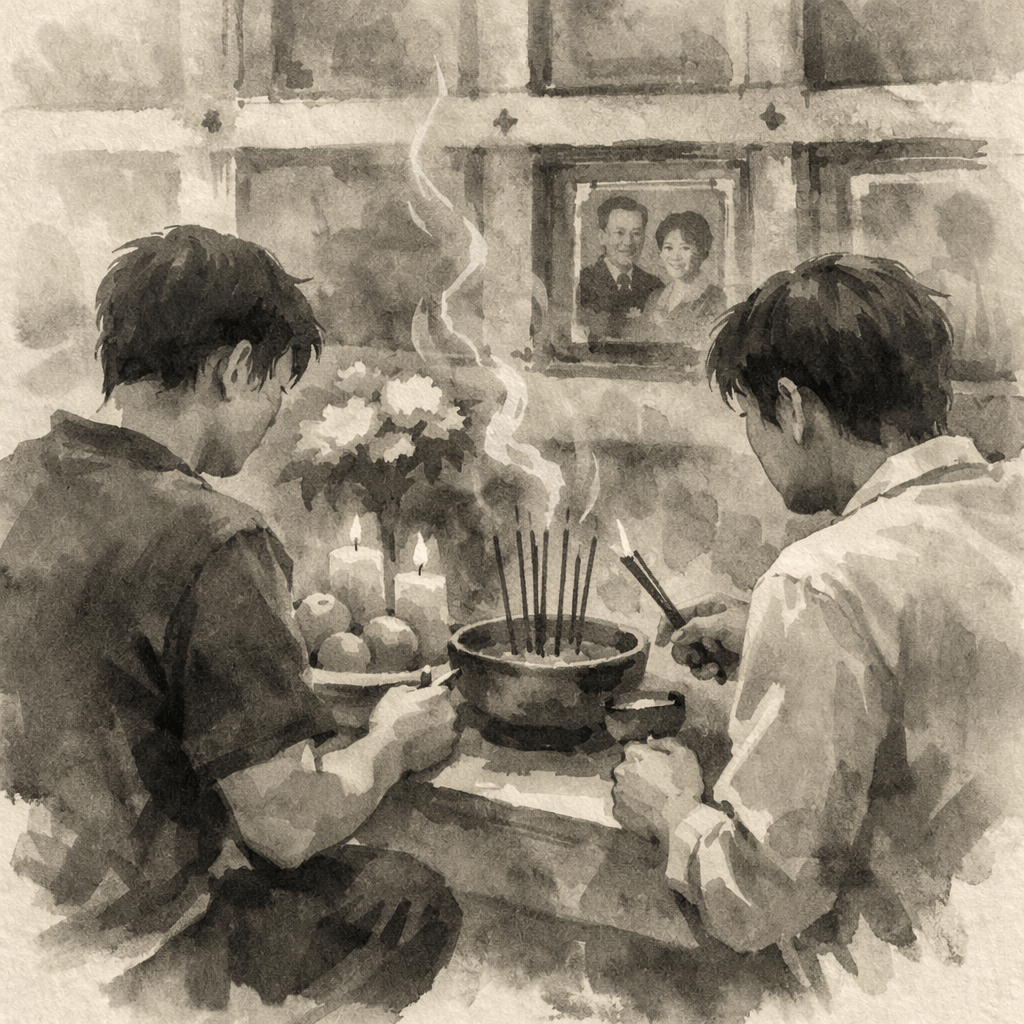
Two photographs were inscribed on the stone. Their mother’s showed her in her final years: hair gone entirely silver, golden‑rimmed spectacles, and an expression of calm, composed grace — the look of an old lady who had settled gently into age. The picture had been taken at the care home, shortly before she died. A group of voluntary workers had gathered around her for a snapshot; she sat in front of her walker, smiling faintly. Later, the photo was edited to zoom in on her while the other people were removed, leaving behind a striking portrait that the funeral home used. It was a small mercy, he felt — a final image that captured her dignity and grace without the clutter of circumstance.
Their father’s was different. It featured a young face in his early thirties with a full head of dark hair. There had been no recent photograph taken of him around his death at about sixty, and so this was the only one they had to use. Placed next to each other, the two images did not look like a couple from the same moment in life. The contrast was sharp: one elderly, one youthful. Seeing them together always created a slight sense of dislocation, making it hard to believe they were a couple. But it was such long time ago now , he thought. Time can dismiss everything.
Jimmy set down his tote bag, took out two small cups and a bottle of wine, and poured a little wine into them. The brothers took turns to bow to their parents and stood there for a moment, letting the quiet settle around them. The ritual was simple. It didn’t need many words. The climb, the flowers, the stillness, the libation — these were enough. “Father’s been gone forty‑seven years now,” Jimmy said. “Mother… fourteen.”
“You remember all this so well,” Benny said.
“Well, when you don’t have many milestones of your own,” Jimmy replied, in a self-deprecating fashion that’s typical of him, “the few ones you do have stay with you.”
“I sometimes wonder where they are now,” Benny said. “Maybe they’ve already been reborn.”
“Maybe,” Jimmy said. “But I think they’ve moved on to another place entirely. Another star, perhaps.”
“You really believe that?” Benny looked at him askance.
“Why not? I read something once — it said that when a soul leaves the body, it departs for its next life somewhere else in the universe.”
“So Father has been living somewhere out there for almost fifty years now?”
‘Yes.’ Jimmy sounded almost certain. ‘ And mother may be a girl of fourteen now burgeoning into her maidenhead. And they don’t remember their past lives. Anything about us. And that’s good for them. Forgetting is how you avoid the same woes. If you live a new life, you’d better be oblivious to your previous existence’.
“I didn’t realize you’re becoming more metaphysical about life,” Benny said, with a hint of disbelief.
“I’m not sure, Benny” Jimmy whispered. “I just feel our lives should have a niche beyond this lifetime. Maybe it’s only a wish — a mere hope that something continues. You know I’m not the philosophical type.”
Benny looked at his brother for a long moment, as if weighing something. “Still, it’s good to look beyond ourselves. I love philosophy, but you have the intuition to sense what’s true.” A thought surfaced — one he had never said aloud. “Sometimes,” he said quietly, “I think philosophy gets in the way. It leads you into a labyrinth of thoughts. Too many explanations. And the truth… the real truth… might be simpler than all that. Something you feel before you can think it.” Jimmy didn’t speak. The silence between them sharpened — as if they had finally reached the edge of the question. “You don’t need philosophy to explore this,” Benny said at last. His voice was steady, almost serene. “Some things are clearer without it.” And he realised Jimmy’s moments when thought becomes a veil, and intuition — bare, unadorned — sees further. Jimmy, in his direct way, had always known how to step beyond the world without naming the step. Benny had always tried to reason his way through. For the first time, he saw the difference plainly:
Jimmy approached the metaphysical by letting go, and Benny by deepening his thoughts. And perhaps the truth lay somewhere between — a place where thought softens into intuition, and intuition sharpens into awakening.
Halfway down the steps on their journey back, Jimmy said, almost casually, “I’m just mediocre.”
Benny glanced at him. “I don’t think you’re doing yourself enough justice. You deserve a better adjective for yourself ”
“Well, I’ve never done anything remarkable.”
They walked on. A breeze moved through the trees.
“You’ve lived your life responsibly, Jimmy, and that’s what a full and meaningful life ought to be.” Benny assured him. “That ain’t something you just dismiss as ordinary.”
Jimmy didn’t respond, but he slowed down, holding the rail.
“You’ve taken care of what needed taking care of,” Benny continued, gently. “Work. Family. Your daughter. You’ve done all of it without making noise about it.
“That’s just life,” Jimmy said.
“Exactly. And you’ve lived it well. People equate a good life with glam and wealth. I find it ludicrous.”
They reached a landing where the hillside opened to the city below — small, distant, full of its own restless movements.
“I suppose… doing things properly is enough,” Jimmy said.
“It is,” his brother replied. “More than enough.”
VI
That night, Benny sat in his serviced apartment by the window, watching the lights flicker across Castle Peak Bay. They were not the same lights that had once pulled at him from that sheltered corner of the small bay stretching in front of his flat, back in 1968. He felt free now — and yet there was something unsettling in that freedom, a sense of being unmoored. He thought of the quiet vows, the burdens carried alone. He thought of the columbarium — the plaques, the flowers, the slow pouring of wine. He thought of Jimmy calling himself mediocre, and of the truth he now understood: that some lives do not blaze, but endure. He stayed by the window until the last of the light slipped away. Somewhere beyond the city’s glow, the stars were beginning to appear — faint, scattered, indifferent — yet he found himself thinking of them differently now, as if each one might hold a life once known, a life begun again. In the soft dark, he felt the presence of Jimmy — not beside him, but woven through the years they had shared, holding the family’s memory the way a keeper tends a flame, steady through the years, through loss, through the slow erosion of time.
He let the thought rest there, unforced, and allowed the night to gather around him, soft and complete.

