“The summer is over… The autumn has begun; the leaves are falling, and the air is cold.”— The Diary of Virginia Woolf, Volume 1: 1915-1919
“Autumn is my season, dear. It is, after all, the season of the soul; and all my thoughts fly to you.”— The Letters of Virginia Woolf, Volume 1
Now, in September, the sprawling, exuberant energy of summer begins its gentle transformation. It quiets down, folding itself into a resonant silence—a silence heavy with richness. This richness manifests itself as a vivid tapestry of colour, where the bravado of summer gives way to the saturation of early autumn tones. Everything seems distilled, concentrated into a kind of hushed thoughtfulness, a stillness so profound and complete it feels as though nature is holding its breath. The earth, dressed in its warmest hues—amber, gold, russet—invites both observation and introspection. It is exactly this moment of fullness, of ripeness in September, that Virginia Woolf experienced while living in her Sussex cottage, a retreat she cherished deeply.
From her window, or perhaps as she stepped into her garden with its clinging scents of dew and late-blooming flowers, Woolf would have watched how early autumn subtly painted itself across the landscape. For her, as for the Romantic poet John Keats, September was not a time of decline or decay—it did not forewarn of death. It was, instead, a season of saturation, a season where nature reached its fullest expression, offering an overflowing harvest both without and within. The rich amber glow of the fields, the slow parting of leaves from their branches, the gilding of the green landscape into honeyed tones—all of this was not an ending, but a transformation. To Woolf, it was a perfection so profound that it required a kind of surrender, the abandonment of the rational, controlling mind, a plunge into pure sensory and creative experience.
This transition that others might mistake for disintegration or the waning of life, Woolf understood as a deepening, a quiet culmination. It was a season yielding not only external fruitfulness but also the ripeness of the mind, a time of intellectual harvest. September was her season of saturation and reflection, when the vibrant pursuits of summer—the entertaining of friends, the whirl of social commitments—gave way to solitude. And within that stillness, her thoughts, long ripening, began to blossom into the works we now revere.
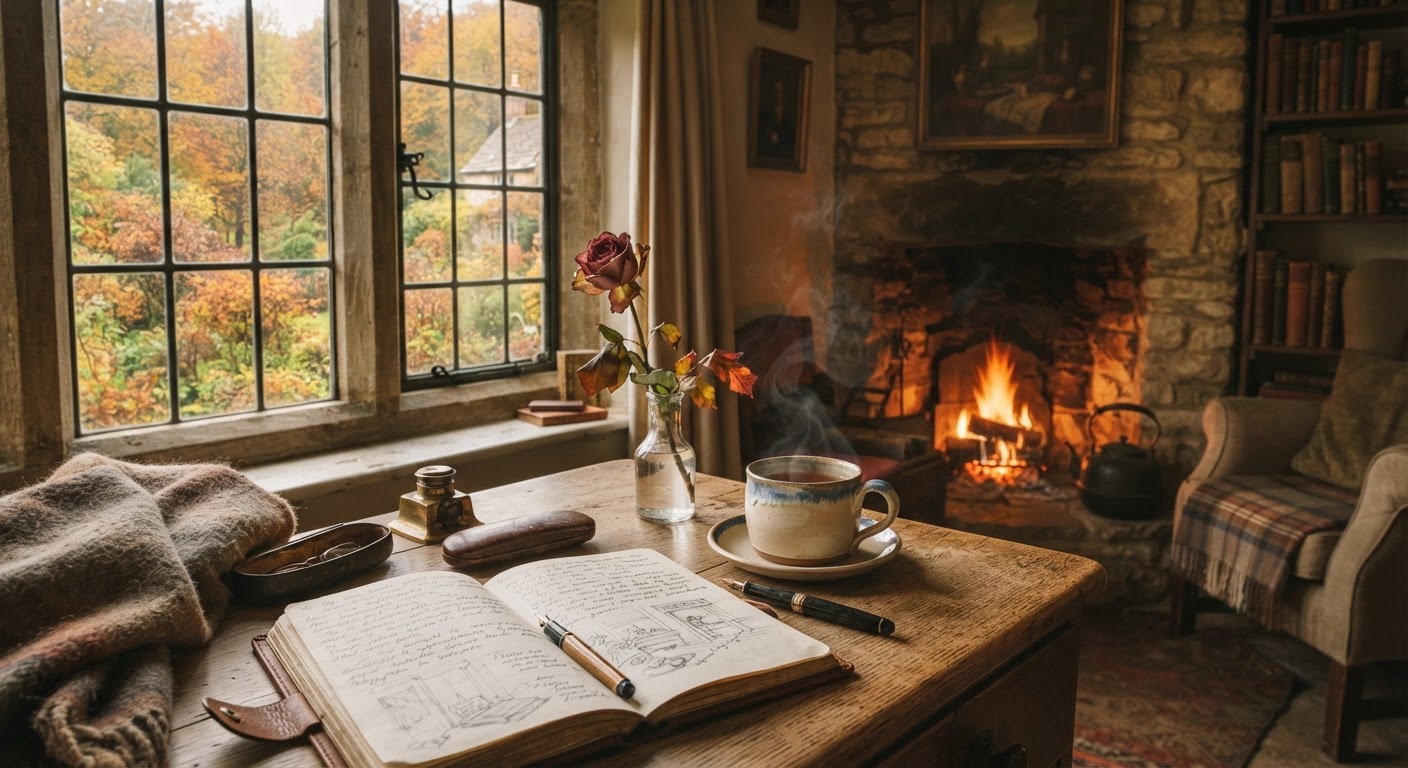
As the daylight hours grew shorter and dusk set in earlier, I imagine Woolf retreating to the sanctuary of her writing room, where she would kindle a fire in the hearth. It wasn’t the chill in the air alone that beckoned her indoors, but the magnetic pull of this place made warm and intimate by the glow of the fire. Here, Woolf would brew both tea and thought. She would write and dream, turning ideas over in her mind, warming them over the steady flames until they were ready to take shape. The room was no mere shelter from autumn’s crisp evenings; it was, for Woolf, a crucible—a space where her creativity, like the embers in the hearth, would ignite and flare into brilliance.
For Woolf, the hearth was not an accessory to the season but its beating heart. Where summer had been full of laughter, outdoor excursions, and companionship, September returned her to the fire. It was here that she underwent some of her most intense periods of writing. The fire did more than warm her body; it became a metaphor for the creative process itself. She stoked the flames of the grate just as she stoked the flames of her imagination. In the slower, quieter heat of autumn, far removed from the blistering passion of summer, her ideas were no longer hurried or scattered. Instead, they were simmering, stewing slowly into something new, something whole.
John Keats saw autumn as a tactile season—a time of fruitfulness and ripeness, where the air is filled with the scent of orchards and the skies are laden with the setting sun. Woolf, too, admired the season’s external abundance, but for her, the fruitfulness was as much internal as external. Autumn drew her to the hearth, to the quiet inner sanctum where writers like herself could distill the season’s richness into words. The hearth, in this sense, became a site of alchemy, a space where wood and fire, thought and remembrance, and time, all coalesced to produce something greater—a harvest not of apples or grain, but of ideas and inspiration.
In her diaries, Woolf often wrote of how her mind settled under the spell of autumn’s quietude. She recalled how, after the frenetic, explosive energy of summer, she welcomed the stillness that came with September evenings. She would sit by the fire, watching the sparks fly, and feel her thoughts align themselves with the season’s natural rhythm. Where summer demanded outward action, autumn called her inward, to a state of calm where thoughts could ripen and bloom. The lyrical tranquility of these moments would, in time, underpin her novels, infusing them with that serene yet introspective quality that makes her writing timeless.
The act of returning to the hearth was, for Woolf, deeply symbolic. It marked her transition back to herself, to the core of her creative being. As she tended the fire, feeding it with kindling and logs, she mirrored the process of nurturing her own ideas, carefully stoking them until they too ignited. The slow, consistent heat of the hearth—a far cry from the blazing intensity of the summer sun—suited the mellow brilliance of her September mind. It was a stewing process, a melting down of thoughts into something luminous and refined, as if the flames themselves were weaving her reflections into the fabric of her prose.
For Woolf, the hearth was more than just a source of warmth—it was the cauldron in which her ideas took shape. Autumn fire became an element of transformation, where the energy of summer was distilled into pure potential. As the green of the landscape outside turned into luminous shades of crimson and amber, so too did her chaotic bursts of summer energy refine into focused streams of creativity which translated into streams of consciousness in her fiction. The hearth, with its glowing heart of flame, became the place where the alchemy of writing occurred, where ideas simmered and eventually flowered into the novels that defined her brilliance.
Thus, September brought Woolf to this sacred space where she found inspiration not in the fury of activity, but in the quiet maturing of her thoughts. The month, with all its gilded richness, was her season of ripening—a time when her mind and spirit, steeped in the mellowness of autumn’s touch, harvested the visions that would later become immortal in her work.
“The autumn leaves blew across the lawn… there was a little cold nip in the air.”— To the Lighthouse
This inner harvest—the quiet maturation of thought and creativity—forms a fundamental part of the creative principle in Virginia Woolf’s fiction. The unbounded passion and energetic force of summer stand in stark contrast to the reflective depth of early autumn, and together, these phases become essential to the rhythm of her narrative structures. Particularly in To the Lighthouse, Woolf captures this seasonal progression with remarkable precision, intertwining the external transitions of nature with the interior lives and artistic journeys of her characters.
The summer phase in To the Lighthouse is imbued with vibrant action, symbolizing the boundless energy and activity that Woolf associates with the season. These activities, particularly in the first section of the novel, revolve around the preparations and social gatherings orchestrated by Mrs. Ramsay. It is late summer when we see her at the height of her influence, planning the trip to the lighthouse for her family and her guests, and bringing everyone together for a dinner imbued with ritual significance. There is an urgency, a hurriedness about this time—a sense of fleetingness, as though every action is tied to the glowing, ephemeral energy of summer itself.
In this first section, aptly titled “The Window,” the passage of time feels swift and overflowing, reflecting the spontaneous and unrestrained vitality of summer. Mrs. Ramsay, as the figure at the novel’s centre, is a master conductor of this seasonal orchestra. Her organizational brilliance turns the mundane into something nearly sacred. The dinner scene, for example, is more than just a gathering—it becomes a work of art. She strives to create harmony amidst the flux of life, bringing together discordant individuals and attempting, however fleetingly, to impose order on a chaotic and impermanent world. In her way, she becomes an artist of living itself, carefully curating the feast, solving dilemmas, and uniting the guests under the fragile illusion of harmony and order. Yet, as with all things in her world, this harmony does not last. The dinner ends, the guests dissolve back into themselves, and summer too fades, giving way to a seasonal and existential shift.
The artistic vision that begins to surface in summer, however, cannot be completed during this feverish season. This is particularly true for Lily Briscoe, a painter who serves as one of Woolf’s most significant vessels for exploring the creative process. Throughout the first section of the novel, Lily struggles to find completion in her work. The chaotic liveliness of summer provides the spark—the initial fire of inspiration—but this unbounded energy is too restless, too fleeting, to allow for the quiet resolution and focus her art demands. The artistic undertaking of her painting, which she begins entangled in the rush of summer’s activities, remains unfinished.
It is in early autumn, after the storms of time, that Lily’s creative vision ripens into maturity. Woolf captures this vividly: what began as an idea nurtured in the summer heat finally blossoms in autumn’s reflective silence. After the passage of ten years—years marked by death, decay, and neglect—the household once ruled by Mrs. Ramsay and her vivid summer scenes has now been overtaken by nature. The vibrant human energy of the past has been replaced by the elements, by the somber rhythm of time untethered by life. The second section of the novel, “Time Passes,” plunges the reader into the melancholy of this interlude. During this period of absence, summer’s vitality has entirely dispersed. The house has fallen into ruin. Death has claimed Mrs. Ramsay and others. The lives once intertwined within its walls have scattered across the world. The tide of time has erased much of what the late summer scenes attempted to hold onto.
Yet it is precisely this dissolution—the breaking apart of summer’s passions and the quiet passage of time—that sets the stage for Lily’s final act of creation. In the autumnal stillness of the novel’s last section, “The Lighthouse,” Lily returns to the task she could not complete before. Autumn becomes not merely a time of decay but a moment of ripening, of culmination. It is during this season of reflection and saturation that Lily is able to distill the chaos of her earlier vision into something whole, something permanent. Her painting—the physical manifestation of her creative violence—achieves its final, harmonious form, tied intimately to the maturing qualities of early autumn.
This creative resolution mirrors the Keatsian vision of the season: autumn as a space of fruitfulness and reflection, where the vivid passions of summer give way to a calm and thoughtful harvest. Woolf uses Lily’s artistic struggle to explore not simply the nature of art, but the process of creativity itself—a process that requires both the fiery spark of summer and the quieter, steadier heat of autumn. The passion and activity of late summer, the feasts and gatherings that Mrs. Ramsay orchestrates so carefully, burn brightly but are ultimately unsustainable. They do not survive the season. The guests Mrs. Ramsay brought together so artfully are eventually scattered, much like the summer leaves that must fall from the trees. But the seed of Lily’s vision, planted during these chaotic summer days, finds its time of maturity and fruition in the mellow denouement of early autumn.
For Woolf, this creative process parallels her own experiences. In summer, there is the rush of social obligations, bursts of outward energy, and fleeting moments of inspiration. But it is in the quiet of early autumn, in the sanctuary of reflection, that the true harvest of ideas occurs. The charm of autumn lies in its ability to ripen and refine, to take the raw material of summer’s passion and distill it into lasting wisdom and art. Lily’s painting is not merely a culmination of her thoughts but the distilled essence of the novel itself—a representation of Woolf’s broader vision, where the richness of autumnal thought provides both artistic and existential clarity.
In Woolf’s fiction, the cyclical forces of nature mirror the cycles of creativity and human life. The unbounded energy of summer gives way to the reflective richness of early autumn, which in turn shapes and defines the works born of these seasons. Woolf’s Keatsian vision, her understanding of autumn as more than just a time of external fruitfulness, permeates the heart of her narratives. For both Keats and Woolf, the ripeness of the season is not merely tactile but philosophical. And for Lily Briscoe, as for Woolf herself, this ripeness transforms into art—a maturing that could only occur under the serene light of early autumn skies and the inward warmth of a quiet hearth.

