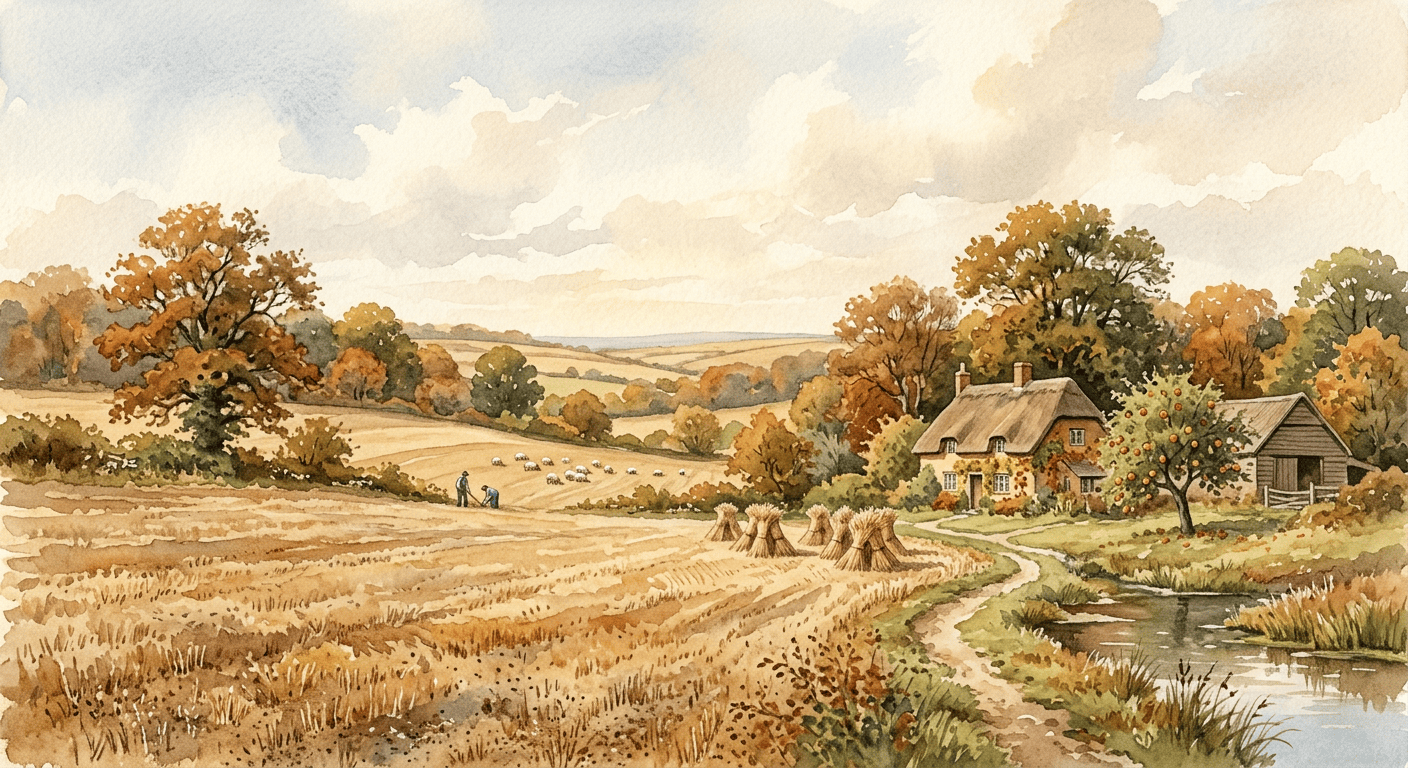
Season of mists and mellow fruitfulness,
Close bosom-friend of the maturing sun…
Until they think warm days will never cease,
For summer has o’er-brimm’d their clammy cells.
— John Keats, To Autumn
The first shift is never about temperature; it’s about the light.
Earlier this week, stepping outside late in the afternoon, the glare of high summer was gone. In its place was a thick, honeyed radiance slanting low through the trees—a light that doesn’t push you into shade, but invites you to stand still inside it. The air held a faint, crisp edge, but the day itself was warm, heavy, and ripe.
It is the precise mood John Keats captured in September 1819 when he wrote his famous ode, To Autumn:
“Season of mists and mellow fruitfulness,
Close bosom-friend of the maturing sun…
Until they think warm days will never cease,
For summer has o’er-brimm’d their clammy cells.”
Keats wrote those lines after a daily walk through the stubble fields outside Winchester, England. What makes his poem so enduring is that he doesn’t treat autumn as the tragic death of summer, nor as an elegiac descent into winter. Instead, he paints it as a grand, unhurried pause — a season of quiet abundance where the world feels full, satisfied, and complete.
In our day-to-day lives, we are rarely taught to appreciate the middle ground. We rush from the high-energy output of summer straight into setting goals, organizing schedules, and bracing for what’s next. But early autumn asks for something different. It asks us to notice that things are finishing, and that finishing can be sublime.
When the light turns golden in early September, it acts as a quiet permission slip to slow down. The harvest isn’t just about crops; it’s about acknowledging what has ripened in our own lives over the past year—the projects completed, the habits settled, the simple survival of hotter, busier days.
Before the leaves brown and drop to the earth, there is this short, golden window where everything is simply allowed to BE.
On the surface, To Autumn reads like a pure act of enjoyment, but the biographical reality behind it adds a poignant, almost heartbreaking dimension. Keats craved that sense of peace and completeness, and in writing the poem, he achieved a brief, miraculous moment of acceptance—even though his personal life was unraveling.
When Keats walked through those Winchester stubble fields in September 1819, he was only 23 years old, but his circumstances were exceptionally grim:
First, he was living under the shadow of mortality. He was a trained apothecary-surgeon who had spent the previous year nursing his younger brother Tom as he died of tuberculosis. Keats was already displaying early symptoms of the same disease, knowing full well what it meant.
To make it worse, he was experiencing financial and romantic heartbreak. He was penniless, unable to marry the love of his life, Fanny Brawne, because he couldn’t support her.
Then came a blow when his previous published works had been brutally savaged by literary critics.
What possibly saved the poet from the abyss of despair and enabled him to immerse himself totally in the pure sensation of autumnal mellowness is what he called Negative Capability — the ability to exist in uncertainties, mysteries, and doubts without irritably reaching after fact and reason. That echoes the Buddhist Truth of observing things unfold just as they are.
In To Autumn, Keats does something radical for a Romantic poet: he erases his own ego completely. In his other famous odes (Ode to a Nightingale, Ode on a Grecian Urn), he struggles with pain, time, and mortality, longing to escape the human condition. But in To Autumn, the speaker “I” never appears. Keats does not bemoan his failing health, his money troubles. Nor does he fear dying young. Instead, he pours his entire consciousness into the landscape itself. He allows Autumn to personify the complete cycle of life:
Stanza 1 (Ripening): He surrenders to sensory abundance—gourds swelling, hazel shells plumping, bees thinking warm days will never cease.
Stanza 2 (Harvesting): He watches Autumn sitting careless on a granary floor, or watching the last oozing of a cider press—a calm, unhurried surrender to labour ending.
Stanza 3 (Music of Decay): When he asks, “Where are the songs of Spring? Ay, where are they?”, he immediately checks himself: “Think not of them, thou hast thy music too.” He listens to gnats mourning in the shallows, full-grown lambs bleating, and swallows gathering for migration.
Was it true enjoyment?
It was not a blissful, naive enjoyment. It was something far deeper: reconciliation.
Keats recognized that fulfillment and death are inseparable—that fruit can only become sweet at the end of its life cycle, and that the beauty of evening exists precisely because the sun is setting. By stepping outside his own suffering and fully immersing himself in the quiet harmony of the earth, he found a temporary refuge.
It turned out to be the last major poem he ever wrote. Less than eighteen months later, he died in Rome. The “completeness” of To Autumn wasn’t just a description of a September afternoon—it was Keats making peace with the finite nature of his own life.
A Thought to Carry This Week
Take ten minutes late this afternoon to find a patch of low autumn sunlight. Leave your phone inside. Notice how the light sits on the walls, the trees, or your hands — and ask yourself what summer effort you are finally ready to rest from.

