Make no mistake: I don’t mean that we can remain forever in the fullness of early autumn, lingering in September as though time itself had decided to suspend there for good. It cannot last. The bright, generous days will move on, and this golden season will gradually give way to an October of a darker, more contemplative mood.
Yeats, as we have seen, feels something of his own decline reflected in that sterner month: the fading of light, the thinning of leaves, the sense that the year is drawing inward. Yet there is more to October than loss. The passing of time brings with it another kind of beauty—a quieter, more austere beauty, perhaps, but no less real. Beauty is not only about abundance, warmth, and flowering things. It appears, too, in bare branches against blue skies, in the sharpness of the air, in the muted colours of a late afternoon, and in the calm acceptance of change.
Beauty has many forms, and it speaks in many tones. September may offer us richness and radiance, but October ushers us further into the depths of autumn that teaches us to notice grace in restraint, in fading, and even in the solemn dignity of the way things are coming to an end.
Some years after I retired, I returned to Macau, where I had spent the final part of my working life. Once a Portuguese enclave, Macau remains a place steeped in history with its Mediterranean mosaic streets and Portuguse green and red buildings carrying traces of a past epoch.
It was late October when I revisited Lim Ioc Park. The temperature was still around 25°C, warm enough that one might easily mistake the day for summer. Yet the clear sky and the faint crispness in the air was decidedly autumn.
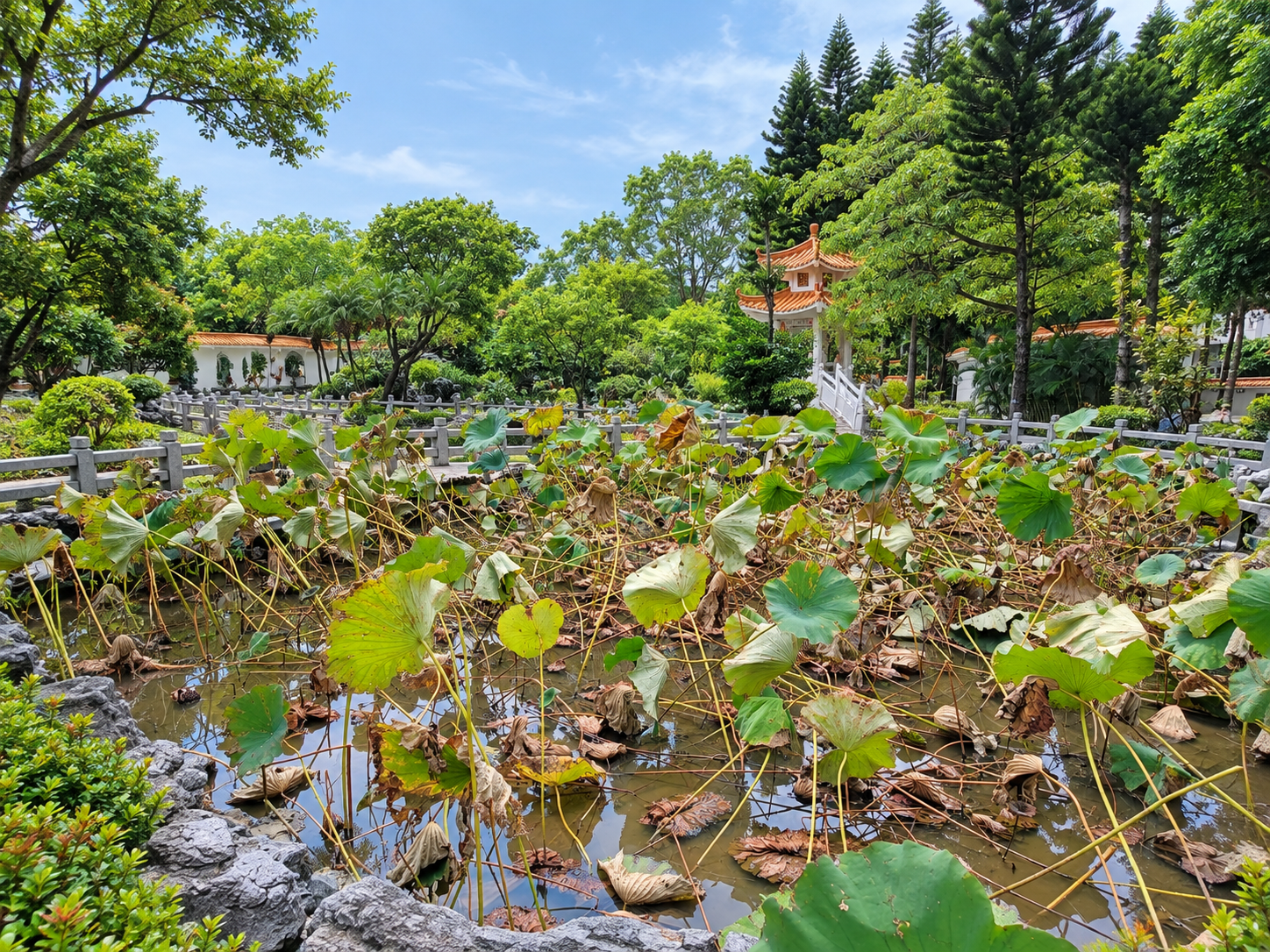
As I made my way through the park, passing the limestone formations shaped like human figures, I came upon a lotus pond. Floating on the still water were lotus leaves that had withered to a parched brown. Their stalks had folded sharply towards the surface, as if exhausted by the long work of holding themselves upright. The edges of the leaves were frayed and curled, and the whole pond seemed to have entered a deep, quiet decline.
I remembered seeing that same pond at the height of summer. Then it had been alive with broad green leaves and lotus flowers, full of brightness and movement. Often, after dawn, the leaves held shining beads of dew upon their smooth surfaces. The dew should have vanished quickly in the heat, yet it seemed to linger there for hours, caught in the shallow cups of the leaves and glittering in the sun. Those wide leaves stood like little parasols above the water, generous and graceful.
Only a few months had passed, and everything had changed. The green vibrancy of summer had given way to broken stalks and weathered leaves. There were fewer visitors now who stopped to look. Perhaps, to most people, the pond appeared desolate—a scene of decay rather than beauty.
But I saw it differently. There was something moving in the lotus leaves as they leaned towards the water, something dignified in their surrender to the season. If we can set aside our instinctive sadness at their dying, we may see that they possess a beauty no less pronounced than they did in summer. Summer offered fullness, colour, and vitality; October now offered fragility, stillness, and form. The leaves were no longer lush or decorated with flowers, but they had acquired another kind of grace: the beauty of having lived through their season and yielded, quietly, to time.
As I sat in the pavilion beside the pond, watching the wilted lotuses, I took out my phone and began to frame a photograph. At first, I wanted simply to capture the melancholy of loss. I shifted slightly from one side to another, trying to find the angle that would best express what had disappeared: the summer colour, the flowers, the sense of life rising so freely from the water.
But the longer I looked, the more I began to see that these dying plants were revealing another dimension of beauty. In summer, the pond had expressed itself in colour and richness. It was full of broad green leaves, bright blossoms, and glistening drops of water. Now, with the lushness gone and the colour drained away, the scene had become almost elemental. My phone camera no longer recorded abundance; it registered form, line, shadow, and space.
Indeed, there was no drama about the scene. The bent stalks formed nearly perfect triangles over the dark water. Around them, the shrivelled leaves trembled lightly in the autumn wind. Beneath them, the water moved quietly, almost imperceptibly. There was a striking simplicity in it all. The pond was not a graveyard for the lotuses, as I had first imagined. Instead, it had become a kind of natural canvas on which there sketched an architecture of stems, angles, surfaces, and, between them, silence.
Yet that reduction did not make the scene feel empty. On the contrary, it brought the forms into sharper focus. Stripped of ornament, the lotuses seemed less like symbols of death than like a work of art pared down to its essential elements. Their beauty was no longer in bloom or of a luxurious mass, but in restraint: in the curve of a stalk, the ragged edge of leaves, the contrast between fragile brown forms and the dark, still water beneath them.
I felt a deep resonance with what I was seeing. This, I thought, is the autumn of my own life. The gradual physical weakening has made that reality difficult to ignore. Like the lotuses before me, I have begun to feel some of the old urgency receding: the daily striving, the pressure to achieve, the endless busyness that once seemed so necessary.
Yet there is also something freeing in that change. As those demands slowly ebb away, I am learning to make room for a quieter life—for stillness, reflection, and a kind of inner calm that I might once have overlooked.
Yeats saw in this season of the year the pain of time passing, and one can understand why. Autumn carries an ache: it reminds us that nothing remains at its height forever. But what I saw in Macau did not feel like death, though at first glance it might have appeared so. The pond’s desolation had distilled the lotuses into something almost artistic. Their bent, drooping stalks, their faded leaves, and their loss of colour had become a composition of lines and shapes against the dark water.
What seemed to be decline had, in its own quiet way, been distilled into art.

