I once wrote on my blog about wanting my voice to be a star in the vast writing cosmos—wondering if, across the reaches of space and time, some distant reader might eventually catch its light like stardust drifting from a long-dead past. It was a romantic, pure vision of connection.
But a strange thing happens the moment you bring your writing into the public square. The second you aim to reach a reader, you become agonizingly conscious of the camera. You stop looking at the page, and start looking at how the reader will look at the page.
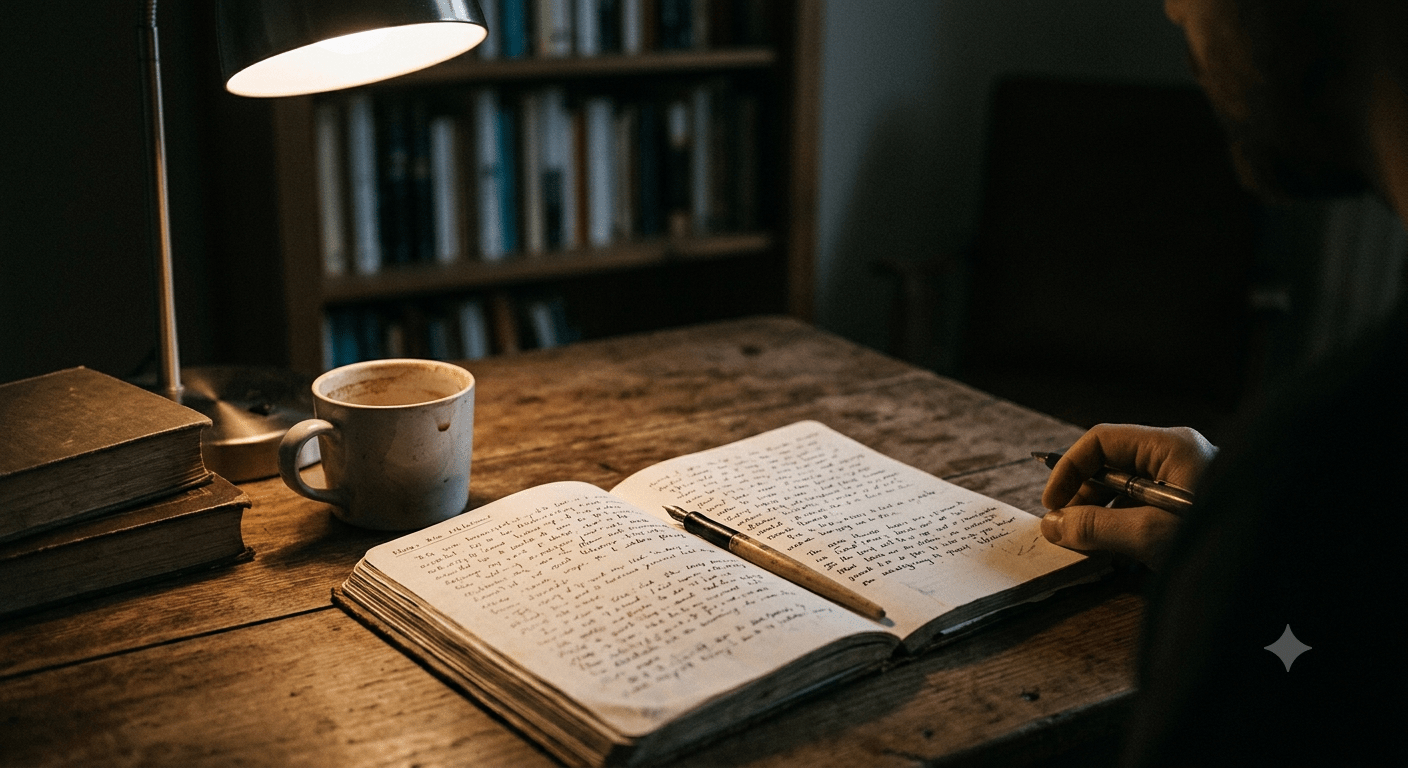
In my own work, I have felt this compromise deeply. When preparing pieces for my blog, I often dig into my past writings—old, raw notebooks filled with deeply personal reflections and philosophical notes. But I do not publish them as they are. Fearing they are too sensitive, too vulnerable, or too intensely private, I adapt them for the screen. I strip away the personal references. I delete the raw edges, change the names, disguise real experiences as fictional stories, or dryly intellectualize them into detached “philosophical features.”
It then all chalks down to the question of the cost of the curated self. We must ask ourselves : What is left after all this adaptation?
By shielding ourselves from the reader, we strip away our true selves. We muffle our own voices. When we write with a hyper-awareness of how our work will “go down” with an audience, writing ceases to be a private, sacred experience of self-confrontation. It becomes a trade-off. We dilute our personality and compromise our genuine feelings for the sake of palatability.
Yes, the resulting prose might be more artful. It might be smoother, shinier, and more appealing to the digital passerby. But we have sacrificed the very soul of the craft.
Writing is, at its core, an act of becoming in the moment. It is a therapeutic release of feeling that allows us to inhabit the absolute, vibrant Now. But when we write solely to prepare for how future readers might appreciate us, we completely miss this creative present.
For the sake of appealing to the crowd, we dress our raw thoughts in heavy, decorative armor. Eventually, our original self is lost entirely within the thick thicket of our own aesthetic adornments.
Which leads to the ultimate trade-Off. If our present creative moments are entirely preoccupied with how we will be read in the future, we have stopped living. We have allowed the anxiety of future judgment to hijack the magic of present creation. We might start writing because we want to discover the person we are capable of becoming. But we may well end up writing only in a persona that has never existed.
We are left with a haunting, final question: If our writing has finally become perfect for them, where then is ourselves?

