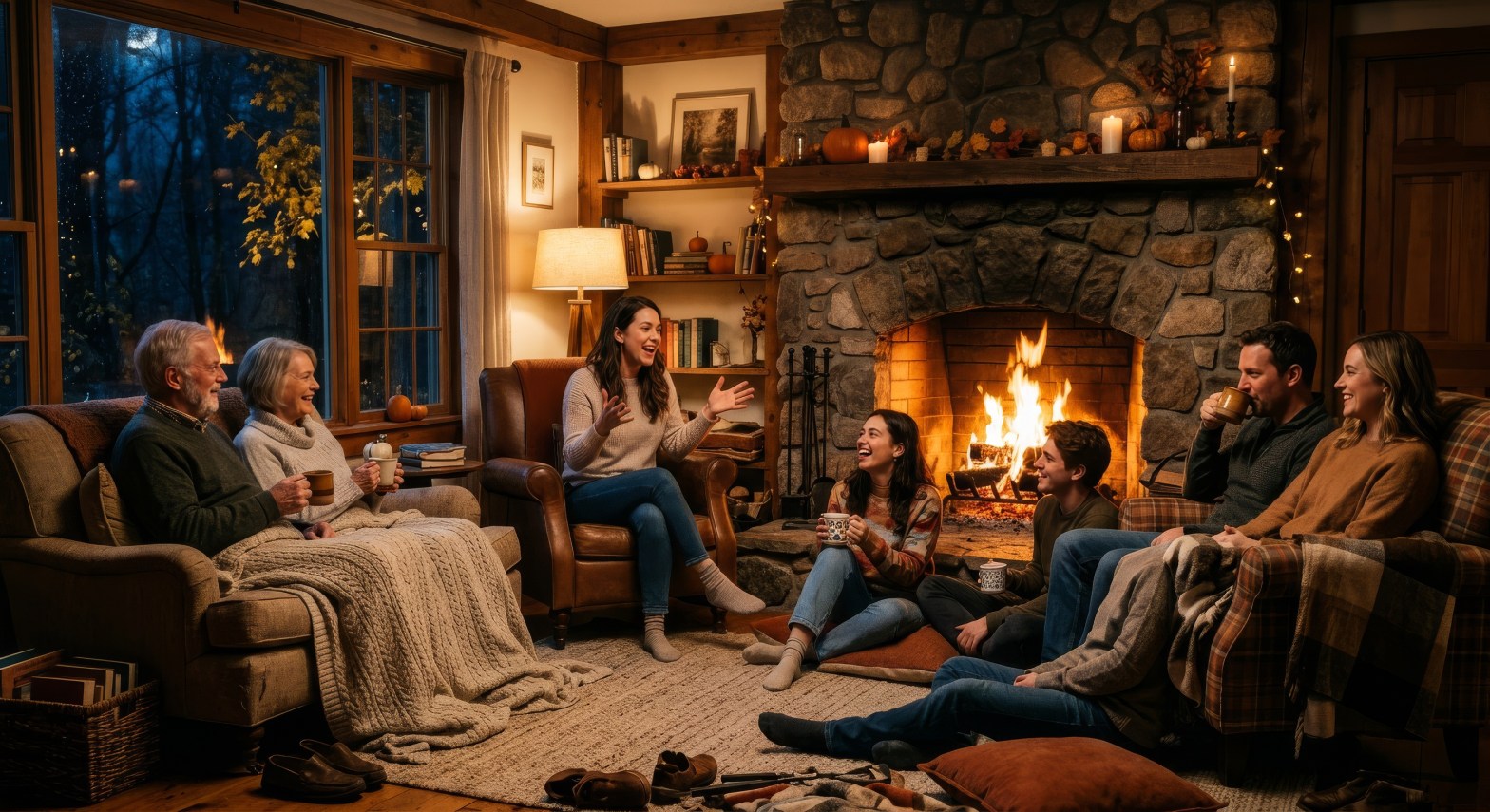
The picture above shows how people would in the past gather round the fireplace at home to share stories in autumn nights
Occasionally I write short stories for my blog not only as a a form of self-expression, but it is also a way of conjuring my memories. I often find myself returning to small moments from childhood—the things and people I can still remember clearly, or at least the fragments that remain. A certain room, a familiar voice, the smell of rain on the pavement, a summer afternoon that seemed to last forever. These memories intrigue me. They have aged like vintage wine: softened by time, deepened by distance, and perhaps made more poignantly beautiful by the fact that they can never be fully recovered.
There is a strange contrast between those remembered days and my current age. As we grow older, the world can begin to lose some of its mystery. Things that once felt astonishing may become ordinary. Curiosity, which came so naturally in childhood, can sometimes fade beneath routine, worry, and disappointment. Perhaps that is why memories become so precious. They remind us of a time when the world seemed larger, purer, and full of possibility.
Maybe that is also why we love stories. When the reality of the present feels heavy or depressing, stories offer us a doorway elsewhere. They allow us to return—not necessarily to the past exactly as it was, but to the past as we carry it within us. We look back with a romantic vision, convinced that our “good old days” are waiting there.
Of course, the past was never perfect. Childhood had its fears, losses, and lonely moments too. But time has a gentle way of editing what we remember. It leaves us with the warmth, the colour, and the feeling of having once belonged completely to a world that is now gone.
Through writing, I try to visit that world again—not to escape the present, but to understand it better. Each story is a small act of remembrance, a way of preserving the people, places, and emotions that helped make me who I am.
That is why writing short stories—and sharing them on a blog—can feel so meaningful. Storytelling is one of humanity’s oldest communal activities. Long before books, theatres, or screens, our ancestors likely gathered around fires and told tales: stories of danger, wonder, loss, animals, gods, and the mysterious forces they could not yet explain. In that sense, storytelling may have been among the earliest forms of art, but it was also something more practical and intimate. It helped people pass on knowledge, make sense of experience, and strengthen their bonds with one another.
At first, stories may simply have retold events: what happened on a hunt, where a journey led, who was lost, who survived. Yet, over time, storytelling became more than a record of facts. The telling itself became important. A story could shape an event, give it meaning, and reveal emotions that ordinary description could not contain. Through narrative, people began to explore the complexity of love, fear, ambition, grief, hope, and regret—the enduring conditions of being human.
Stories are often connected to the past, which is why remembrance plays such a central role in literature. But memory in a story is rarely just nostalgia or simple reminiscing. It is a way of asking: “Who was I then? Who am I now? What have I lost, and what have I carried forward?” Our memories do not merely preserve the past; they help create our unfolding identity through which we understand ourselves.
Many novelists and short-story writers use memory to examine an individual’s struggle against larger forces—history, family, society, war, poverty, change, and time itself. By bringing a vanished world back to life on the page, a writer can create a kind of resistance to time’s constant flow. The past cannot be restored exactly as it was, but through storytelling, it can be revisited, questioned, and give those characters whose real selves have long gone a voice once more.
Perhaps that is what makes stories so enduring. They do not stop time, but they allow us to pause within it. They help us hold on to the people, places, and moments that might otherwise disappear.

