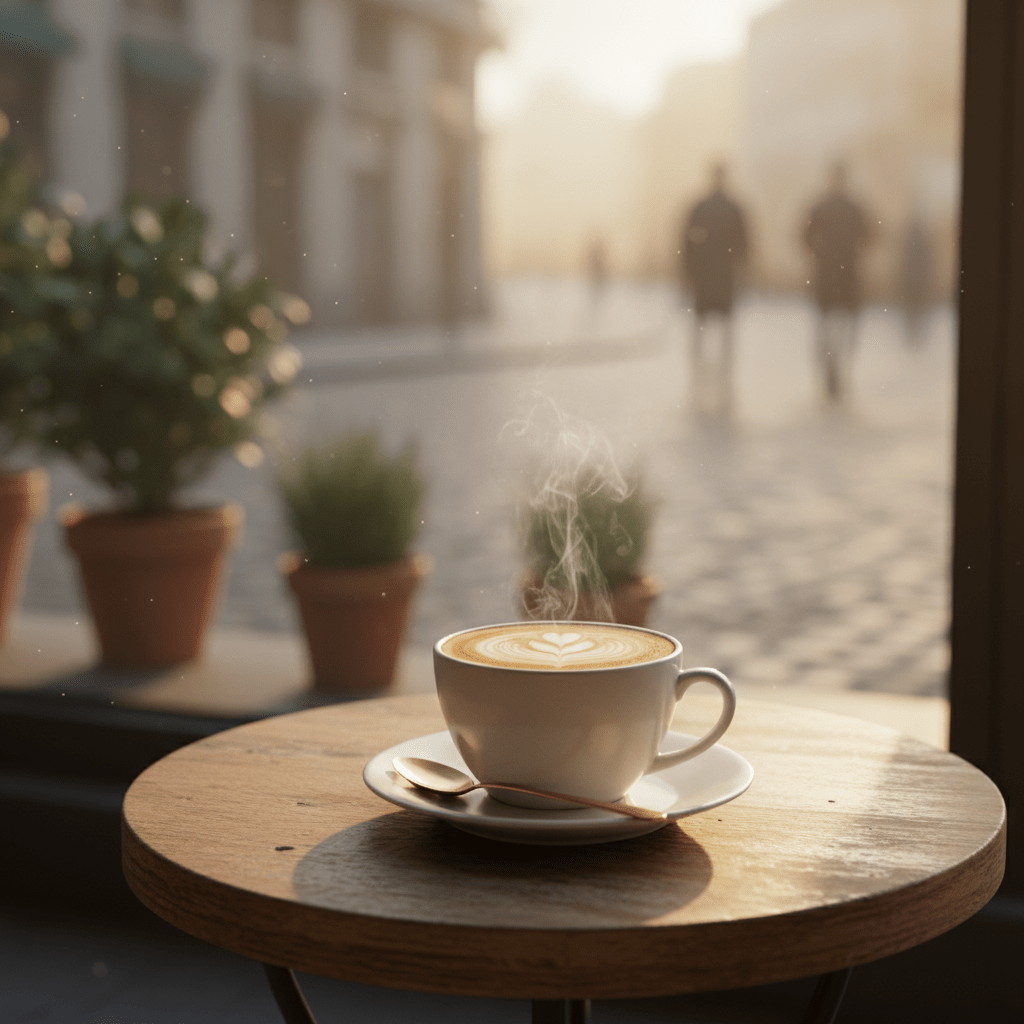
Recently, I’ve been spending slow coffee mornings at Pret, sitting by the floor‑to‑ceiling glass window with a flat white or latte in hand. Most of my time there slips away in writing and reading, punctuated now and then by moments of idle gazing—watching the world drift past the window.
Then there was another ordinary morning—so ordinary it almost escaped notice—the sunlight came streaming through the glass in slender, golden shafts. They fell across my table, catching the rising steam from my cup. Such a simple, fleeting thing—and yet something about it felt extraordinary, almost poetic.
That was it. No grand epiphany. No orchestral swell. Just a ribbon of light, and a sudden awareness that I had ‘seen’ it—truly seen it—not merely with my eyes but with some part of the subconsciousness that rarely awakens. That tiny flicker of life was and vanished all in one breath. Just as all things do.
Maybe that’s the whole secret. We’re always searching for something real, something that endures. But perhaps it doesn’t take a story worthy of an ancient Greek tragedy to remind us how fragile beauty really is. We wait for life to come in fanfare, when meaning often arrives softly: sunlight caressing a coffee cup; the conversations of strangers at nearby tables weaving their own stories; the stirring of our mind for some inspiration. Each moment appears, glints, vanishes – the triptych of our being.
We don’t have to stand, like the man in the green overcoat in Casper David Friedric’s famous painting The Wanderer Above the Sea of Fog, gazing heroically at the horizon to have a brush with the sublime. Sometimes, it’s hidden inside the most mundane jiffies of our lives—tucked so gently into our days that we overlook them.
When I paused long enough to notice that light, something inside me paused too—or perhaps, stepped briefly into a state unbound by time. For that instant, I glimpsed what the Buddha called śūnyatā —emptiness not as absence, but as the infinite space from which all things arise and to which they return. It’s the Truth he awakened to beneath the Bodhi tree two and a half millennia ago.
Outside the window, the world then became a moving poem: blurred reflections, people passing through the sunlight, each heading into their own horizons. None stayed long enough to be part of mine, and that, I realized, was a quiet comfort. Everything, like the light, moves on.
Maybe life is just that—a sequence of shimmering moments, each one vanishing even as we notice it. And yet, when we do notice, the ordinary becomes luminous. The mundane glows. Existence itself turns into poetry—fragile, radiant, ephemeral.
So now, each morning, I still sit by that window. The coffee tastes the same. The world still hurries past. The only difference is that sometimes, I look up from my screen and see how the light touches the steam, how time folds itself into an ordinary hour. And in that instant, I remember: The purpose of life is not to chase the permanent, but to experience the efflorescence —while it happens, in ribbons of gold, before it slips quietly into memory.
Imagine waking up tomorrow with a timer floating above your head—visible only to you—counting down to the exact moment of your death. Years, months, days, hours, minutes, seconds. Every tick echoing through your consciousness.
Would this knowledge liberate you or destroy you?
Sarah discovered her timer on a Tuesday morning. Thirty-seven years, four months, and sixteen days. She was 28, sitting in a cubicle, halfway through an email about quarterly projections. The fluorescent lights hummed above her as she stared at the numbers, watching the seconds vanish like water through her fingers.
At first, the timer felt like a prison sentence. Every sunset became a reminder of scarcity. Every birthday, a milestone toward the end. She quit her job within a week—what was the point of climbing a corporate ladder she’d never reach the top of? But then came the paralysis: if everything ends, why start anything at all?
Three months into knowing, something shifted. Sarah stood at a farmer’s market, holding a perfectly ripe peach. The timer read thirty-seven years, one month, eight days. She bit into the fruit, and for the first time since seeing the numbers, she truly tasted it. Sweet, messy, temporary—and somehow more precious because of it.
The timer changed everything and nothing. She still got angry in traffic. Still worried about money. Still fell in love—harder, actually, knowing that every kiss was numbered. She had a daughter at 35, knowing she’d live to see her child grow up, but not grow old. Every bedtime story carried weight. Every “I love you” meant more.
Some days, Sarah envied those who lived in ignorance, treating time like an infinite resource. They complained about Mondays, wished away entire seasons, scrolled through their phones during sunsets. But she also pitied them. They didn’t know what she knew: that the ticking wasn’t a countdown to death, but a drumbeat calling her to life.
The philosopher Heidegger called it “being-toward-death” — the idea that truly living requires confronting our mortality. But there’s a difference between knowing death exists and watching it approach with mathematical precision. One is philosophy; the other is poetry written in vanishing ink.
Would you want to know?
Before you answer, consider this: you already have a timer. You just can’t see the numbers. Every morning you wake up one day closer to an ending you can’t predict. The only difference between you and Sarah is the illusion of uncertainty.
Maybe the real question isn’t whether we’d want to know when we’ll die. Maybe it’s why we live as if we’ll never die at all. We make five-year plans while ignoring five-minute sunsets. We hold grudges for decades but can’t hold our loved ones for five extra seconds. We save our best wine for special occasions that never come.
Sarah’s timer now reads twenty-nine years, two months, five days. She’s teaching her daughter to ride a bike, running alongside, letting go, watching her wobble forward into her own uncertain future. The timer ticks. The wheels turn. Life moves forward, not despite its ending, but because of it.
Perhaps meaning isn’t something we find or create. Perhaps it’s something that emerges in the space between knowing we’re temporary and choosing to love anyway. Between seeing the timer and tasting the peach. Between the countdown and the courage to count each moment as if it matters.
Because it does.
What would change in your life if you could see your timer? What would stay the same? And perhaps most importantly—what’s stopping you from living as if you can already see it?
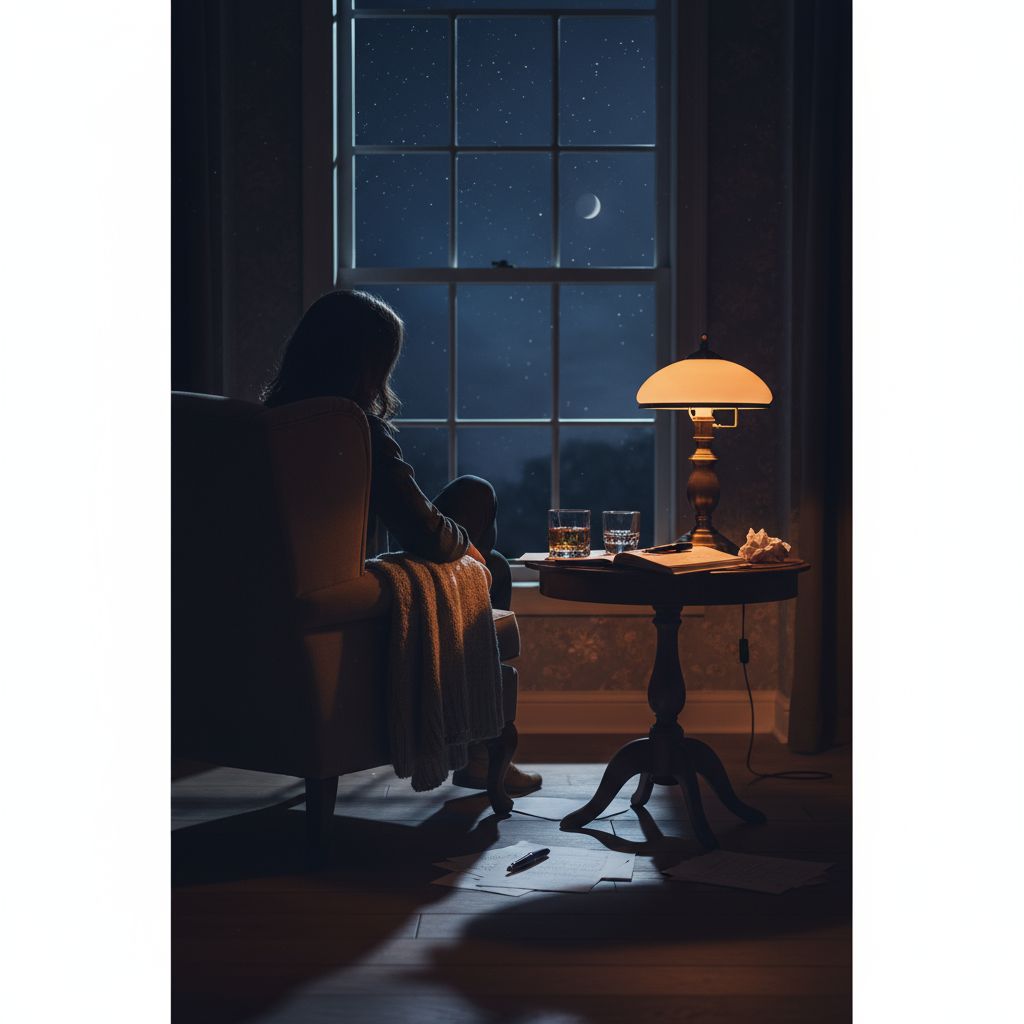
Sitting by the window right now, just staring out at the night, and I can’t stop thinking about life. Like, what’s the point, you know? It’s so beautiful and messy and fleeting. One second, we’re here, and the next… we’re just gone. And what do we leave behind? A few stories? Some words? Does any of it even stick?
I keep coming back to this idea of writing and language. Like, we spend so much time trying to make sense of everything. Writing stuff down, telling stories, putting words to it all. I guess it’s our way of trying to make it make sense. But honestly? Do words even work? Can they really capture everything? The love, the fear, the joy, the chaos? Sometimes it feels like I’m trying to hold water in my hands—it just slips through no matter what I do.
When I was younger, I thought writing would be this big, meaningful thing. Like, if I wrote enough, or wrote something ‘important’, it would last forever. That my words would be my way of leaving a mark. But now? I don’t know. Words aren’t forever, and they’re definitely not monuments. They’re more like little whispers—here for a second and then gone. And honestly, I think I’m okay with that now. These days, I write more to just remember things—faces, moments, even ideas I’m afraid of losing as time goes on.
I’ve spent so many hours just sitting and writing, trying to figure life out. Like, why are we here? What does it all mean? I’ve written about love and heartbreak, big hopes and even bigger disappointments. And sometimes, when I go back and read it, it feels… small. Like the words never really capture what I wanted them to. But maybe that’s just how it is. Maybe words can’t hold everything. Maybe they’re just the best shot we’ve got, even if they’re not perfect.
And honestly? What else can we even do but try? There’s something kind of amazing about creating something, even if it feels pointless sometimes. Finding the right word, putting together a sentence—it’s like my way of saying, “Hey, I’m here. I see this. I feel this.” Even if no one else gets it, I think I write for me. Just to figure things out, to make things make sense in my own head.
And then I think about how small we all are. Like, the stars outside? They’ve been shining for millions of years, watching people like us come and go. And the wildest part? Every single atom in me came from a star. Like, how crazy is that? When I’m gone, those same atoms will go back into the earth, back into the cycle, and become part of something else. It’s kind of comforting, in a way. Like, even after I’m gone, I’ll still be part of something bigger.
So maybe that’s the point? Not to make something that lasts forever, but just to do it*. To write, to create, to try. Not to beat death or anything dramatic like that, but just to sit with it and say, “Hey, I lived. I gave it a shot. I told my story.” And maybe that’s enough.
Anyway, I’m just sitting here with my drink, staring at the night, and I don’t think I’m looking for answers anymore. I’m just trying to figure out where I fit in all of this. And if writing helps me do that, then yeah, I’m gonna keep writing. Even if it’s small, even if it’s just for me. Because maybe that’s what it’s all about.
A Friend of mine found the narrative of Virgnia Woolf’s To the Lighthouse too chaotic to understand and he decided to pass it up as holiday reading. Instead he chose Joseph Conrad’s Victory. Here’s what he said to me:
“I’ve temporarily abandoned To the Lighthouse. It doesn’t seem suitable as holiday reading. I’ll borrow it from the library in Macau. I’ve switched to Victory by Joseph Conrad, which is more a narrative, though different in that the narrator is always present but ‘unreliable’” .
I replied to him:
You either love Virginia Woolf’s novels, or you don’t—there’s rarely any middle ground. My first encounter with To the Lighthouse was as a prescribed text during my matriculation, sometime between 1976 and 1978. I’ve often wondered why it was chosen for the A-level syllabus, and I suspect it was because of its deceptively short length. But at the time, calling it “difficult” would have been an understatement—it felt utterly impenetrable, even obfuscating.
The experience wasn’t helped by our lackluster literature teacher (I still remember calling him Mr. Harrison). Even now, fifty years later, I still remember him simply reading the text aloud to us, offering little in the way of critique, commentary, or analysis. It was as though he, too, was overwhelmed by the novel’s complexity and beauty, unable to guide us through its intricate layers.
Yet, despite these challenges, my young mind was already captivated by something in Woolf’s writing. I couldn’t articulate it back then, but I fell in love with her poetic language and the unspeakable poignancy that seemed to linger between the lines. There was a haunting quality to the prose, a rhythm and texture that moved me, even if I didn’t fully understand it.
Over the years, as I grew older—my being adding rings like a tree—and revisited the book casually a few more times, something began to shift. Each re-reading awakened me further to the sheer beauty of it. What had once seemed opaque and elusive now revealed itself as luminous and profound. The novel’s exploration of time, memory, and the fleeting nature of human existence resonated more deeply with each passing year. It’s as though the book itself matured alongside me, offering new insights as I grew into the person capable of appreciating them.
The earliest memory I can summon is not crystal clear, but it holds a warmth that has stayed with me for decades. It was sometime around 1960 or 1961. I was two or three years old, small enough to be carried on my mother’s back, cradled close in a traditional ‘mei dai’ carrier. I don’t remember her face in that moment—only the sensation of her presence, the rhythmic sway of her steps, and the comforting pressure of her back against my small body.
The air inside seemed thick with the mingling smells of the city—or at least, that’s how I imagine it now. Perhaps there were faint whiffs of engine oil, the salty tang of the harbour, or the occasional drift of food from someone’s bag. These details might not even be true, but they linger in my mind as part of the atmosphere of that moment. Whether they were real sensations or fragments my mind has pieced together over the years, the impression is of a sensory world just beginning to unfold to me.
As my mother navigated the narrow aisle of the tram, her steps swayed me gently. I was too young to understand where we were headed, but I felt safe in the cocoon of her care.
The tram rattled and clattered through Admiralty which in those days was called Queensway. That name is etched in my memory. Queensway. It sounded grand and foreign, a name that carried the weight of colonial times. From my perch on my mother’s back, I could only catch glimpses of the world through the tram’s windows. I faintly recall the barracks—low, austere buildings that lined the area. They seemed so still, so orderly, a stark contrast to the bustling hub as we know it today.
I often wonder where my mother was going that day. Was she running errands? Visiting a relative? Or was she simply taking me along for a ride to pacify a restless toddler? I never thought to ask her later in life. By the time I was old enough to reflect on such questions, childhood memories had become unmoored from their context, floating in the vast sea of time.
But what I do know is this: that memory is not about the destination. It’s about the bond. In that moment, I was connected to my mother in the most profound way possible. Her back was my world—strong, steady, and unyielding. I can only imagine her thoughts as she carried me through the bustling city, weighed down not just by the physical burden of a child, but by the responsibilities and uncertainties of life in those difficult post-war years. The Hong Kong of my childhood was a city in transition. The barracks at Queensway would eventually vanish, replaced by the towering glass and steel structures of modern Admiralty. The trams, however, remained a constant, their green frames continuing to weave through the ever-changing city.
This curious pattern of recollection—where my memory of being carried on my mother’s back remains vivid while the rest fades into obscurity—reveals something profound about how memory works. It seems to preserve what matters most, what anchors us emoionally, while allowing the less significant details to blur over time. The clarity of my mother’s presence, her warmth, and the physical connection speaks to the deep bond between us, a bond that, even now, feels more important than the fleeting impressions of the world around us. This is where my story begins—the first memory of how, through the tram’s windows, the sensory world beyond began to expand before me. Perhaps this is how memory helps us hold onto what truly shapes us, filtering out the noise to leave behind the moments that ground us in love and belonging.
Sometimes time vanishes without a trace—like those nights of dreamless sleep when the clock leaps forward and we only meet ourselves again at morning. But I’ve never passed a night without a dream—and I don’t think most people do—so I couldn’t quite imagine what that absence feels like until a recent colonoscopy. I was sedated for about forty-five minutes and woke to a clean page: no dreams, no drift, just the next moment. The interval might have been a thousand years—or none at all. I had no sense that any time had passed. It was as if I’d stepped out of one moment and directly into the next.
It made me wonder what we mean by time when the mind is absent, and what we fear in death if there is nothing there to feel the fear. Epicurus said we never meet death; anesthesia seemed to stage a small demonstration. Our consciousness stitches time together; without the stitching, the fabric falls silent.
Not everyone’s sedation is serene, and beliefs differ. Still, I find a strange comfort in this thought: life as music, death as the rest between notes—silence that carries no weight. Have you ever opened your eyes and realized the gap had already let you go?
The identity of an object does not lie in its material, but in its form and purpose, which persist even through transformation. Thomas Hobbes
As I trace these fragments of myself—Margaret’s scarf in the wind, James’s quiet wisdom, Angel’s laughter dissolving into Pattaya’s sky, the long gone voices —I wonder: if identity is woven from transient moments and borrowed voices, what anchors us to a sense of self? It’s a question that echoes an ancient paradox: the Ship of Theseus. Imagine a vessel, plank by plank, replaced over time until nothing original remains. Is it still the same ship? Like my own life—cells renewing, memories softening, yet somehow I persist—the Ship whispers that identity isn’t in the pieces, but in the continuity of the journey. Likewise, I thread my different selves over the years with my memories to form a story with a plot ever evolving and characters ever coming and going .
So, let’s set sail into this puzzle, where philosophy meets the quiet truth of our multi-faceted lives.
The sun is setting, and I sit by a window, watching the last glow of day slip into dusk before surrendering to night. On the warm October breeze, childhood finds me again. Then the mid-autumn moon is ascending to the sky – silvering the sill and the glass. Fifty-seven years ago, a ten-year-old boy would stand at this same window, gazing at distant rolling hills and a small crescent harbour with ferries gliding across it—until my mother’s dialect interrupted: “Silly Billy, if you keep arsing around there like a statue, you can kiss your supper goodbye !”
Not without hesitation, I left the window for the brown-lacquered table where the four of us would gather under the amber glow of the wall lamp, while moonlight kept a low, silver calm on the floor. For the next ten years, until my father passed away, that table and lamp would serve the heart of our home—a steady anchor in the currents of time. Now, with all the changes life has brought, the breeze ruffling my hair feels like a thread connecting me to those evenings, to the version of myself that once stood at that window beneath a full bright moon like the one tonight.
Those people I’ve met, the places I’ve been, and the moments I’ve lived through. Where are they now—the friends, the family who shaped my life, and even those whose paths crossed mine for only a moment? Time has scattered them like leaves in the wind, yet somehow, they are all still here. They’ve melted together into the essence of who I am. And so I wonder: am I truly just “me”? Or am I an amalgamation of everyone and everything I have ever known?
Now the thread is frayed; the spool unwinds. Still, I must gather, must tell these stories though the telling will never be complete.
Margaret once told me she would come back. “I’ll meet you under the banyan tree by the river,” she said as we walked along the Shing Mun River, her scarf slipping from her shoulder as the wind caught it. I waited. I waited as the shadows grew long and the October air turned chilly; the moon, pale and patient, lifted above the hills. But she never came. Or perhaps she did—years later, as another voice, another face, another moment. Now, almost forty years on, the thoughts of her no longer stir my heart. Yet she still appears in my dreams, sometimes solid, sometimes just faintly recognizable, still in her twenties as when I last saw her.
And then there was James, always catching fragments of life’s deeper truths in his laconic way. “If that’s how you find meaning, Bart, then by all means do so,” he said in his customary matter-of-fact tone that somehow felt warm. I remember the day I told him, in our regular restaurant, that I’d move out of the flat, seeking a new way of life. “Do come back whenever you want to,” he said softly. Simple words. No flourishes. They were drowned in the din of the restaurant. I hurried home to try to scribble down our conversation, but the words on the page felt hollow, unable to capture the muted passion beneath them. So I gave up. Yet his words stayed with me, resonating in ways I didn’t fully understand at the time. The other day when I stood on Shau Kei Wan Road on my way to the MTR station, as faces blurred past and the city pressed in, I thought of him. His words are mine now, his warmth too.
The self is not mine alone. It is theirs—Margaret’s, James’s. And there are voices I cannot place, voices whose origins are blurred by time. “Listen, Bart,” one of them says, as if from a dream I’ve long forgotten. Their face is a flicker of firelight; their name lost in the mist of memory. Perhaps it was a classmate, speaking late at night in a tent we pitched on Pui O Beach on our matriculation graduation day, our words dissolving into the whisper of waves and the hush of a moonlit tide. Or perhaps it was no one at all, just a fragment I created to make sense of myself. “It’s all here and now,” the voice says. “We’re the stories. This is what we are—stories pressed together, layered, overlapping.” At the time, my younger self dismissed our stories as plain– if indeed the stories they are, I thought. But as the years unfolded with their twists and turns, I began to wonder if they were right. For what am I if not a tale told by those I’ve known?
And yet I am not merely the narrator of my own story. I live in theirs too though I cannot know what remains of me in their memories. I think of Angel, her laughter startling birds into flight as we walked in Pattaya. “You can’t catch them, Bart,” she teased, as I ran after the flock. But isn’t that what I was doing? What I have always done? Chasing the fleeting, the ephemeral, trying to hold what cannot be held. Now cupping moonlight in my hands, but with it slipping through my fingers, I find myself thinking how my life has navigated its twists and turns.
Angel’s faith in God is unshakable. “When will you ever believe in Him?” she asked once. “I can’t imagine how I would be in God’s presence one day without you.” I envied her eternal vision, even though I balked at it. I told Bill Crewe. He teased me: “You’re denying yourself the chance to hear her lyre in the Divine Kingdom.” Such a cynic as he always is. I stayed silent. Instead, I walked through Jardim de Flores in Taipa, where the autumn lotuses, wilted and fading, seemed to embody both death and beauty.
Now the memories rise unbidden, their edges softened, their colours fading. The self is not fixed. It is not merely the stories of James, or Angel, or Margaret, or that voice I half remember. It is all of them, all of me, folded together, inseparable. Each moment, each face, each voice enters the cauldron, distinct at first—sharp, vivid, whole. But time stirs, and they dissolve, blending, becoming essence, as moonlight dissolves the edges of things until only their contous remain.
And still, there are flashes—moments when they return. James’s brevity of words at dusk (with him, I thought of Lydia. With him, I thought of Angelina. I hold them in a triad). The faint murmur of a camp as evening light fades. Angel’s vision of eternity. Margaret’s scarf, caught in the wind. They are not gone; they cannot be gone. They are here, in the way I pause to think of them, in the words I choose, in the life I live—in the quiet, lunar hours when the city softens and the mind listens.
Now the fire burns low. The pot simmers quietly. Outside, the moon is high, patient as a witness. The voices soften, merging into one. And still, I must tell. For this is what we are—not solitary beings, but mosaics, composites, each of us carrying the others within us, bright and dim as phases of a shared moon.
The thread is nearly gone now, the spool almost empty. Still, I must gather, must weave. For when I, too, dissolve—when I, too, melt into the whole—perhaps my voice will remain, soft but steady, in the cauldron where we all meet, where we all become one, as the tide answers the moon.
I’ll be honest: I hovered over the “publish” button for way too long, wondering if anyone would read what I wrote—and if it would even matter. But as I watched the words land on the screen, something shifted. Maybe it isn’t about who reads it. Maybe it’s about finding my voice—one that can tell my stories, articulate my ideas, and say what I actually think.
Writing is funny that way. It starts out as this quiet, private thing—just you and the blank page—but there’s always a little hope tucked inside that someone out there will hear you. It can feel lonely, dropping words into the silence. But underneath that loneliness is a simple wish: to connect, to reach across the gap between me and you. And somewhere in that process, reflection turns into self-expression.
It’s also a way of pushing back against impermanence. When we put our experiences, our stories, and ideas into words, we anchor them against flux. Even if those words only reach one person—or even just our future selves—they become a voice that endures.
And now, with blogging, we get to do this through self- publishing without waiting for permission. No gatekeepers, no middlemen—just our words, as they are, added to the expanding constellation of voices out there. Who knows? Maybe something I write will be a small light at the edge of someone’s horizon—a glow they didn’t know they were looking for until they found it.

 Site Title