People have long sought a kind of immortality by leaving behind legacies—works of art, writing, institutions, traces of themselves meant to endure. This impulse stretches back across human history. Shakespeare, for instance, imagined that his poetry could grant a form of permanence, declaring, “So long as men can breathe or eyes can see, / So long lives this, and this gives life to thee.” Here, the poem itself becomes a vessel of immortality, preserving not only the beloved but, implicitly, the poet as well.
But why should this matter to us? It may benefit future generations, certainly, yet what good does it do for the one who creates it? We will not be around to witness its impact or take comfort in its survival. In that case, in what sense does the pursuit of immortality through legacy truly make sense for us at all?
Few philosophical questions are as old—or as persistent—as this one: why do we strive for a kind of immortality through our achievements? Art, writing, and other legacies seem to promise a life that stretches beyond our own, yet we will never be there to witness it. So what, exactly, are we gaining?
The answer may be less about the future and more about the present. We do not create for the sake of some distant recognition after death, but to make our lives feel coherent and worthwhile now. Human life is, in many ways, a quiet struggle against existential unease—a sense that everything is fleeting, unstable, and ultimately beyond our control. In response, we reach for meaning. We commit ourselves to projects, relationships, and creations that allow us to feel anchored.
In doing so, we construct what might be called a form of symbolic immortality. It is not that we literally continue on, but that our actions seem to resist the erasure that time threatens. The alternative—surrendering entirely to the chaos and impermanence of the world—is difficult to accept. Meaning, then, becomes less a luxury and more a necessity. It is what renders life not just bearable, but, in some fragile and deeply human way, lovable.
There is also the question of the self. We tend to think of ourselves as discrete individuals: bounded, self-contained, and ultimately extinguished at death. From that perspective, the idea of legacy can seem irrelevant. If consciousness ends, then nothing that follows can matter to us—at least not in any direct, experiential sense. This is a coherent and, in many ways, compelling view.
Yet it may rest on too narrow a notion of who we are. Our sense of self is rarely confined to the limits of our own bodies or lifespans. We are entangled with others—extended through our children, embedded in our communities, and shaped by the cultures that give us language, values, and form. In this broader frame, the self is not a fixed point but a continuum, something that exceeds the individual life.
Seen this way, the idea of living on in one’s work is not mere sentimentality. When a writer says, “I live in my work,” it is not meant literally. Rather, it gestures toward a different understanding of life—one in which a person’s thoughts, sensibilities, and ways of seeing continue to move through the world, carried by others. What persists is not the body or the private stream of consciousness, but something less tangible and yet still real: a pattern of life that outlasts the individual who first gave it shape.
Perhaps, then, the Epicurean view has the final word. The world matters to us only insofar as we are alive to experience it; beyond that boundary, meaning dissolves. As Epicurus famously put it, “Where death is, I am not; where I am, death is not.” On this account, the idea of legacy cannot truly concern us once we are gone. Whatever follows our death unfolds without us, and to invest it with personal significance may seem like a subtle form of self-deception.
There is a hard clarity to this position. The dead do not witness, feel, or take pride in what they leave behind. No work, however enduring, can be experienced by the one who created it once their consciousness has ceased. In that sense, legacy belongs entirely to the living—to those who remember, interpret, and carry it forward—not to the one who is no longer there to claim it.
Perhaps, then, the point is not to solve the problem of death at all. Creating art, writing novels, founding institutions—these are not strategies for outwitting mortality, but ways of learning how to live with it. They do not grant us literal permanence; rather, they reshape our experience of finitude.
Legacy, in this sense, is not for the person we will no longer be, but for the one we are now. It offers a way to gather the scattered moments of a life into something that feels coherent, directed, and meaningful. In a world marked by constant change and uncertainty, the act of creating or building something enduring allows us to take hold of our existence, however briefly, and give it form.
What we seek, then, is not immortality in any strict sense, but a kind of steadiness within impermanence—a way of anchoring ourselves in the midst of flux. Legacy is less about surviving death than about making life, while it is ours, feel inhabitable and whole.
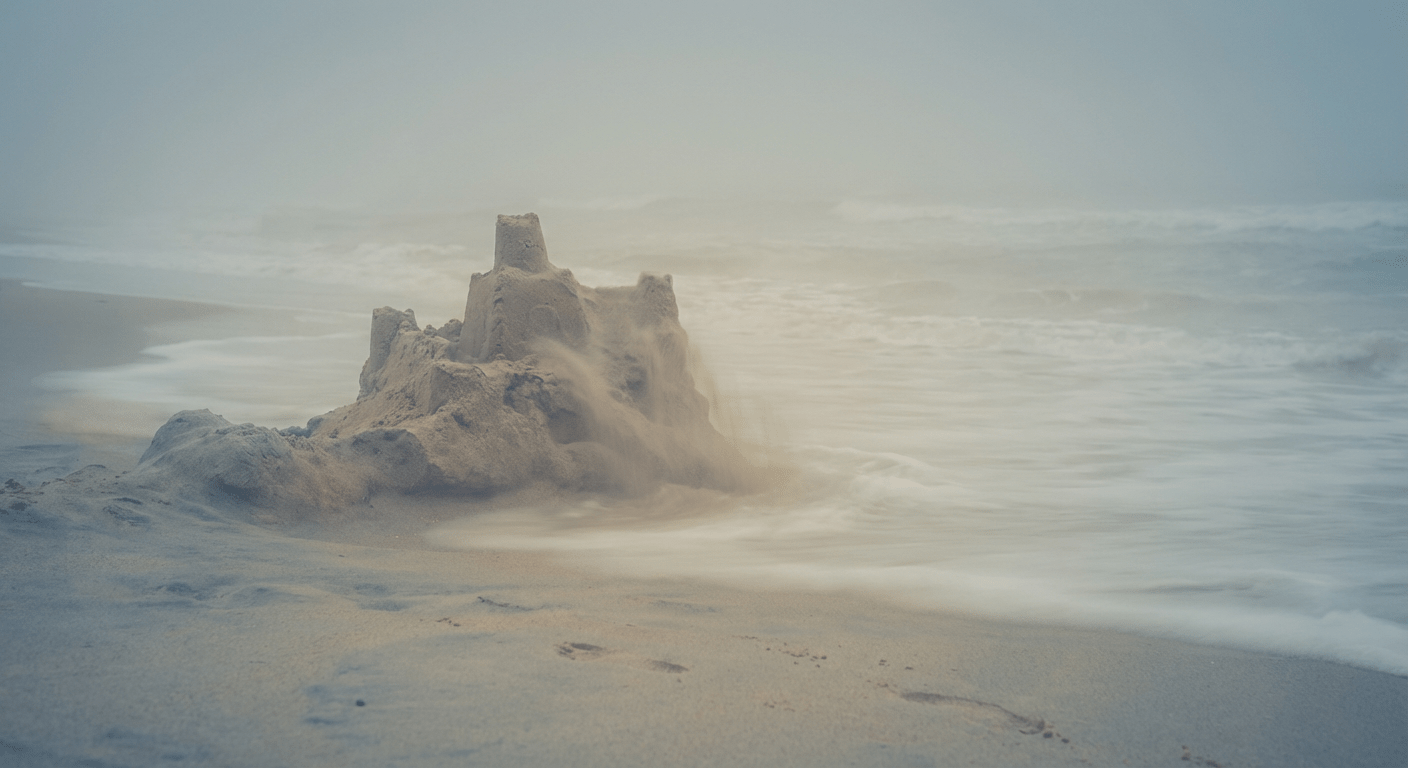
You know the waves will eventually wash ashore and carry everything away, and yet you still choose to build a sandcastle. Why devote yourself to something so obviously temporary? The example brings the question of legacy and immortality into sharp focus.
What matters is not the endurance of the sandcastle, but the act of building it. Its value lies entirely in the doing—in the shaping, the attention, the small satisfaction of creation. There is no real expectation that it will last, nor does its meaning depend on that. As a piece of art, it is complete in the moment of its existence, not in whatever remains of it afterward.
In this way, the sandcastle quietly challenges the very premise of immortality. It suggests that something need not endure to be worthwhile. Its brief presence is already enough to justify the effort, reminding us that meaning can reside fully in the act itself, rather than in any hope of permanence.
Against the Tide: Why We Still Create
 Site Title