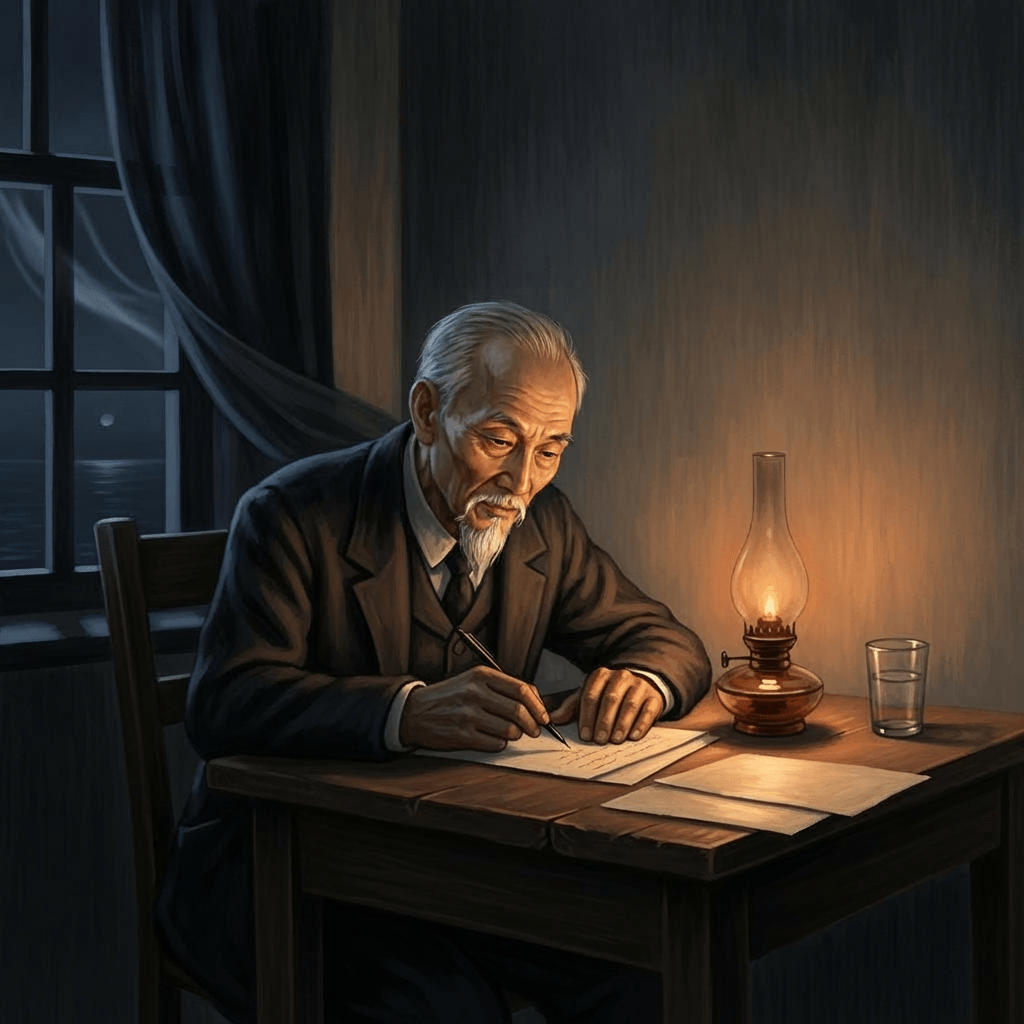
Amber light seeps into the dark, softening the edges of the things in the care home —chair, curtain, glass of water—until everything becomes mere smudges of shadows.
I take up my pen, as I often do at this hour, to write. Habit, almost: to trawl the day for small truths, to catch brief scraps of living in a net of words before they slip away. But tonight it’s different. Tonight I’m not trying to gather anything. I’m trying to reduce.
I’m writing a line—yes, only a line—here at the end of my dying days.
An epitaph. It’s a strange task, isn’t it? To leave behind a single line, and beyond that, cross into silence.
I’ve seen the world in constant motion. Monday follows Sunday, Tuesday follows Monday. It’s now September. Soon October. And things happen in between. I sought verbs to catch these moments the way I, once as a child, thought I could catch falling stars—by setting out a bucket of water and waiting for their reflections to settle there, trapped. So I believed verbs were the key to truth. The noun sits still, but the verb breathes.
What are you thinking, Bart? You’re so quiet? Margaret’s voice. I’ve been thinking about verbs, honey. Verbs? Then how would you think of me as a verb? She was laughing. You’re not serious. I am. Go on then—how would you animate me? If verbs capture the essence of life, as you say, how would you frame me in one? You bloom. Ah. And what about thirty years from now? Well? She looked at me. Such a tender look. Well, You’d still be blooming. Blooming still?
Where is she now? She may have faded long ago. Mother went twenty years past.
The trees outside green and brown—green and brown, green and brown—the way seasons verb themselves through wood. I thought verbs could best catch the fleeting, the fluorescent, the thing that flares and goes. And I came to believe that life, like everything else, was bracketed by verbs: to bud, to bloom, to fade, and all the others in between in infinite permutation. One summer night I trapped a moth in a box which I filled with plastic leaves and branches to emulate the woods through which it had flown. And I suppose I have done the same with life—trapped it in a box of verbs, hoping it might go on beating its wings there, believing the plastic leaves were real.
But now I see it as vanity. And yet I find glory in it too.
What is a story, after all? A net cast into the sea of chaos, hauling something back. I imposed order where there was none. Looking back at those protagonists I created—women, men, the dead, the living—they raged, they loved, they suffered. Hope existed alongside despair because I willed it so. I gave them motives. I gave them voices. Most important, I gave them a purpose for living. Never mind that they were fictional. The ghost said, “I said this because I was suffering.” Or he said, “I did that because it hurt so much I had no choice.” I soothed them by setting them at the beach where waves caressed them with whispers. I carved pattern from formlessness. From the raw, buzzing, inchoate mess of being, I extracted order. All this I did with words in those moments of quiet. All this I completed by giving them voices that could speak their emotions—their trepidations, their pangs of pain, their small bewildered joys. I turned the random falling of leaves into omen. I turned the conversation of two lovers into layers: silence and speech, the muted and the sounded, what was said and what could never be said.
Now death brings me an impossible task: to compress sixty years of stories into a single line. It asks me to reverse everything I ever did as a writer.Then, I expanded. I found words elastic, capable of stretching to hold whole lives. Now, I must pare it all down to a point of singularity—one sentence, maybe two. How can I compress sixty years into that? All those experiences that occurred between the greening and the yellowing of the trees outside. All those moments that seared themselves into memory. There is so much I want to say. How can any of it fit onto a cold stone?
Language is a sieve. We pour hot soup through it, and the froth filters away, the warmth escapes, the body of it slips through the mesh. What remains are only the solid bits—verbs, nouns. The bones of meaning. But the taste, the heat, the nourishment—the ineffable passes through and is lost
Once, Margaret and I stood on an island bluff, watching the sea foam against the rocks below. It was September. The wind came hard off the water, ruffling her hair across her face; she lifted her right hand to smooth it back and slipped off her glasses, as if to meet the moment unmediated. A grain of sand blew into my eye. We laughed, or perhaps we said something trivial about the cold. I no longer remember.
Years later, trying to set that afternoon down in a story, I found that what endured was not the warmth of the wind or the salt in the air, not the softness of her unguarded face, but only the scaffolding of action. Verbs threading through nouns: she smoothed her hair; she removed her glasses; the sea broke; the wind blew. The mesh had done its work. The immediacy had thinned to grammar. What remained were gestures without weather, movement without heat.
The rest—the living warmth of it—had already drained away.
Will anyone who reads it understand? I would be glad — truly glad — if even one person knew what it meant. I wanted to walk up to King’s Road and hold up my notebook of sprawling stories and say:
here, here is the key to truth.
But there is no answer. The passers-by stream across the road. The light turns and they cross in currents, scattering toward their separate destinations. Red again. They accumulate once more. The process repeats. Next turn.
Now I know. Story is a contrivance. Things and people in real life do not live in such a neat, formulaic fashion. They do not arrive at a satisfying dénouement. Their stories come to a sudden halt — no development, no arc. They merely stop. The thread snaps and the tension is gone. Their lives fan out along paths pre-determined for them. But in my story I must design a resolution: mostly happy, some tragic, though I feel obliged to ring a note of hope — for me, for my protagonists, for readers.
Disillusioned? And yet… and yet…
Oh, disillusioned? There was that mirror in the dining room, wasn’t there? Can language ever be as reflective as that glass was? I could have got Margaret to fetch it for me. Just imagine how one day I can still be around to do your chores. She said this, standing me in front of it. Bullshit! I laughed. I saw her last cleaning the mirror with a small towel. When was it? She hasn’t been around for — how long? Five years? No, no, it can’t be that short. I attended a concert at the Barbican five years ago. Mahler’s Ninth. It paused. It ended. Like all the others in the audience I left in silence — no ceremonial applause. I was alone. I held out my hand, instinctively wanting to hold hers. There was no hand. I was by myself. No, no, must be longer than five years. Ten? Ah. That should be it. She hasn’t been around for ten years. I have been greying. She had been getting weaker. She wore jeans. She was holding my hands. She stood on my left — or left on reflection, and actually she was to my right? Which one is really you, she asked, the reflection or the self outside the mirror? I really wish we could be in the glass world — a pause — forever. The last word delayed. No way, I said. We cannot arrest the flux except in language. She was dabbing her face, pressing close to the pane. Her pale face glowed as the autumn morning sun streamed in.
I’m struggling from my bed and shuffling across the room to reach the mirror, propped at an angle on my desk in this small room. My wrinkled paws. My trembling. No more reflections of the past — my vision is fading as the last ray of sun fades in this part of the day. Who am I if I have not been writing? A chance existence at this particular spot, this particular time. What if I had never existed? What if I had never written a single story? Would I be anything more than a bone on a beach, left to bleach under the sun? Perhaps deception is necessary — it is what underwrites my creativity. Without creativity, what is left? And perhaps our imagination is the only truth we have.
I am not a single one. I am the mélange of many. I am the boy who once dreamt of dissolving a star in a basin of water. I am the man who baulked at the faith Margaret tried to make me believe in. I am the old man who is afraid of the dark and thought language was a tool against death. I am all of them. They spoke through my writing — first one by one, then their voices folding into one another’s until they formed a chorus.
So I start to write. I will no longer be able to write in profusion. I will have to write only one line. Not a summation. Not a story — no more time for stories. Those I wanted to write about have all gone, and to write about them now would be to chase the phantoms of memory. I will write one line, only to acknowledge the inadequacy of the cold stone.
I will write this much: that I was here. That I tried to make sense of people and the mess of things by pinning them down with words. That I braided them into tales, knowing—always knowing—that each narrative would fall short of the crowded, stubborn complexity of the real.
I am tired. I am exhausted. I’m too tired even to hold my pen the way I used to, as if it could steady me. And now I’m tired of language itself: of its shine, its tricks, its habit of pretending it can contain what it only circles. I want to dissolve. Not to be understood, not even to be remembered—just to be gone from the burden of words.
Is there any way to dissolve into the worlds I made for my characters? To step through the paper and become only another figure in the distance—unwritten, unnamed, and therefore free? The strange thing is: I built those places, and still I don’t belong there. They were never meant to hold me. They were meant to hold everyone else. Yet I want them now the way a drowning man wants the imagined shore. But now they are but just mirages. And – listen. What’s that distant thud outside the window, an incessant and rhythmic hum?
But edging near as privately for me rustling at my feet,
Creeping thence steadily up to my ears and laving me softly all over,
Professor Gray was reading out those lines in that classroom. I was twenty then. I was in awe of his deep-throated voice, almost a croon. I understand now that he wasn’t so much performing as confessing. Years later, I learnt that he’d drunk himself to death. Perhaps in that distant afternoon when he intoned those lines, he had already heard what the sea was saying and simply had decided to let himself surrender to the ‘grey old mother’. I chose words instead. I’ve often wondered which of us was the braver.
I wish to stop being the “I” who writes and become the “we” who are silent and I would melt into their choruses.
But I still have one sentence left to write. I must make it count before I exit.
“The waves break,” I whisper. “They hiss into foam. And we are gone.”
No—not for the stone. That is for the dark.
“Here lies a man who told stories to the night.”
It isn’t enough. I know it the moment the ink settles. One line cannot be the seed of all truth. It cannot hold the whole weight of a life, or the hunger that drove it. And yet I have to treat it as everything now. I have to let it stand—one small shape pitched against the vast, formless outside.
All my life I cast language like a net, knowing it would come back torn, knowing the ineffable would slip through every knot. But the casting was the point—the throw, the reach, the brief arc of effort. If that is sublimation, then so be it. And what follows, when the arm finally gives out, is resignation.
The waves recede. They leave a thin line on the beach—temporary, precise, already fading.
That is enough.
That must be enough.
 Site Title