I’m standing in a clinic queue right now—one of the many lines I find myself in every day. You queue for banking, for the bus, at the grocery counter. For such an ordinary experience, I should just take it for granted, the way we take breathing or blinking for granted. But curiously, there’s a sense of something amiss. It feels, in its small way, like suffering. Not the dramatic kind—no one writes tragedies about waiting for your number to be called. But it’s a feeling that clings to the mind like a dull ache, a quiet wrongness you can’t quite name.
It’s a curious cycle. When I’m trapped in waiting, my mind drifts toward the question: what do all these waits actually mean? Perhaps you’ve wondered the same. We’re all waiting for something, always. Waiting for exam results. Waiting for the Chinese new year, when the lucky money comes again. Waiting to hear back after an interview. Waiting for the light to change while running late. Waiting for the bus that never seems to arrive on time.
These tiny waits accumulate into something larger. If we were to add them all up, we’d find that a surprising portion of life is spent in this strange suspension. Present in body, but not quite here. You are leaning forward into a future that hasn’t arrived yet, unable to settle into the moment you’re actually standing in.
What does waiting reveal about us? At its core, it is a confrontation between our desire to be agents of our own lives and the stubborn reality that we cannot bend time to our will. We cannot make the bus arrive faster. We cannot know the outcome of a job interview the moment we walk out the door.
There’s a small ritual of disappointment built into these situations. When you ask, half-hopefully, “When will I hear back?”—and they reply, “Possibly in a month”—something sinks. It’s too long. Too vague. We want certainty, and we want it now. Modern life, in particular, has trained us for immediacy. We refresh the page, check our phones, glance at the clock, as though our attention could somehow hurry things along. Beneath the surface, there’s always a low hum of irritation.
Why does waiting feel so unbearable? Perhaps because we’ve come to see it as wasted time—empty, unproductive, a gap between the moments that actually count. In an age that prizes busyness over stillness, doing over simply being, waiting becomes a kind of failure. It resists usefulness. It refuses to justify itself. And so we treat it as mere transition, something to endure on the way to somewhere else, rather than an experience worth inhabiting on its own terms.
Waiting is often dismissed as empty time, but the quiet suspense between one moment and the next carries its own quiet power. In those pauses—standing in line, anticipating a reply, watching the clock before a new beginning—we are suspended between what was and what will be. This in‑between space invites reflection, heightens awareness, and deepens our appreciation of what finally arrives. While impatience urges us to rush past these intervals, waiting subtly shapes our resilience, teaches us trust in unfolding processes, and reminds us that growth often happens in unseen transitions. The suspense of waiting is not wasted time; it is the threshold where anticipation matures into meaning.
I used to find waiting unsettling, an uncomfortable limbo I wanted to escape. But I’ve since learned to bend toward these pauses, even to welcome them. Waiting resists being “useful” in the conventional sense—if usefulness means actively doing, producing, advancing. Instead, the suspense of waiting invites us into a different kind of attention: a heightened awareness of the present moment itself. These pauses position us in a liminal space between what was and what is yet to come, offering us space to slow down and reflect. Often, the wait isn’t an obstacle delaying our progress but a preparation, priming us for what lies ahead rather than holding us back.
Consider how our lives unfold like stories, shaped by the drift and turn of happenstance. In any good story, the transitions between scenes are rarely empty—they’re filled with authorial asides, atmospheric shifts, internal reflections that enrich the narrative’s texture. These interludes aren’t filler; they’re intrinsic to the story’s meaning. Our waits function much the same way. They give us a window for our own reflections and awareness, a chance to observe rather than simply react. In those moments, you might feel something approaching authorship over your own experience—not because you control what happens next, but because you can step aside from the current, hold yourself at a remove, and simply witness. Here, in the pause, we’re granted permission to be rather than to do, to inhabit our existence rather than relentlessly propel it forward.
Perhaps waiting is, at heart, the experience of standing before a crossing. We wait in order to move into another stage. The traffic light changes, and we cross to the other side of the road. Our number appears on the screen, and it is our turn to see the doctor. Each wait, however brief or mundane, carries the quiet possibility of transition. What follows may become a consequential moment. In this way, waiting stitches together the twists and turns of our lives. If life itself is ritualistic in rhythm, then waiting is not incidental but intrinsic to its design. To cross a threshold is to risk change; once crossed, life may never be quite the same.
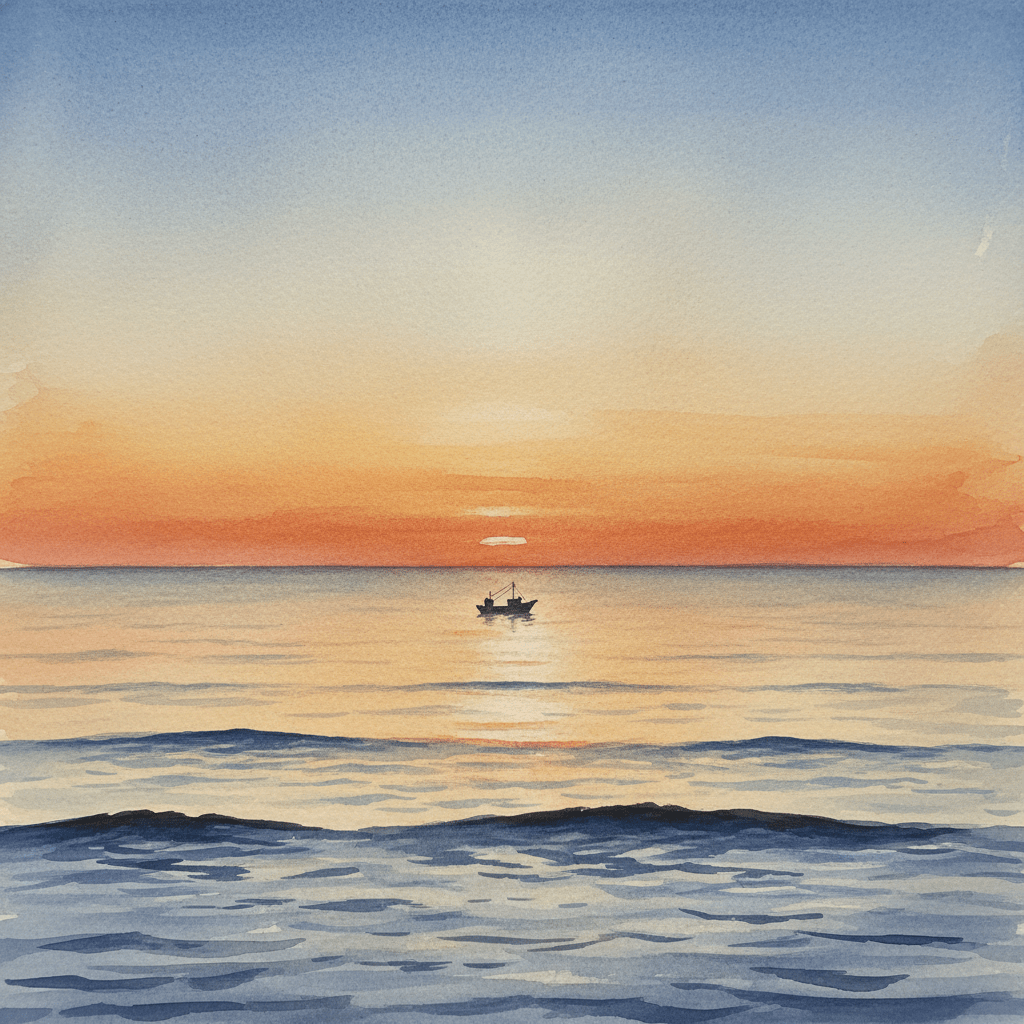
Though waiting often feels ordinary—almost woven invisibly into the fabric of daily routine—it matters precisely because it marks the space between “before” and “after.” If we extend this idea further, if we imagine the span of an entire lifetime as a kind of waiting, then the significance deepens. What then of the final crossing — the one we all must cross ? Alfred, Lord Tennyson’s poem ‘Crossing the Bar’ captures this ultimate moment: the crossing from life into what lies beyond. This beautiful poem goes like this:
“Sunset and evening star,
And one clear call for me!
And may there be no moaning of the bar,
When I put out to sea,
But such a tide as moving seems asleep,
Too full for sound and foam,
When that which drew from out the boundless deep
Turns again home.
Twilight and evening bell,
And after that the dark!
And may there be no sadness of farewell,
When I embark;
For tho’ from out our bourne of Time and Place
The flood may bear me far,
I hope to see my Pilot face to face
When I have crost the bar.”
The poem frames death not as an abrupt end, but as a passage—like putting out to sea, borne by a quiet tide toward a hoped‑for meeting “face to face” with the Pilot. In this light, waiting becomes more than delay; it is preparation for crossing. Just as the poet envisions death as a serene transition into another stage of being, so every wait in our lives, small or great, stands as a passage. To wait is to stand at the edge of change—and to trust that on the other side, another chapter awaits.
So, even waiting here at this moment for my number to be called, I’m already crossing.
 Site Title